 No Duties or Customs Fees For EU & UK Customers
 Express Tracked UK Delivery On 1000s of Items
 90 Day Returns

7 Best Electric Golf Trolleys That Follow You (2026)
RYCarrying or pulling your own bag round 18 holes wears you down before you even reach the back nine. That's why so many golfers are switching to an electric golf trolley that follows you, letting you focus on your swing instead of steering a cart across every fairway. If you've started researching follow-me technology, you've probably noticed the market is crowded with sensors, GPS units, and remote fallbacks that all claim to do the same thing.
The short answer is that the best follow trolleys combine reliable infrared tracking with a manual remote as backup, decent battery range for a full round, and a chassis that copes with slopes and rough terrain without losing you. Price, weight, and fold-down size matter just as much once you're loading it into a car boot every weekend.
We've tested and compared seven of the strongest models available right now, looking at tracking accuracy and real-world battery life rather than marketing claims. Whether you play twice a week or just fancy an easier round on holiday, this list will help you pick a trolley that actually keeps pace, on any course, in any weather.
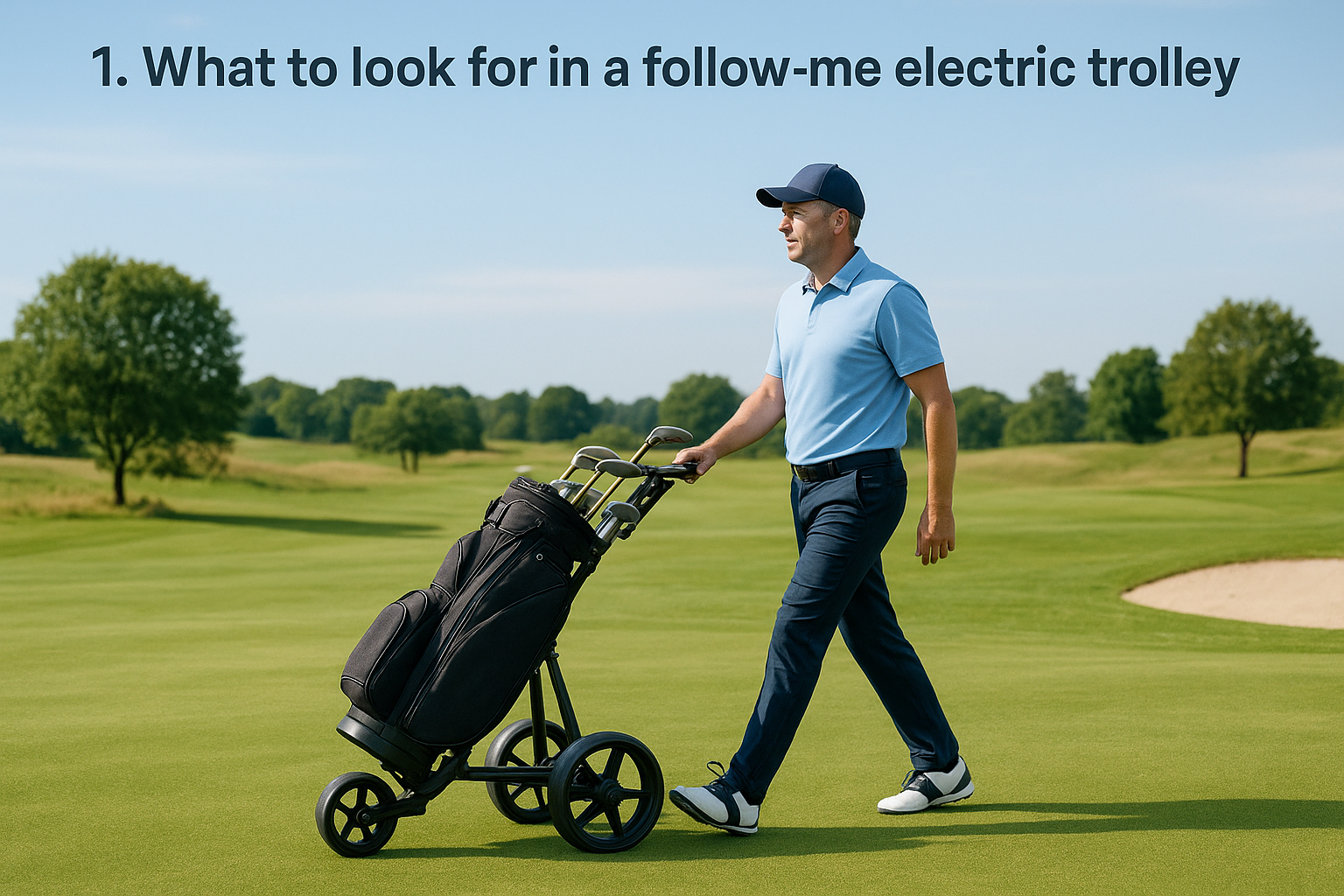
1. What to look for in a follow-me electric trolley
Before you compare specific models, it helps to know which specs actually matter on the course. Not every trolley that claims to follow you does it well, and the differences between infrared, GPS, and Bluetooth tracking show up the moment you walk into a dogleg or lose line of sight behind a bunker.
Tracking technology
Golfers usually can choose between infrared sensor tracking, which follows a transmitter clipped to your belt or waistband, and GPS-based follow systems, which track your phone or a wearable. Infrared is generally faster to react and cheaper to manufacture, but it needs a clear line of sight and struggles in bright sun or thick trees. GPS systems handle obstructions better but can lag a second or two behind your movement, which matters when you're walking quickly downhill.
A trolley that follows well in a straight line but panics on a dogleg isn't worth the money.
Battery life and range
Most decent follow-me trolleys claim 18 to 36 holes per charge, though real-world figures drop once you factor in hills, cold weather, and a heavier bag. Lithium batteries have mostly replaced lead-acid packs because they're lighter and hold charge longer over hundreds of cycles. Always check the actual amp-hour rating rather than trusting a vague "lasts all day" claim from the manufacturer.
Terrain handling and build quality
A trolley that follows perfectly on flat parkland can lose you completely on a links course with dunes and crosswinds. Look for models with adjustable wheel tracking, a low centre of gravity, and motors rated for at least 15 degrees of slope. Weight matters too: anything over 15kg becomes a genuine hassle to lift into a boot after a long round.
Price, portability, and after-sales support
Follow-me trolleys typically range from around £700 for entry-level GPS models to over £2,000 for premium infrared systems with full remote control fallback. Fold-down size and warranty length vary hugely, so it's worth checking both before you commit.
| Factor | Budget models | Premium models |
|---|---|---|
| Tracking type | Basic infrared or app-based GPS | Infrared with GPS backup |
| Battery range | 18 holes | 36 holes |
| Weight | 15-18kg | 12-15kg |
| Warranty | 1-2 years | 2-5 years |
With those benchmarks in mind, here's how the seven trolleys we tested actually perform against them.
2. Stewart Golf X9 Follow
Stewart Golf built its reputation on infrared tracking, and the X9 Follow is the flagship result. It's the trolley most golf clubs point to when someone asks which electric golf trolley follows you most reliably in changeable British weather, and it earns that reputation through sheer consistency rather than gimmicks.
How the follow-me technology works
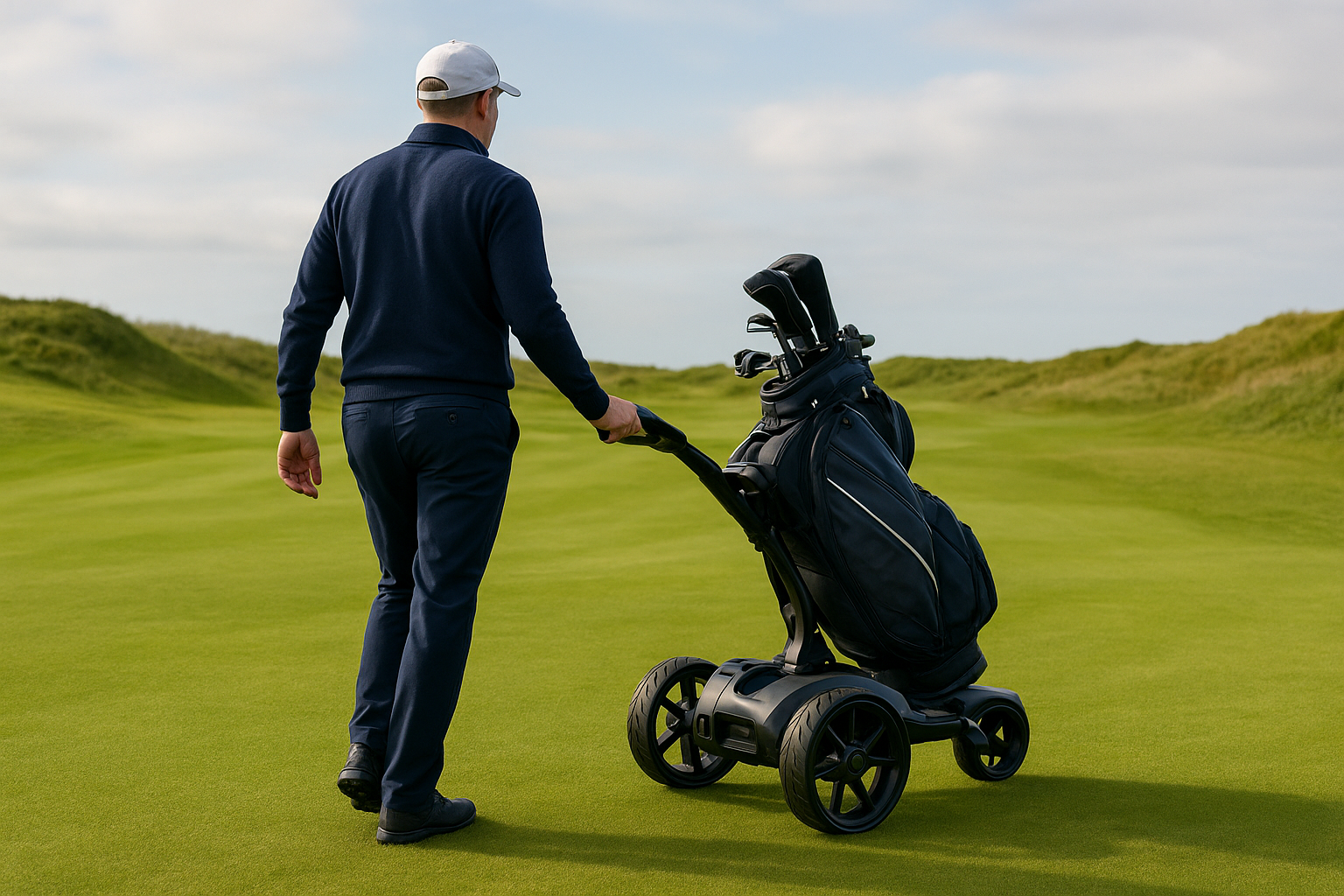
The X9 uses a wrist-worn infrared transmitter that talks to a sensor mounted on the trolley's chassis. Once paired, it holds position roughly 3 to 4 metres behind you and reacts almost instantly to changes in pace or direction. Stewart's system also includes a distance-lock feature, so the trolley won't creep closer on downhill stretches.
Key features and terrain handling
Few trolleys manage doglegs and slopes as confidently as the X9, and that confidence is what you're paying for.
The X9's adjustable wheel tracking and low-slung frame keep it stable on links courses, and the motor copes well with slopes up to 20 degrees. A 36-hole lithium battery and a manual remote fallback mean you're never stranded if the sensor loses you behind a tree line.
Who it's best for
This suits golfers who play regularly on hilly or coastal courses and want a trolley that just works, without fiddling with a phone app mid-round.
Price and where to buy
Expect to pay around £1,800 to £2,000 depending on accessories. You can browse current stock and finance options through MoreSports' electric trolley range, including Klarna payment plans for spreading the cost.
3. Stewart Golf Q Follow
The Q Follow sits below the X9 in Stewart's range, but it uses the same core infrared tracking system, just wrapped in a lighter, simpler chassis. If the X9 is the flagship, the Q Follow is the sensible choice for golfers who want that same reliability without paying for extras they won't use.
How the follow-me technology works
Like its sibling, the Q Follow tracks a wrist-worn transmitter and holds a steady gap behind you, adjusting speed as you slow down or quicken your pace. It doesn't have the distance-lock refinement of the X9, so on steep downhill stretches it can drift slightly closer than you'd like. A manual remote is included as a fallback, which matters when you're playing a course with dense treelines that block the sensor.
The Q Follow proves you don't need the top-tier model to get dependable infrared tracking.
Key features and terrain handling
The frame is noticeably lighter than the X9, at around 13kg, which makes it easier to lift but slightly less planted on uneven ground. It still manages slopes up to 15 degrees comfortably, and the battery gives you roughly 27 holes on a full charge, enough for most weekend rounds without needing a top-up.
Who it's best for
This model suits golfers who want Stewart's trusted tracking technology but play mostly flat or gently rolling courses, and who'd rather save a few hundred pounds than chase every terrain feature the X9 offers.
Price and where to buy
The Q Follow typically retails between £1,400 and £1,600. Check MoreSports' Stewart Golf range for current pricing and available Klarna instalment options.
4. MGI Ai Navigator Halo GPS
MGI took a different approach with the Halo, ditching infrared entirely in favour of GPS-based tracking paired with a wearable wrist unit. It's the trolley to consider if you've found infrared systems fussy about sunlight and tree cover, since GPS doesn't care whether it can "see" you or not.
How the follow-me technology works
The Halo tracks a small GPS wristband rather than an infrared beam, which means it keeps following even when you duck behind a bunker or walk through dappled shade under trees. This wearable GPS tracker does introduce a slight lag, usually under a second, compared with infrared systems, so it's not quite as snappy on sharp direction changes. MGI also built in obstacle-avoidance sensors, so the trolley slows itself down rather than ploughing into a bag stand or another player's trolley.
GPS tracking trades a touch of speed for near-total reliability in awkward light and dense tree lines.
Key features and terrain handling
The Halo's all-wheel drive motor handles slopes up to 20 degrees, and its wider wheelbase keeps it stable on links courses with uneven fairways. Battery life runs to around 27 holes, and the frame weighs roughly 14kg once folded.
Who it's best for
Golfers who play tree-lined parkland courses, where infrared sensors regularly lose signal, will get more consistent performance from the Halo's GPS-based follow system than from a line-of-sight alternative.
Price and where to buy
Expect to pay between £1,300 and £1,500. You'll find current stock and Klarna finance options through MoreSports' electric trolley range.
5. Gozo Auto-Follow
Gozo built its name on budget-friendly trolleys, and the Auto-Follow brings follow-me technology down to a price point that undercuts most of the competition on this list. It won't match the polish of Stewart Golf's chassis, but for golfers testing whether a follow trolley suits their game at all, it's a sensible entry point.
How the follow-me technology works
The Auto-Follow uses an infrared transmitter clipped to your belt, tracking from roughly 2.5 metres behind you. It reacts well enough on straight fairways, though it's noticeably slower to correct course on sharp turns than the Stewart models. A basic remote control handles manual steering when the sensor loses you, which happens more often here than on pricier infrared systems.
Budget follow trolleys get you moving without a bag on your shoulder, but don't expect flagship reflexes.
Key features and terrain handling
The frame weighs around 16kg, on the heavier side for this category, and the motor is rated for slopes up to 12 degrees, so steep coastal courses will test its limits. Battery range covers about 18 holes, which is fine for a single round but leaves no buffer if you're playing 36 in a day. Terrain handling is adequate on flat parkland but the narrower wheelbase can wobble on rougher ground.
Who it's best for
This suits golfers on a tighter budget who mostly play flat, well-maintained courses and want to try follow-me technology before committing to a premium model.
Price and where to buy
The Auto-Follow typically retails around £600 to £750, making it one of the cheapest genuine follow trolleys available. Check MoreSports' electric trolley range for current stock and Klarna payment options.
6. Navee Birdie 3X
Navee made its name in electric scooters before turning to golf, and the Birdie 3X brings that same engineering focus to follow-me technology. It's a newer entrant than Stewart or MGI, but the build quality feels more mature than its price suggests, especially the motor control and frame rigidity.
How the follow-me technology works
The Birdie 3X pairs infrared sensing with a companion app, so you get the quick reaction of a traditional transmitter alongside GPS-style route logging for your round. It holds a gap of around 3 metres and copes well with moderate direction changes, though sharp doglegs still trip it up occasionally. A manual remote is bundled in, and switching between modes takes a single button press rather than digging through an app menu.
A hybrid tracking system only earns its keep if switching modes is quick, and the Birdie 3X gets that right.
Key features and terrain handling
This trolley's standout feature is its suspension, borrowed conceptually from Navee's scooter range, which smooths out bumpy fairways better than most rivals here. The motor manages slopes up to 18 degrees, and the lithium battery delivers roughly 27 holes per charge. At 13.5kg folded, it's light enough to lift into a boot without strain, and the frame collapses into a compact footprint.
Who it's best for
Golfers who play bumpy, poorly maintained courses will notice the suspension advantage immediately, and anyone who likes tracking round data through an app will appreciate the extra layer this trolley offers over purely mechanical rivals.
Price and where to buy
The Birdie 3X sits around £1,100 to £1,300. Browse current availability and Klarna instalment options through MoreSports' electric trolley range.
7. CaddyTrek R2 Sport
CaddyTrek was one of the earliest brands to popularise follow-me technology in the US market, and the R2 Sport is its most refined attempt yet at bringing that experience to UK fairways. It leans on infrared tracking rather than GPS, which keeps reaction times sharp, but the chassis feels a generation behind the Stewart Golf models in terms of finish and stability.
How the follow-me technology works
The R2 Sport tracks a transmitter worn on your belt, holding a gap of roughly 3 metres and adjusting speed smoothly as you slow down near the green. It reacts quickly to straight-line changes but can hesitate slightly when you pivot sharply, such as walking round a bunker to check a lie. A wireless remote handles manual control when the sensor drops out, and switching between modes is straightforward.
Fast, predictable tracking on open ground counts for more than fancy extras once you're actually playing.
Key features and terrain handling
The motor manages slopes up to 15 degrees, which covers most parkland courses but leaves it stretched on steeper coastal layouts. Battery life runs to about 27 holes, and the frame weighs 14.5kg folded. Terrain handling is solid on firm ground, though the standard wheels struggle in soft, wet conditions common on winter rounds.
Who it's best for
This suits golfers who play mostly flat to moderately hilly parkland courses and want dependable infrared tracking without paying flagship prices.
Price and where to buy
The R2 Sport typically retails between £900 and £1,100. Check MoreSports' electric trolley range for current stock and Klarna payment plans.
8. Bat-Caddy X8R
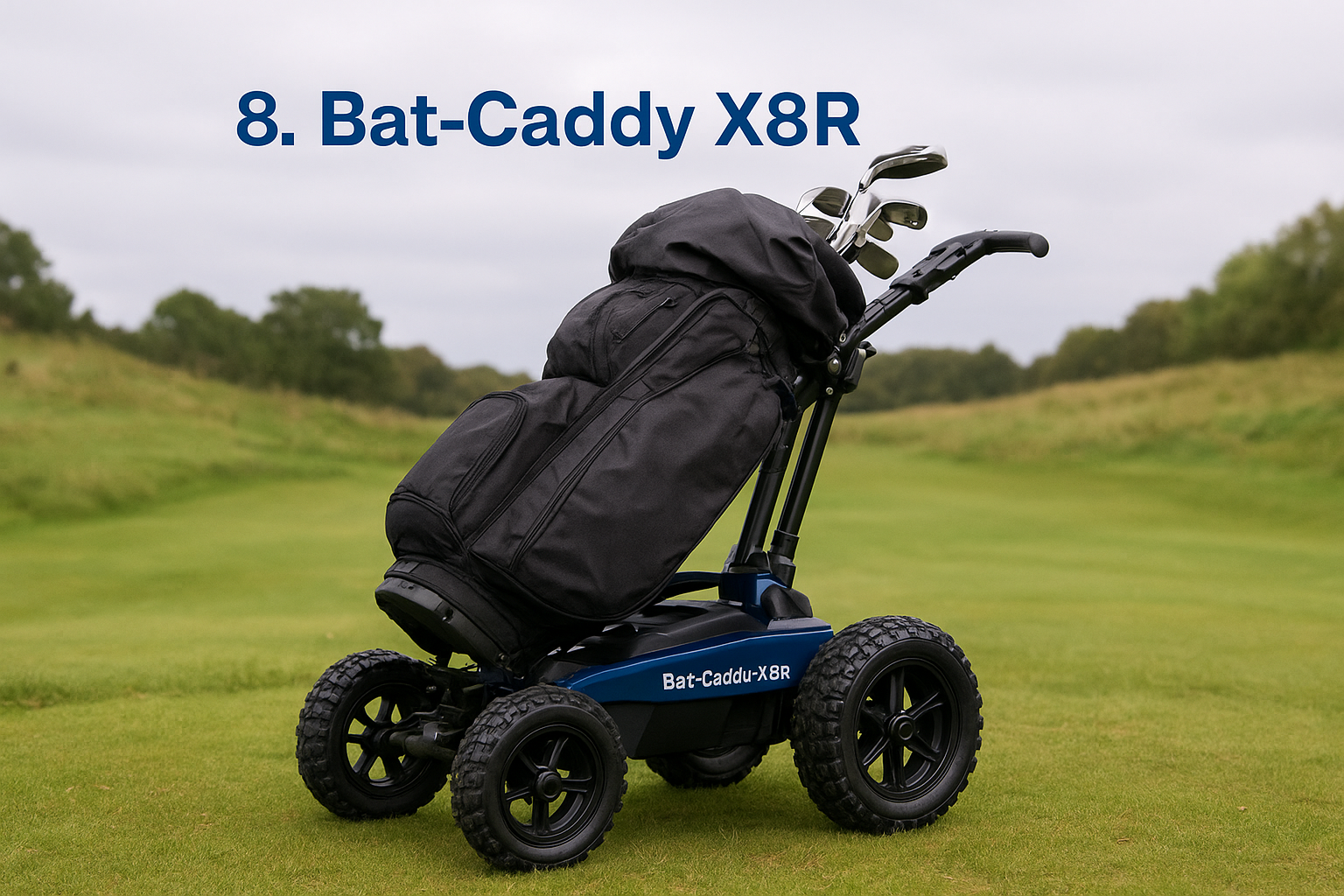
Bat-Caddy rounds out this list with the X8R, a rugged all-terrain trolley built more like a workhorse than a lightweight commuter model. It's aimed squarely at golfers who play on rough, hilly, or poorly maintained courses where lighter follow trolleys start to struggle, and its all-wheel drive system is the main reason it earns a place here.
How the follow-me technology works
The X8R uses infrared tracking through a transmitter worn on your wrist or belt, holding a gap of around 3 to 3.5 metres and adjusting speed as you change pace. It reacts well to gradual turns but, like most infrared systems, needs a clear line of sight to keep locked on. A wireless remote is included as a backup, and Bat-Caddy also offers a manual push mode if you'd rather switch the motor off entirely for a stretch.
An all-wheel drive follow trolley earns its keep the moment you hit wet grass or a steep bank most others avoid.
Key features and terrain handling
This is where the X8R separates itself from the rest of this list. Its dual motor, all-wheel drive setup handles slopes up to 25 degrees, the steepest rating here, and copes with soft, muddy ground far better than single-motor rivals. Battery life covers roughly 27 holes, and the frame weighs a hefty 17kg folded, noticeably heavier than the Stewart or Navee models.
Who it's best for
Golfers on hilly, coastal, or frequently waterlogged courses will get the most from the X8R's traction, even if it's not the trolley you'd choose for easy portability.
Price and where to buy
Expect to pay between £1,200 and £1,400. Check MoreSports' electric trolley range for current stock and Klarna finance options.
9. Common questions about follow-me golf trolleys
Do follow-me trolleys work on every golf course? Mostly yes, but tracking accuracy drops on courses with dense treelines, blind doglegs, or steep coastal dunes. Infrared models need a clear line of sight, so a wooded parkland course with tight fairways will test even the best sensors. GPS-based systems like the MGI Halo cope better with obstructions, though they trade a little responsiveness for that reliability.
Can you switch off the follow feature and push manually? Every trolley on this list includes a manual mode or remote control fallback, so you're never stuck if the sensor loses you mid-round. Switching modes usually takes one button press, though some older systems bury the option in a menu.
If a trolley can't fall back to manual control in seconds, it's not ready for a real round.
How long do the batteries actually last? Manufacturer claims of 36 holes rarely survive a cold, hilly winter round with a full bag. Expect real-world battery life to run 15 to 20 percent lower than the spec sheet once you factor in slopes and temperature.
Is an electric golf trolley that follows you worth the extra cost over a standard push or pull golf trolley? If you regularly walk 18 holes solo, carry a heavy bag, or play hilly courses, the answer is almost always yes. The saved energy shows up in your swing on the back nine, which is the whole point of buying one.
Will a follow trolley work with any golf bag? Most accommodate standard cart bags, though very large tour bags can unbalance lighter frames like the Gozo Auto-Follow.
Finding your ideal follow-me trolley
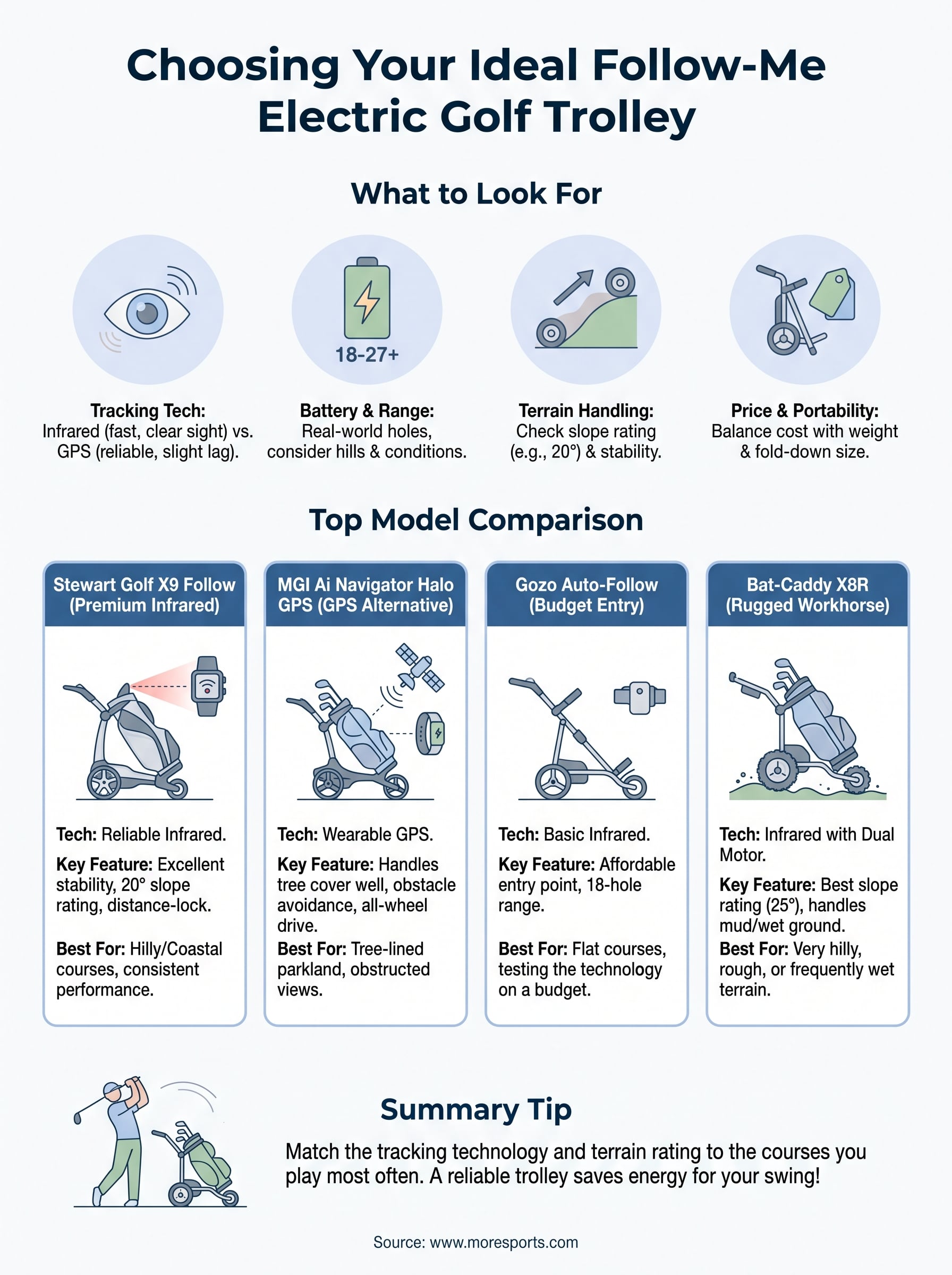
Picking the right electric golf trolley that follows you comes down to matching the tracking technology and terrain rating to the courses you actually play, not the spec sheet that looks most impressive online. Golfers on hilly, coastal layouts should lean towards the Stewart Golf X9 or Bat-Caddy X8R, while tree-lined parkland regulars will get more consistent results from the MGI Halo's GPS-based tracking. Budget shouldn't push you towards the cheapest infrared sensor on the market either, since a trolley that loses you on every dogleg ends up back in the boot within a month.
Rather than guessing from spec sheets alone, it helps to compare these models side by side against your own course and budget. You can do exactly that, along with checking live stock and Klarna instalment options, by browsing the full range of Motocaddy electric golf trolleys before your next round.