 No Duties or Customs Fees For EU & UK Customers
 Express Tracked UK Delivery On 1000s of Items
 90 Day Returns

Golf Ball Spin Explained: Spin Rate, Axis, And Ball Flight
RYEvery golfer has watched a shot fly off the clubface and wondered why it curved, climbed, or dropped short. The answer almost always comes down to spin. Having golf ball spin explained properly can change the way you think about your equipment, your swing, and even your course strategy. It's one of those fundamentals that separates guesswork from genuine understanding of ball flight.
Spin rate, measured in revolutions per minute (RPM), and spin axis, the invisible tilt that dictates curve, are the two core concepts behind every draw, fade, and towering iron shot you hit. Getting these right isn't just theory; it directly affects how far and how accurately you strike the ball. Choosing the right golf ball for your spin profile can be worth several strokes per round, which is exactly why we stock a wide range of golf balls from leading brands here at MoreSports.
This article breaks down what spin rate and spin axis actually mean, how they shape ball flight through lift and drag forces, and what you can do, through ball selection and swing adjustments, to optimise your spin for better performance. Whether you're fighting a persistent slice or trying to add stopping power on approach shots, you'll walk away with practical knowledge you can use on the course.
Why spin matters for distance and control
Spin is what keeps the golf ball airborne and determines where it finishes. Without the right amount of backspin, your ball drops far sooner than it should, losing trajectory and distance. Too much spin balloons the shot upward, wastes energy, and costs you yards off the tee. Understanding how spin shapes both distance and control is the foundation of getting golf ball spin explained in a way that genuinely helps your game.
How spin generates lift
When a ball leaves the clubface with backspin, it creates a pressure difference between the top and bottom of the ball. Air moves faster over the top of the spinning ball and slower underneath, which produces upward lift using the same aerodynamic principle that keeps aircraft in the air. This is known as the Magnus effect, and it is the primary reason a well-struck iron shot climbs high and holds its line rather than tumbling to the ground.

The Magnus effect means a ball with adequate backspin can carry further through the air than a flat, spinless shot at the same launch speed, because the lift force extends the ball's time in the air.
Spin rate and launch angle work together to define the optimal flight window for each shot type. A driver performs best with a higher launch and lower spin rate, where carrying the ball as far as possible takes priority. A mid-iron benefits from moderate spin to maintain height and land softly on the green.
How spin affects stopping power and shot shape
Control is the other side of the equation. Backspin on approach shots grips the green surface and stops the ball quickly, giving you a realistic chance of holding pins tucked near edges or sloping sections. Without adequate spin, the ball pitches and runs, making distance control much harder to achieve consistently. This is why most skilled players prioritise spin performance from their irons and wedges above almost any other performance metric.
Your shot shape also depends directly on spin. A draw or fade happens when the spin axis tilts away from vertical, causing the ball to curve in flight. The steeper that tilt, the more the ball curves, which is something we break down in full later in this article.
The basics of spin: backspin, sidespin, topspin
Golf ball spin comes in three main types, each shaping your shot in a different way. Backspin, sidespin, and topspin are all produced at impact based on how the clubface meets the ball. Getting golf ball spin explained at this foundational level helps you understand why shots fly the way they do and where to start making improvements.
Backspin
Backspin occurs when the clubface imparts backward rotation to the ball relative to its direction of travel. It is the dominant spin type on virtually every full shot you hit, and it is what generates the lift and height you see from lofted clubs.
A sand wedge can generate 8,000 to 10,000 RPM of backspin, while a well-struck driver produces closer to 2,000 to 3,500 RPM.
Sidespin
Sidespin is what causes the ball to curve left or right during flight. It happens when the clubface is open or closed relative to the swing path at impact, producing a fade, slice, draw, or hook depending on the degree of misalignment.
Cutting unwanted sidespin comes down to squaring the face at impact, which is something both swing adjustments and ball selection can help you achieve more consistently.
Topspin
Topspin in golf appears mostly on putts and low running chips, where forward rotation encourages the ball to roll smoothly along the ground after landing rather than bouncing unpredictably off the surface.
Understanding all three spin types gives you a much clearer picture of what happens at impact, which is the foundation for making smarter decisions about your equipment and technique.
Spin rate in RPM and what changes it
Spin rate is the number of complete rotations per minute the ball makes after leaving the clubface. It is measured in RPM using launch monitor technology, and it gives you one of the most reliable indicators of how your ball will perform in flight. Once you understand spin rate, a major part of having golf ball spin explained becomes much more practical and actionable.
Club loft and swing speed
The two biggest factors driving your spin rate are club loft and swing speed. Higher lofted clubs naturally produce more backspin because the steeper angle of attack imparts more rotational force at impact. A pitching wedge will generate significantly more RPM than a 5-iron struck with the same swing speed, purely because of the difference in loft.
Swing speed also plays a direct role. Faster swing speeds tend to compress the ball more, which increases spin rate across all clubs. This is why slower swingers often benefit from lower-compression golf balls, which help them generate adequate spin without needing elite clubhead speed.
Ball construction and cover material
Your choice of golf ball has a measurable effect on spin rate across every club in the bag. Multi-layer balls with urethane covers produce noticeably more spin than two-piece ionomer balls on iron and wedge shots, giving you better control and stopping power around the greens.
A urethane-covered ball can generate up to 2,000 more RPM of backspin on a wedge shot compared to a basic two-piece ball.
Spin axis and why the ball curves
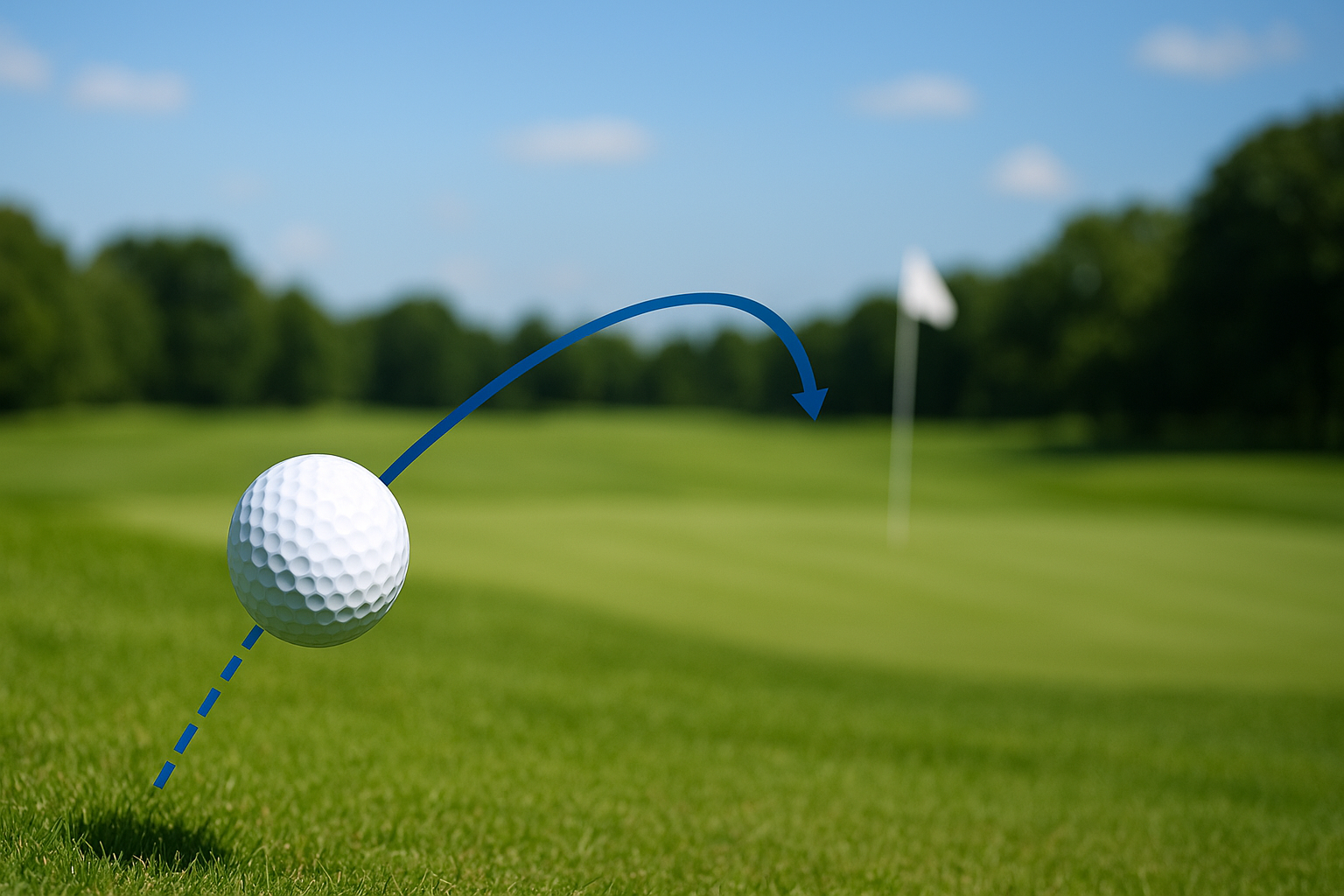
The spin axis is the invisible line around which the golf ball rotates during flight. While backspin spins around a horizontal axis, any tilt in that axis causes the ball to curve left or right. This tilt is the key mechanic behind every draw, fade, hook, and slice you have ever hit, and it is the part of having golf ball spin explained that most golfers overlook entirely.
What spin axis tilt means
Spin axis tilt happens when the clubface angle and swing path differ at impact. If the face is open relative to the path, the ball launches with a rightward axis tilt for a right-handed golfer, producing a fade or slice. If the face is closed to the path, the tilt goes left, creating a draw or hook.
The greater the difference between face angle and swing path at impact, the steeper the axis tilt and the more the ball curves in flight.
How tilt affects your ball flight
Understanding axis tilt helps you make deliberate corrections rather than hoping for something better next round. A small axis tilt of around 10 to 15 degrees produces a gentle draw or fade, which most golfers can use as a reliable shape off the tee. Beyond 20 to 25 degrees, the curve becomes difficult to control and usually costs you both distance and accuracy.
You can reduce unwanted tilt by focusing on the face-to-path relationship at impact, which is something a launch monitor session will show you in clear, measurable numbers.
How to get the spin you want and choose a ball
Putting golf ball spin explained into practice starts with two practical decisions: the ball you play and the adjustments you make to your swing. Both have a measurable impact on how much spin you generate and where your shots finish, so approach each one with a clear idea of what you actually need.
Match your ball to your swing speed
Your swing speed determines which ball construction will work best for you. If your driver swing speed sits below 85 mph, a low-compression two-piece ball helps you generate adequate spin to maintain height and distance without needing to swing harder. Faster swingers above 100 mph will get the most from a multi-layer urethane ball, which rewards compression with greater short-game spin and stopping power.
Choosing the wrong ball for your swing speed can cost you distance off the tee and stopping power on approach shots at the same time.
Ball dimple patterns also affect spin in windy conditions, so check the manufacturer's specifications before committing to a new model.
Adjust your technique at impact
Your angle of attack and contact point on the clubface are the two variables you have direct control over at impact. Consider these practical adjustments based on the club you are hitting:
- Irons: strike slightly on the downswing to increase compression and backspin, improving both height and stopping power on the green.
- Driver: use a positive angle of attack by tilting your spine away from the target and striking on the upswing to reduce spin and gain distance.
- Wedges: steepen your angle of attack and maintain firm wrist conditions through impact to maximise backspin on short approach shots.
Key takeaways and next steps
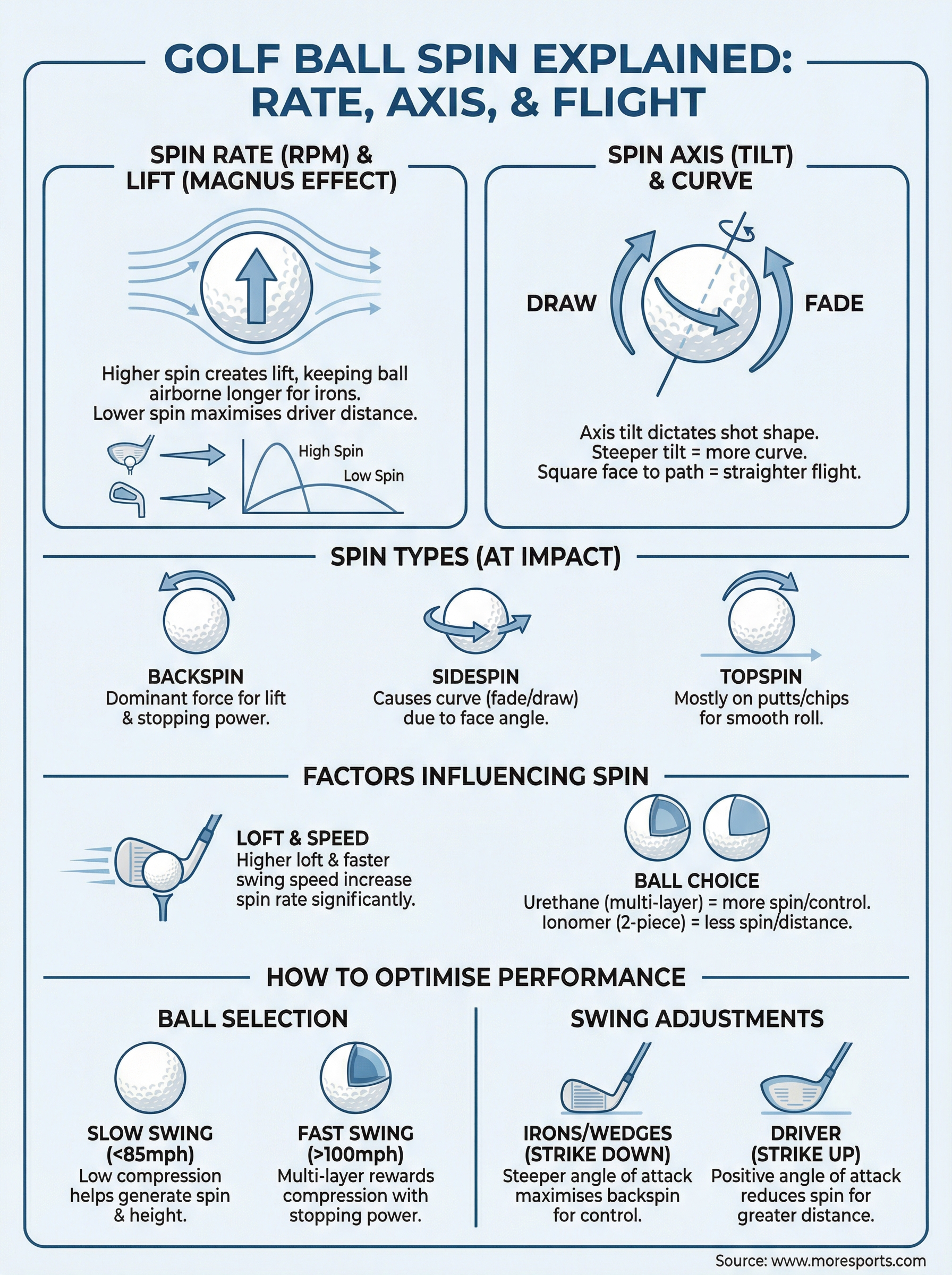
Having golf ball spin explained clearly gives you a real advantage over golfers who rely on guesswork. Spin rate in RPM controls your height and distance, while spin axis tilt controls your curve. Backspin keeps the ball airborne and stops it on the green. Sidespin shapes the flight left or right. Getting these two fundamentals right consistently is what separates a golfer who manages the course from one who simply reacts to bad shots.
Your next step is straightforward. Match your ball construction to your swing speed, work on your angle of attack at impact, and consider a launch monitor session to see your actual numbers. Small, informed changes to your equipment and technique will produce measurable results far sooner than any generic tip. Browse the full range of golf balls from top brands at MoreSports and find the right ball for your game today.