 No Duties or Customs Fees For EU & UK Customers
 Express Tracked UK Delivery On 1000s of Items
 90 Day Returns

How Many Dividers Should A Golf Bag Have? 4, 6 Or 14
RYChoosing a golf bag sounds straightforward until you're staring at a wall of options and wondering how many dividers should a golf bag have. It's one of those details that seems minor but directly affects how you organise, protect, and carry your clubs on the course.
The answer depends on how you play. A golfer who walks 18 holes has different priorities than someone who rides a cart every round. Four, six, and fourteen-divider configurations each come with distinct trade-offs in weight, club protection, and accessibility, and picking the wrong one can make your round more frustrating than it needs to be.
At MoreSports, we stock golf bags across all divider types from brands like TaylorMade, Titleist, and MacGregor, so we've helped thousands of golfers work through this exact decision. Below, we'll break down what each divider count offers, who it suits best, and how to match it to your game.
Why golf bag dividers matter
Dividers are not just about keeping your clubs tidy. They separate your clubs physically, which stops them from clanking against each other during a round, whether you're walking the fairway, loading the bag onto a cart, or chucking it into the boot of your car. When you think about how many dividers should a golf bag have, you're really asking how much protection and organisation matters to your game, and that answer changes depending on how you play.
Club protection during transport
Every time your bag moves, your clubs move with it. Without proper dividers, iron shafts and club heads knock together repeatedly, which causes scratches on club faces and wears down grips faster than most golfers expect. A bag with more dividers keeps each club in its own slot, reducing that contact significantly over 18 holes. If you've ever pulled a wedge out mid-round and noticed the face is already scuffed, a bag with better divider coverage is often the straightforward fix.
The more your bag moves during a round, the more damage your clubs take without proper dividers keeping them apart.
Access and pace of play
Organisation also directly affects how quickly you grab the right club when you get to the ball. With a 14-way divider, every club sits in a dedicated slot and you can pull one out without disturbing anything around it. With a 4-way or 6-way layout, clubs are grouped in sections, which is faster to load at the start but can mean more rummaging if you're carrying a full set of 14. Over a four-hour round, those seconds add up.
Weight and the walk
Dividers add structure, and structure adds weight and bulk to a bag. A 14-way full-length divider system is noticeably heavier than a simple 4-way cuff at the top of the bag. If you're walking 18 holes without a trolley, that extra weight builds up across several hours on the course. Picking the right divider count comes down to balancing organisation against what you're realistically comfortable carrying from the first tee to the 18th green.
How to choose the right divider count
Before settling on a number, you need to be honest about how you actually play. The main factors that shape this decision are whether you walk or use a cart, how many clubs you carry, and how much you care about protecting your equipment versus keeping the bag light and easy to move. Thinking through each of those points will tell you what divider setup fits your game without overcomplicating things.
Do you walk or ride?
This single question answers most of the debate around how many dividers should a golf bag have. If you walk the course regularly, weight is a genuine concern, and a lighter 4-way or 6-way bag will serve you better over 18 holes than a heavier 14-way option. The extra structure in a 14-way bag is worth it when a cart is doing the carrying, but it becomes a real burden on your shoulder after a few miles.
Riding means you can prioritise organisation and club protection without worrying about the weight penalty. A full 14-way divider makes pulling the right club faster and keeps everything separated on bumpy cart paths. Your bag sits in the cart rather than on your back, so the additional weight simply does not matter.
The way you get around the course is the single biggest factor in choosing the right divider count.
4-way dividers: simple, light, and easy to live with
A 4-way divider splits your bag into four sections, giving you a broad zone for woods and driver, one for long irons, and two additional sections for shorter irons, wedges, and your putter. You're not getting individual slots for every club, but you are getting a much lighter bag that is straightforward to load, carry, and live with across 18 holes.

A 4-way bag is the go-to option if you walk the course regularly and want to keep total bag weight as low as possible.
Who benefits most from a 4-way bag
If you're asking how many dividers should a golf bag have and you walk most of your rounds, the 4-way layout is often the honest answer. The minimal divider structure keeps the overall bag weight low, which matters far more than people expect once you're heading into the back nine with tired shoulders.
Working with a 4-way setup is also easier when you carry fewer than 14 clubs or are comfortable grouping clubs by type rather than having each one in its own dedicated slot. If you value speed over precision organisation and walk the course, a 4-way divider bag covers your needs without adding unnecessary weight or bulk.
6-way dividers: the best all-round option for most
A 6-way divider hits the middle ground between the stripped-back simplicity of a 4-way and the full organisation of a 14-way. Your clubs sit in six clearly defined sections, giving you enough separation to reduce rattling and make grabbing the right club straightforward, without the weight penalty that comes with a fully divided 14-slot system.
A 6-way bag gives you the practical benefits of organisation without committing to the bulk of a 14-way setup.
Who benefits most from a 6-way bag
When you're working out how many dividers should a golf bag have, the 6-way option suits the widest range of golfers. It works well whether you're walking or using a push trolley, and it handles a full set of 14 clubs without forcing you to cram everything into just four sections. You get enough structure to keep your woods, irons, and wedges separated by type, which speeds up club selection without overcomplicating things.
Golfers who mix walking with the occasional cart round will find the 6-way bag adapts well to both situations. The bag stays manageable on foot while offering decent protection on a trolley or cart. If you play regularly and want one bag that covers most situations without compromise, the 6-way layout is the straightforward choice.
14-way dividers: maximum organisation and protection
A 14-way divider gives every single club its own dedicated slot from top to bottom. That means your driver, fairway woods, hybrids, irons, wedges, and putter all sit completely separated, which eliminates club-on-club contact entirely. The trade-off is weight and bulk, since a full-length 14-slot divider system adds meaningful structure to the bag and makes it noticeably heavier than a 4-way or 6-way option.
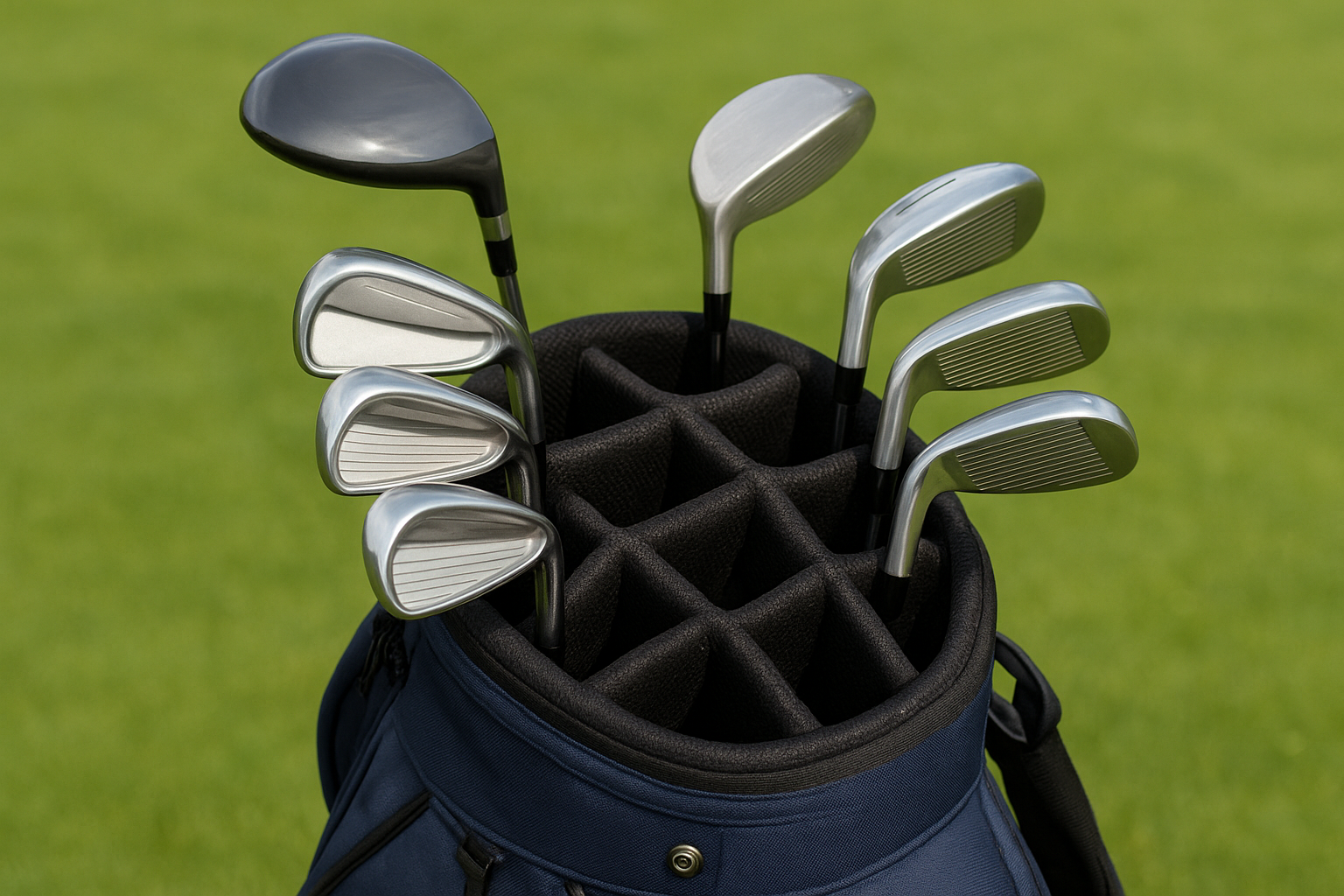
A 14-way bag makes the most sense when a cart or electric trolley is doing the carrying, not your back.
Who benefits most from a 14-way bag
Golfers who ride a cart or use an electric trolley for the majority of their rounds will get the most out of a 14-way setup. When you're not carrying the bag yourself, the extra weight stops being a problem and the benefits of full individual club separation become easy to appreciate. Pulling out a 7-iron without disturbing anything around it saves time at the ball and keeps your clubs in noticeably better condition across hundreds of rounds.
If you're still working out how many dividers should a golf bag have, and your priority is protecting premium equipment like custom-fitted irons or a high-end driver, a 14-way bag gives you the most thorough coverage available. The individual sleeves prevent scratches, reduce shaft wear, and stop grips from rubbing against neighbouring clubs every time the bag moves on a bumpy cart path.
Quick recap and next step
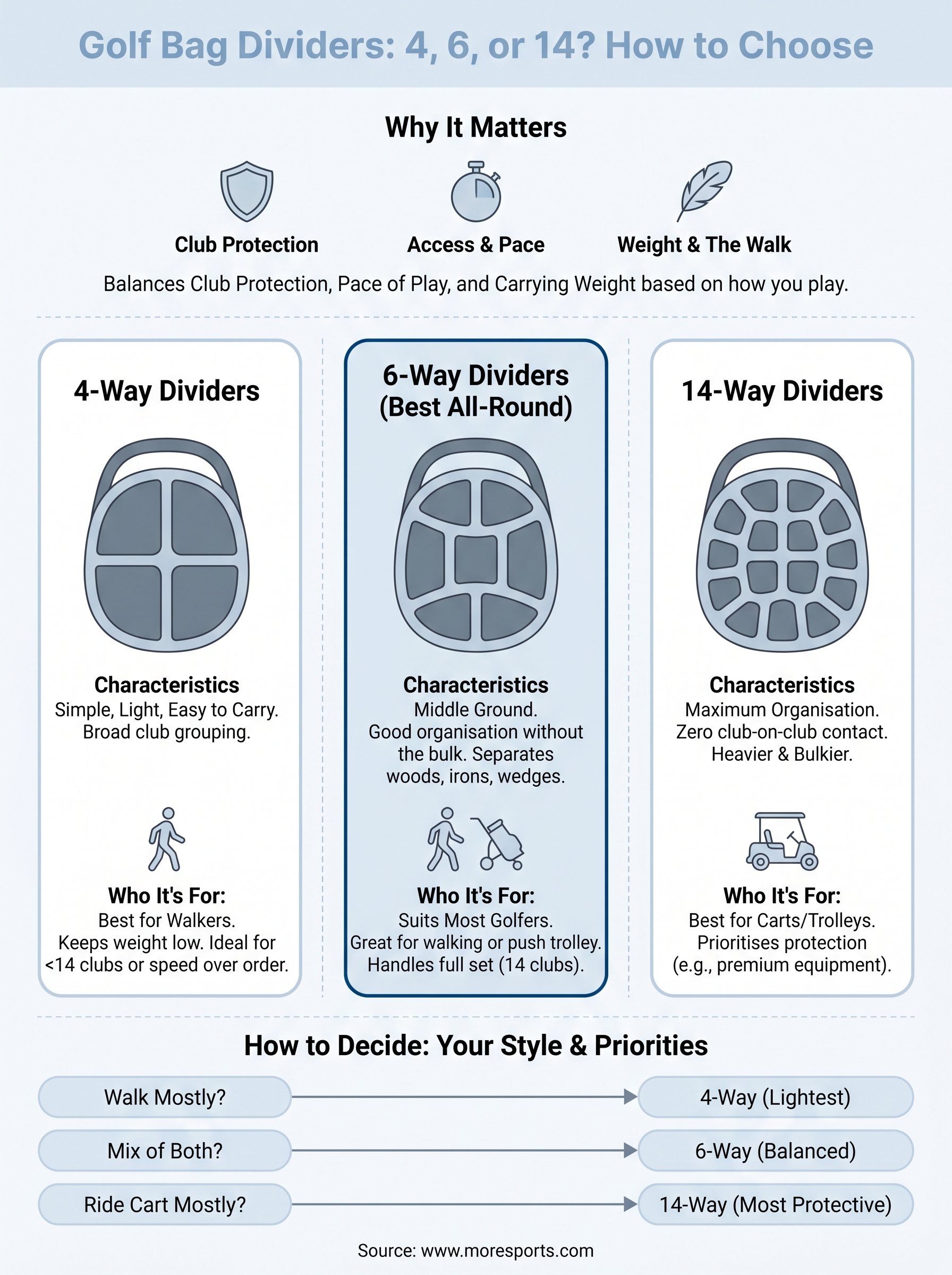
If you've been trying to work out how many dividers should a golf bag have, the answer comes down to how you get around the course. A 4-way bag keeps things light if you walk regularly and prefer simplicity over precise organisation. A 6-way layout suits the widest range of golfers, handling a full set comfortably whether you walk, push a trolley, or occasionally ride. A 14-way bag is the right call if you use a cart or electric trolley and want every club sitting in its own slot with zero contact between them.
Your playing style, how many clubs you carry, and how much you value protection versus portability are the three things worth settling before you buy. Get those right and the divider count follows naturally. Browse the full range of golf bags at MoreSports to find the setup that matches how you actually play.