 No Duties or Customs Fees For EU & UK Customers
 Express Tracked UK Delivery On 1000s of Items
 90 Day Returns

How To Hit A Driver Straight: Setup, Fixes & Drills Today
RYNothing kills confidence on the first tee quite like watching your ball sail into the trees. If you're struggling with how to hit a driver straight, you're far from alone, it's one of the most common frustrations among amateur golfers, and often the single biggest thing holding scores back. The driver demands more from your setup, swing path, and timing than any other club in the bag, so small errors get amplified into big misses.
Whether you're fighting a slice that won't quit or a hook that appears out of nowhere, the fix usually comes down to a handful of fundamentals that are surprisingly easy to overlook. The right adjustments to your grip, ball position, and swing mechanics can transform your tee shots from a liability into a genuine weapon. At MoreSports, we help golfers across the UK and beyond gear up with top brands like TaylorMade, Titleist, and Adidas, but we also know that no piece of equipment replaces solid technique.
This guide breaks down the setup keys, common faults, and practical drills you can take straight to the range to start hitting your driver with real accuracy. Let's get your tee game sorted with step-by-step fixes that actually work.
What makes a driver curve
Understanding why your driver curves is the first step toward fixing it. Every wayward tee shot comes down to one thing: sidespin. That spin gets generated the moment the face contacts the ball, and it is controlled by two variables working together: the angle your clubface points at impact and the direction your clubhead is travelling through the hitting zone. When those two variables are mismatched, the ball curves. Get them working together and you start hitting it straight.
Face angle and swing path
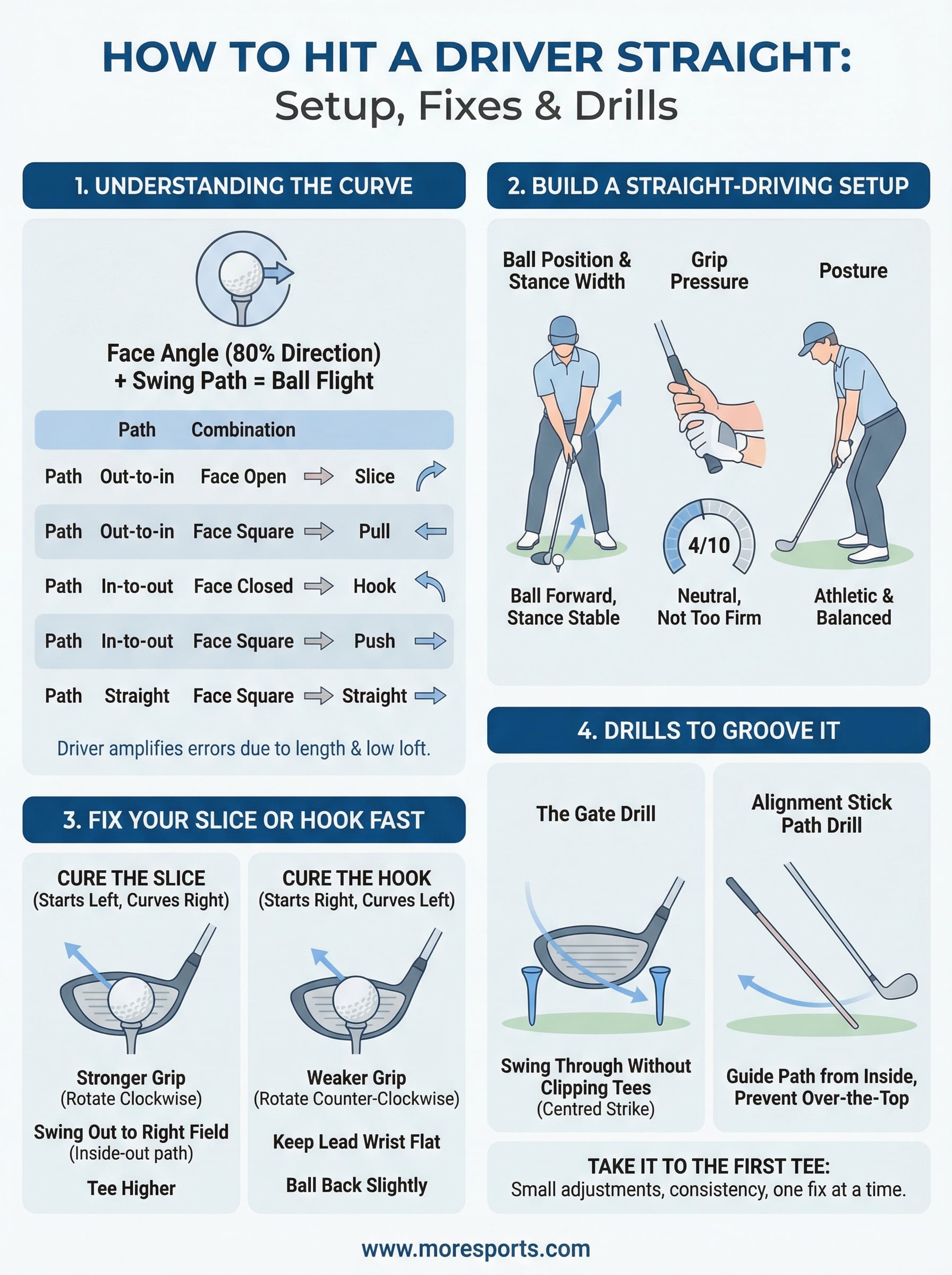
Your face angle at impact is responsible for roughly 75 to 80 percent of the direction your ball starts on. Your swing path then determines how much the ball curves after launch. When your face is open relative to your path at impact, the ball generates left-to-right sidespin (for a right-handed golfer), which produces a slice. When the face is closed relative to your path, you get right-to-left sidespin, which produces a hook. Most golfers focus on their swing path and ignore the face, but the face is the primary driver of ball flight.
The ball does not start where your feet point or where your path goes - it starts predominantly where your face is pointing at impact.
How path and face combine
The table below shows the most common path-and-face combinations and the shot shape each one produces:
| Swing Path | Face Angle at Impact | Result |
|---|---|---|
| Out-to-in (left) | Open to path | Slice |
| Out-to-in (left) | Square to path | Pull (straight left) |
| In-to-out (right) | Closed to path | Hook |
| In-to-out (right) | Square to path | Push (straight right) |
| Straight | Square to path | Straight shot |
Why the driver amplifies every error
The driver makes these mismatches more visible than any other club in your bag, and two physical factors explain why. First, the shaft is the longest of any club, which increases the arc of your swing and gives errors more room to grow by the time the face reaches the ball. Second, low loft reduces backspin, so sidespin has a disproportionately large influence on the ball's flight. A small face-angle error with a 9-iron might produce a gentle fade that still finds the green. That same error with a driver turns into a hard slice that costs you 30 yards of fairway. Knowing this gives you a precise target when working on how to hit a driver straight: close the gap between your face angle and your swing path at impact, and the ball will respond immediately.
Step 1. Build a straight-driving setup
Your setup is the foundation of every tee shot. Most golfers rush through it, but a poor address position locks in swing faults before the club even moves. Fixing your setup is the fastest, zero-cost change you can make on how to hit a driver straight, and it often produces immediate results on the range.
Ball position and stance width
Ball position with a driver should sit off the inside of your lead heel, not in the middle of your stance. This forward position lets the clubhead reach the bottom of its arc and travel slightly upward at impact, which reduces backspin and promotes a straighter, more powerful strike off the tee.

Stance width should match your shoulder width or sit fractionally outside it, giving you a stable base through the full swing. A stance that's too narrow causes you to sway laterally, while one that's too wide locks your hips and restricts your turn through the ball.
A ball that sits too far back in your stance promotes a steep, out-to-in swing path, which is one of the most common causes of a slice.
Grip and posture
Grip pressure is one of the most underestimated setup factors in the game. Hold the club at roughly a 4 out of 10 for tightness. Too firm and your forearms tense up, which restricts the natural rotation of the clubface through impact. A neutral grip, where you see two to two-and-a-half knuckles on your lead hand at address, gives you the best chance of returning the face square at impact.
Your posture should have you bending from the hips, not the waist, with a slight flex in your knees and your weight balanced across the balls of your feet. Stand tall through your spine and let your arms hang naturally below your shoulders.
Step 2. Deliver the face and path
Once your setup is locked in, the real work of learning how to hit a driver straight comes down to what happens in the brief moment the club travels through impact. Face angle and swing path must work together at that point, and the two focal areas below give you a clear, practical way to train both on the range.
Control the clubface through the hitting zone
The clubface rotates naturally during the swing, and your grip pressure and forearm rotation control how fast it closes. If your face arrives at impact still open, the ball will start right and curve further right. To fix this, focus on rotating your lead forearm through the ball so the logo on your glove faces the ground just after contact, not the sky.
If your trail hand dominates through impact, it locks the face open. Let your lead arm drive the motion, and the face will square up on its own.
A useful check is to film your swing from behind and pause the video at impact. Your clubface should appear vertical or fractionally closed relative to your swing path, not fanned open toward the sky.
Shape your swing path from the inside
Your swing path through the hitting zone needs to travel from inside the target line, not across it from outside. Place an alignment stick or a spare headcover six inches outside the ball, angled slightly away from you at address. Swing the clubhead out toward that object through impact rather than cutting across it. This straightforward drill trains the in-to-out path that removes the slice and gives you repeatable, genuine control over your tee shots.

Step 3. Fix your slice or hook fast
Knowing which fault you have is half the battle. A slice and a hook are mirror-image problems, and each needs a specific adjustment to clear it up. Before applying any fix, identify your shot pattern on the range - does the ball start left and curve right, or start right and curve left? That answer points you straight to the right solution.
Cure the slice
A slice comes from an open clubface relative to your swing path at impact, most often combined with an out-to-in path cutting across the ball. The fastest fix is to strengthen your grip slightly by rotating both hands one knuckle clockwise (for a right-handed golfer) on the handle. This pre-sets the face in a marginally closed position at the top, giving it a better chance of arriving square when it matters most.
If you've been fighting a slice for years, a stronger grip combined with an inside path will often fix it within a single range session.
Tee the ball one inch higher than usual and feel like you're swinging out toward right field through impact. This shallower approach removes the steep chop that keeps the face open at contact.
Cure the hook
A hook means your face is closing too early relative to your path. Weaken your grip by rotating both hands slightly counter-clockwise until only one and a half knuckles show on your lead hand. Then focus on keeping your lead wrist flat through impact rather than cupping it, which slows the face rotation down.
Check your ball position too. Moving the ball back half an inch toward the centre of your stance gives the face time to square up naturally rather than roll over, which is one of the quickest ways to apply how to hit a driver straight when a hook is your main fault.
Step 4. Drills to groove it under pressure
Range time only counts if you're training a repeatable pattern, not just hitting balls. These focused drills take the technical adjustments from the earlier steps and burn them into muscle memory so they hold up when you're standing on the first tee with a card in your pocket. Each drill isolates a specific element of how to hit a driver straight and gives you immediate feedback on whether you're getting it right.
The gate drill
Place two tees in the ground just outside the heel and toe of your driver at address, leaving roughly two inches of clearance on each side. Your goal is to swing through the gate without clipping either tee. This drill exposes a path that's too steep or too wide and forces you to find a shallow, centred strike through the hitting zone. Complete ten swings at 70 percent speed before stepping up to full power, and you'll quickly feel exactly where your path is straying.
The alignment stick path drill
Push an alignment stick into the ground at a 45-degree angle just outside your rear hip, pointing away from you on the target side. This acts as both a visual guide and a physical barrier that stops the club from getting steep and cutting across the ball from outside. Swing the driver under and past the stick on the downswing. Hit fifteen balls with this in place, then remove it and try to replicate the same shallow feeling without the guide.
If you can hold that feeling for five consecutive shots without the stick, you've genuinely started to groove the move.
Repeat both drills in the same session and alternate between them every ten balls. This trains your body to link the face control work with the path work, which is what produces consistency when the pressure is real.
Take it to the first tee
You now have everything you need to put these changes into practice. The core of how to hit a driver straight comes down to three things: a solid setup, a shallow path, and a square face at impact. None of these require a complete rebuild of your swing. Small, deliberate adjustments to your grip, ball position, and swing path will produce noticeable results faster than most golfers expect, especially when you back them up with the gate drill and alignment stick work covered above.
Take one fix at a time onto the range rather than trying to apply everything at once. Consistency builds when you change one variable, collect feedback, and repeat until the movement feels automatic. Once a change holds up under pressure at the range, it will hold up on the course.
Ready to pair better technique with the right equipment? Browse the full range of drivers and golf gear at MoreSports.