 No Duties or Customs Fees For EU & UK Customers
 Free UK Delivery On Orders Over £30
 90 Day Returns

Left Handed Vs Right Handed Golf Clubs: Which Should You Use?
RYChoosing between left handed vs right handed golf clubs isn't as straightforward as you might think. Your writing hand doesn't always dictate which side you should swing from, and picking the wrong setup can hold back your progress from day one on the course.
The physical differences between left and right-handed clubs are simple enough, they're mirror images of each other. But figuring out which set belongs in your bag depends on a few factors that go beyond whether you're left or right-hand dominant. Your dominant eye, natural stance, and comfort level all play a role. There are also practical considerations, like equipment availability, that can genuinely affect your experience as a golfer.
This guide breaks down exactly how left and right-handed golf clubs differ, how to determine which side suits you best, and what to keep in mind when buying your first set. At MoreSports, we stock golf clubs and equipment from top brands like TaylorMade, MacGregor, and more, for both left and right-handed players, so whatever you decide, we've got you covered.
Why handedness matters in golf
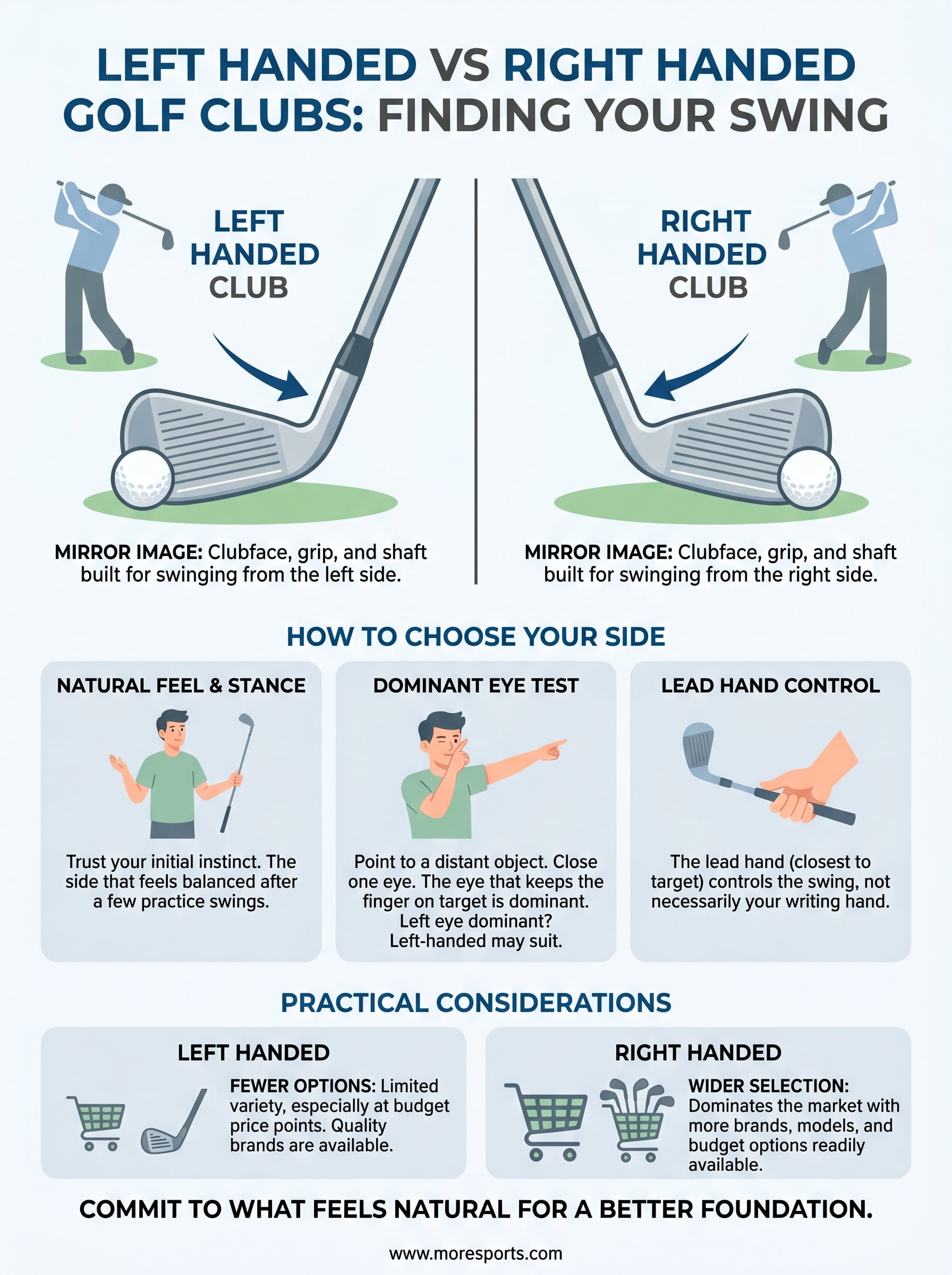
Golf clubs are built for a specific swing direction. A right-handed club is designed so the clubface strikes the ball when you swing from left to right (from your perspective), while a left-handed club mirrors that setup. Using a club built for the wrong side means your grip, stance, and swing mechanics don't line up, making consistent contact much harder than it needs to be.
It's not just about your writing hand
Many beginners assume that writing with your right hand means you automatically play right-handed. That's not always the case. In golf, it's your lead hand (the one closest to the target) that controls the swing, not your dominant writing hand. Some naturally left-handed people feel comfortable playing right-handed, and the reverse is also true. Your instinct when you first pick up a club tends to be the most reliable early signal of which side works for you.
The way you naturally stand over a ball for the first time often tells you more about which side suits you than your writing hand ever will.
How your body determines the right fit
When thinking about left handed vs right handed golf clubs, consider more than just hand preference. Your dominant eye plays a bigger role than most beginners expect. If your left eye is dominant, you may find it easier to align shots as a left-handed golfer, since your dominant eye sits closer to the target line. Getting this right from the start helps you build better muscle memory and avoids the frustration of relearning your technique later.
Here are the key physical factors to consider:
- Lead hand control: which hand naturally takes charge during a practice swing
- Eye dominance: which eye you rely on for targeting and alignment
- Stance comfort: which side feels balanced when you address the ball
What is different in left and right-handed clubs
At a glance, left and right-handed clubs look almost identical, but they're mirror images of each other in every functional way. The entire club is built around which side of the ball you stand on, and using the wrong one makes clean, consistent contact nearly impossible.
The clubhead, face angle, and grip
The most obvious physical difference is the clubhead design. On a right-handed iron, wood, or putter, the clubface angles to suit a swing from the right side. A left-handed version flips that entirely, with the face reversed to match the opposite swing direction. This applies to every club in the bag, from wedges to drivers.
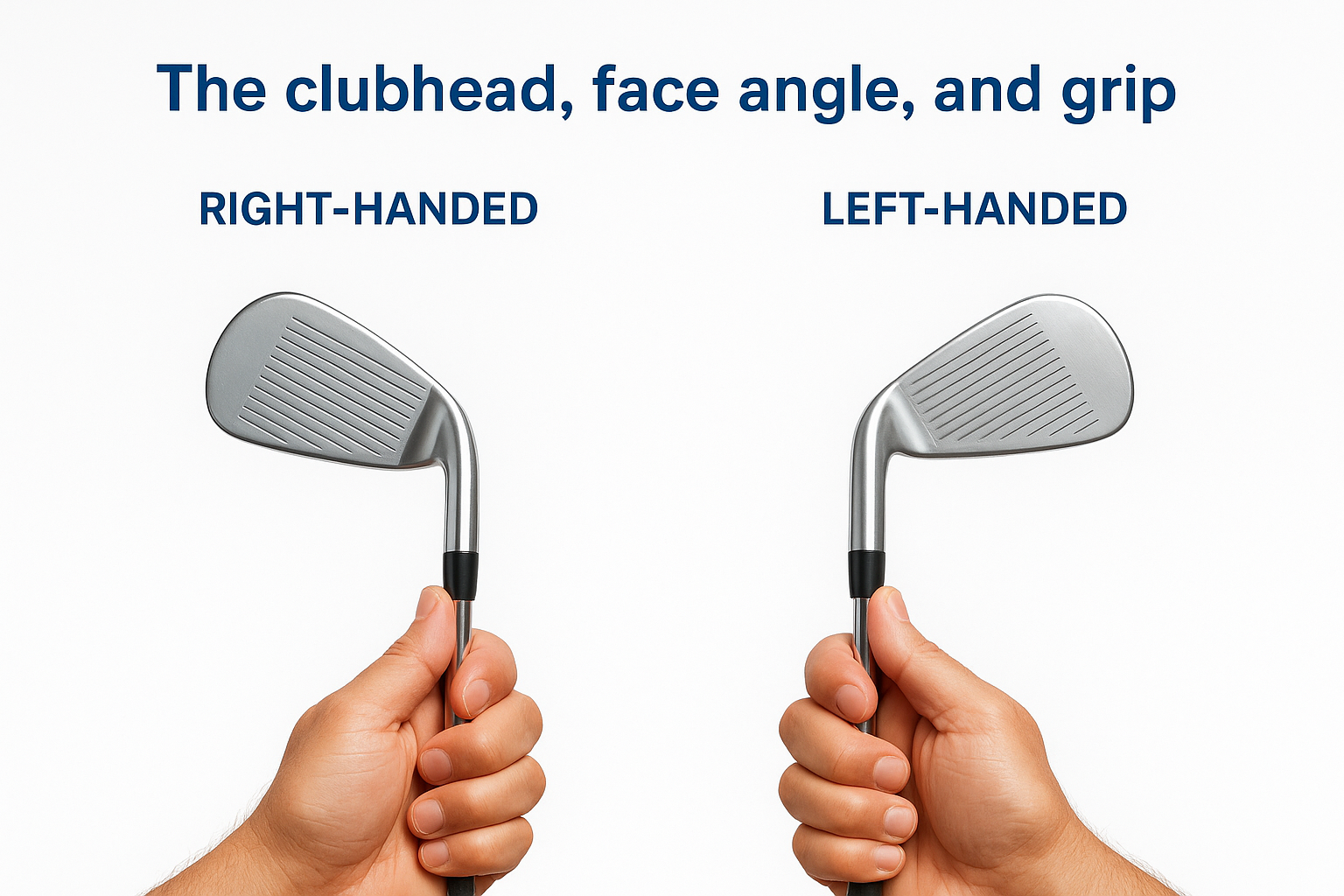
Your grip and shaft orientation also shift in relation to the clubhead. When you hold a left-handed club in a right-handed grip, the face points the wrong way completely. In the left handed vs right handed golf clubs comparison, this is the key physical distinction: every component works as a coordinated unit built for one specific swing path.
Picking up the wrong-handed club and swinging it normally will tell you immediately how much the orientation matters.
How to choose the right side to play golf
The simplest way to figure out which side suits you is to pick up a club and take a few swings on both sides. Your body will naturally feel more balanced and controlled on one side. Trust your initial instinct, because overthinking the choice is where most beginners go wrong.
The side that feels natural after your first few swings is usually the right one to stick with.
Test your dominant eye
Your dominant eye plays a bigger role in golf alignment than most people expect. To find it, point at a distant object with both eyes open, then close each eye in turn. The eye that keeps your finger on target is your dominant eye. Here's how it typically maps to your setup:

- Left eye dominant: left-handed golf may feel more natural for alignment
- Right eye dominant: right-handed golf is usually the easier starting point
- No clear dominance: fall back on your natural swing instinct instead
Consider what feels natural
When comparing left handed vs right handed golf clubs, the most reliable test is a physical one. Stand over a ball and address it from both sides, then swing without overthinking it. The stance that feels balanced and the swing that flows without forcing it are your clearest signals.
Practical pros and cons of each option
Once you know which side feels natural, understanding the real-world trade-offs helps confirm your choice. Both options let you play golf well, but one comes with more immediate convenience in terms of equipment access and variety.
Right-handed: the wider selection
Right-handed clubs dominate the market. Walk into any golf retailer and the vast majority of stock will be built for right-handed players, meaning more choice at every price point, from entry-level sets to premium irons.
- More brands and models available across all categories
- Easier to find budget and second-hand options
- Wider demo club availability in most shops
Left-handed: fewer clubs, real options
The left-handed range has improved significantly in the left handed vs right handed golf clubs space. Major brands like TaylorMade and MacGregor now produce left-handed versions of most key lines, so quality is not the issue. The limitation sits more around variety at the budget end of the market, where the selection thins out compared to right-handed equivalents.
A dedicated retailer stocking both sides removes most of the friction left-handed golfers face when starting out.
- Core ranges from top brands are widely available
- Budget left-handed options are more limited
- Specialist retailers bridge the gap effectively
Quick checks and common questions
Before you commit to a set, a few simple checks can save you time and money. The left handed vs right handed golf clubs decision doesn't need to be complicated, and most common concerns have straightforward answers.
Can you switch sides after you've started playing?
Switching is possible, but it comes with a real learning curve. Your muscle memory resets completely, which means your grip, stance, and swing timing all need rebuilding from scratch. If you've only played a handful of rounds, switching early is manageable. Beyond that, the cost in time and progress is significant enough that most coaches recommend committing to one side from the start.
Getting your setup right in the first few sessions is far easier than unlearning months of muscle memory later.
Does it matter which hand you write with?
Your writing hand is a starting point, not a rule. Some right-handed writers play left-handed golf naturally and perform better for it. What actually matters is which side produces a balanced, controlled stance when you step up to the ball. Use your writing hand as a first guess, then let a few practice swings confirm or override it.
Final thoughts
The left handed vs right handed golf clubs decision comes down to one thing: what feels natural to you. Your dominant eye, your instinctive stance, and the side that produces a controlled swing are far more useful guides than your writing hand alone. Getting this right from the start means your technique builds on a solid foundation rather than fighting your own mechanics.
Both sides of the game are well-served by quality equipment from brands like TaylorMade and MacGregor, so whichever setup suits you best, there's no reason to compromise on quality. Right-handed players have a wider selection at the budget end, but left-handed golfers have more genuine options today than ever before.
Take a few swings on both sides before you buy, trust your instincts, and commit to your choice. When you're ready to find the right clubs, browse our full range of golf equipment at MoreSports and find your perfect fit.