 No Duties or Customs Fees For EU & UK Customers
 Express Tracked UK Delivery On 1000s of Items
 90 Day Returns

Pitching Wedge vs Sand Wedge: What Are The Key Differences?
R YThe pitching wedge vs sand wedge debate centres on two clubs with distinct purposes in your golf bag. A pitching wedge typically has less loft and is designed for approach shots from the fairway, whilst a sand wedge features more loft and a wider sole to help you escape bunkers and navigate softer lies. Understanding when to reach for each club can shave strokes off your scorecard and give you more confidence around the green.
This guide breaks down the technical differences between these two essential wedges, from loft angles and bounce characteristics to distance ranges and shot selection. You'll learn which club to pull in specific situations, how to identify the yardage gap in your bag, and why having the right wedge setup matters for your scoring clubs. Whether you're struggling to choose between these two options or looking to optimise your wedge configuration, you'll find practical advice that applies directly to your next round.
Why specific wedges are essential for scoring
Your performance from 100 yards and in determines whether you break 90, shoot in the 70s, or consistently post competitive scores. Professional golfers attribute more than 60% of their strokes to the short game, and this percentage only increases for amateur players. The pitching wedge vs sand wedge distinction becomes critical when you consider that most scoring opportunities arise within this wedge distance range.
The short game determines your handicap
You can hit every fairway and still post a high score if you lack the wedge control needed to get up and down around the green. Statistics show that golfers who improve their wedge play drop three to five strokes per round on average. Your ability to execute different wedge shots under pressure separates consistent players from those who struggle with their handicap. A well-struck 7-iron means little if you cannot convert a simple pitch shot into a one-putt opportunity.
Mastering your wedges transforms scrambling situations into routine pars and creates genuine birdie chances on short par fours.
Why one wedge cannot cover all situations
Different lies demand different loft angles and bounce characteristics. A buried ball in a greenside bunker requires the high loft and wide sole of a sand wedge, whilst a tight lie on the fairway calls for the lower loft and narrower sole of your pitching wedge. You'll face firm turf, fluffy sand, thick rough, and hardpan all in the same round. Each condition changes how the club interacts with the ground, making a single wedge inadequate for versatile shot-making.
Controlling spin and trajectory to save strokes
Spin rate and ball flight directly influence how quickly your ball stops on the green. Your sand wedge generates maximum spin through increased loft, allowing you to attack tight pin positions without running the ball off the back. Conversely, your pitching wedge produces a lower trajectory that penetrates wind and rolls out predictably on firm greens. Learning to manipulate these characteristics through club selection gives you the tools to navigate any situation and consistently leave yourself within three feet of the hole.
How to select the correct wedge for the situation
Club selection around the green requires you to assess three key factors before pulling a wedge from your bag: the lie of your ball, the distance to the pin, and any obstacles between you and the target. The pitching wedge vs sand wedge decision becomes straightforward once you understand how each club performs in different scenarios. Your goal is to match the club's design characteristics to the demands of the shot, giving yourself the best chance to stop the ball close to the hole.
When to use your sand wedge
You'll reach for your sand wedge whenever you face soft lies or need maximum height. Bunker shots obviously demand this club, but you should also use it from thick rough, fluffy lies, and situations where you must clear a tall obstacle with limited green to work with. The wider sole prevents the club from digging too deeply, whilst the increased loft helps you pop the ball up quickly and land it softly.

When to choose your pitching wedge
Your pitching wedge excels from tight lies on the fairway and when you need a lower, more penetrating ball flight. Pull this club for full approach shots from 100 to 120 yards, bump-and-run shots around the green, and any situation where you want the ball to release and roll after landing. The narrower sole works cleanly through firm turf without bouncing.
Reading the lie before you swing
Before selecting between these clubs, you must evaluate how much grass sits underneath your ball and the firmness of the ground beneath it. A ball sitting down requires more loft, whilst a clean lie allows you to use less.
The lie tells you everything about which club will perform best in that specific situation.
Key differences in loft angles and bounce
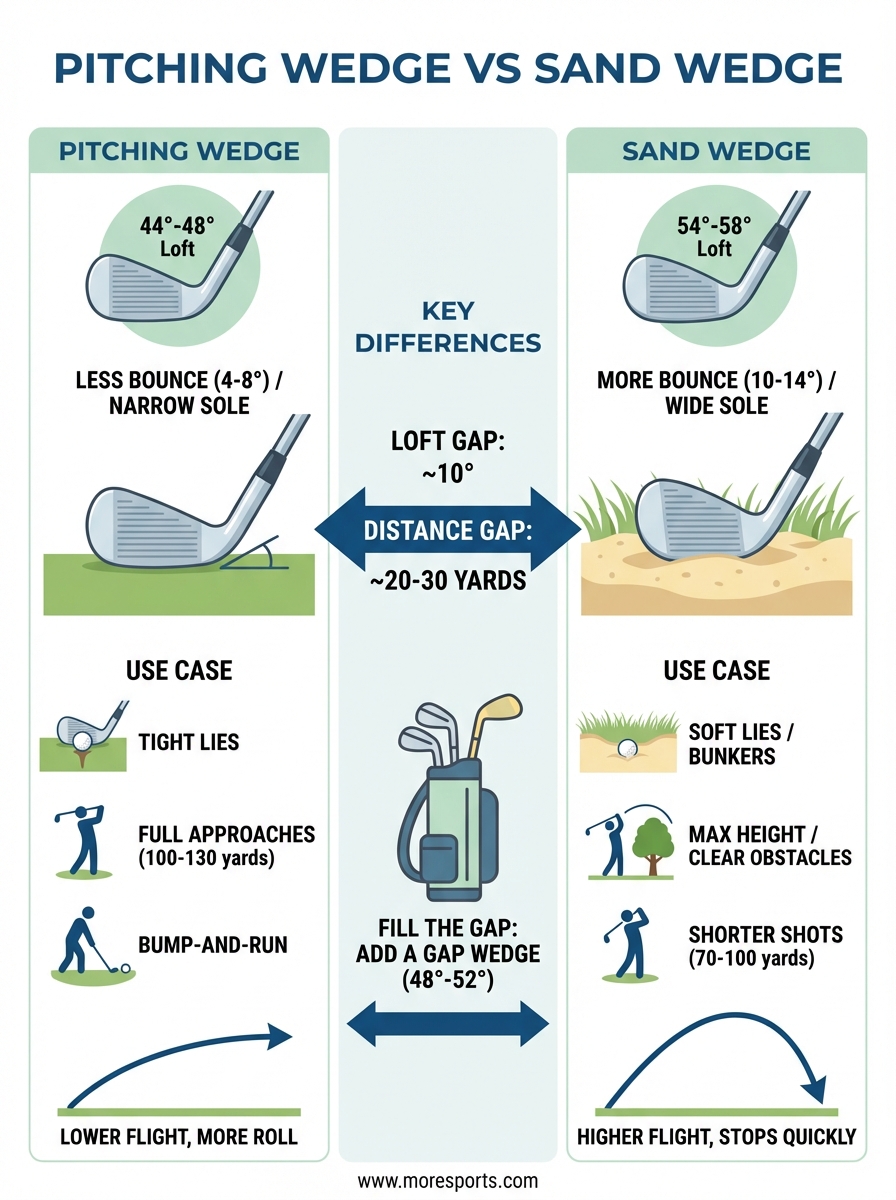
The pitching wedge vs sand wedge comparison reveals significant design differences that directly affect how each club performs. Your pitching wedge typically carries between 44 and 48 degrees of loft, whilst your sand wedge sits in the 54 to 58 degree range. This loft gap of roughly 10 degrees creates distinctly different ball flights and landing characteristics. Beyond loft, the bounce angle and sole width vary considerably between these clubs, influencing how they interact with turf and sand.
Understanding loft degrees
Your pitching wedge's lower loft produces a flatter trajectory that penetrates wind and generates more roll after landing. This characteristic makes it ideal for full approach shots from 100 yards and controlled bump-and-run shots. Sand wedges deliver a higher, softer ball flight that stops quickly on the green, thanks to their increased loft creating more backspin and a steeper descent angle.
The 10-degree loft difference between these clubs fundamentally changes how you attack the green.
The role of bounce in club design
Bounce refers to the angle between the leading edge and the lowest point of the sole. Your sand wedge features significantly more bounce, typically 10 to 14 degrees, combined with a wider sole that prevents the club from digging into soft surfaces. Pitching wedges offer less bounce, usually 4 to 8 degrees, with a narrower sole designed to cut cleanly through firm turf without excessive resistance.
Typical distance ranges for pitching and sand wedges
Understanding your expected yardages with each wedge allows you to make confident decisions from various distances. Your pitching wedge typically carries between 100 and 130 yards for a full swing, whilst your sand wedge produces shots in the 70 to 100 yard range. These distances vary based on your swing speed, strike quality, and individual club specifications. The pitching wedge vs sand wedge distance gap of roughly 20 to 30 yards creates the need for precise club selection on approach shots.
Average yardage for full swings
Most male golfers hit their pitching wedge 110 to 120 yards with a full swing, whilst female golfers average 70 to 90 yards. Your sand wedge produces approximately 15 to 20 yards less than these figures, placing it in the 90 to 100 yard range for men and 60 to 80 yard range for women. Professional golfers generate considerably more distance, often hitting their pitching wedges 130 to 145 yards, but recreational players should focus on their own consistent yardages rather than comparing themselves to tour professionals.

Why distance control trumps raw power
You need repeatable distances at three-quarter and half-swing speeds to score well. Trying to hit your wedges at maximum power leads to inconsistent contact and poor distance control. Instead, focus on developing smooth, controlled swings that produce predictable yardages.
Your ability to land the ball within five yards of your target matters infinitely more than squeezing an extra ten yards from your wedge.
How to fill the loft gap in your golf bag
The pitching wedge vs sand wedge comparison reveals a yardage gap that leaves many golfers struggling with specific distances. Your typical setup creates a 20 to 30 yard void between full pitching wedge distance and full sand wedge distance, forcing you to manufacture awkward half-swings that rarely produce consistent results. This gap becomes particularly problematic on approach shots where you need precise distance control to attack pins and avoid trouble.
Identifying your distance gaps
You must determine your exact carry distances with each wedge through practice range sessions, not guesswork. Hit ten full shots with your pitching wedge and record the average yardage, then repeat with your sand wedge. If you carry your pitching wedge 115 yards and your sand wedge 90 yards, you've identified a 25-yard gap that requires attention. Most golfers benefit from maintaining roughly 10 to 15 yards between each wedge in their bag.
A properly gapped wedge set eliminates the need for awkward partial swings and gives you confidence from every distance.
Adding a gap wedge to your setup
Your gap wedge (also called an approach wedge) typically carries 48 to 52 degrees of loft, sitting perfectly between your pitching and sand wedges. This club fills the distance void and provides you with full-swing options from previously difficult yardages. Consider adding a 50-degree wedge if you struggle with shots from 100 to 105 yards, ensuring you maintain consistent spacing throughout your entire wedge set.
Final thoughts on wedge selection
Your success with the pitching wedge vs sand wedge decision comes down to understanding design differences and matching each club to the appropriate situation. You've learned that loft angles, bounce characteristics, and distance ranges separate these two essential scoring clubs. Apply this knowledge by practising from various lies and distances until you develop instinctive club selection that doesn't require overthinking during your round.
Building a properly gapped wedge set eliminates awkward partial swings and gives you full-swing confidence from every yardage. Start by identifying your exact carry distances with each club, then consider adding a gap wedge if you face a significant distance void. The time you invest in mastering these clubs directly translates to lower scores and more successful up-and-downs around the green.
Browse the complete range of golf equipment and apparel at More Sports to find the wedges that suit your game. You'll discover competitive pricing on leading brands with free UK delivery on orders over £25, ensuring you have the right tools to improve your scoring clubs without breaking your budget.