 No Duties or Customs Fees For EU & UK Customers
 Express Tracked UK Delivery On 1000s of Items
 90 Day Returns

9 Best Remote Control Electric Golf Trolleys in the UK (2026)
RYCarrying your own clubs round 18 holes gets old fast, and pushing a manual trolley up a hill isn't much better on your back. That's why so many golfers switch to remote control electric golf trolleys, letting the trolley do the walking while you focus on your swing and course management instead of hauling gear.
If you're trying to work out which model actually suits your game, this list gives you a straight answer. We've picked out nine of the best electric golf trolleys with remote control available in the UK right now, covering everything from compact three-wheel designs to heavy-duty four-wheelers built for hilly courses and longer rounds.
Each entry looks at battery life, build quality, weight, and how easy the remote control golf trolley actually is to steer around bunkers and tight fairways, plus realistic price ranges so you know what you're paying for. Whether you're replacing an old trolley or buying your first one, you'll find enough detail here to compare models properly and choose the right fit for your clubs, your course, and your budget.
1. Motocaddy M7 GPS Remote
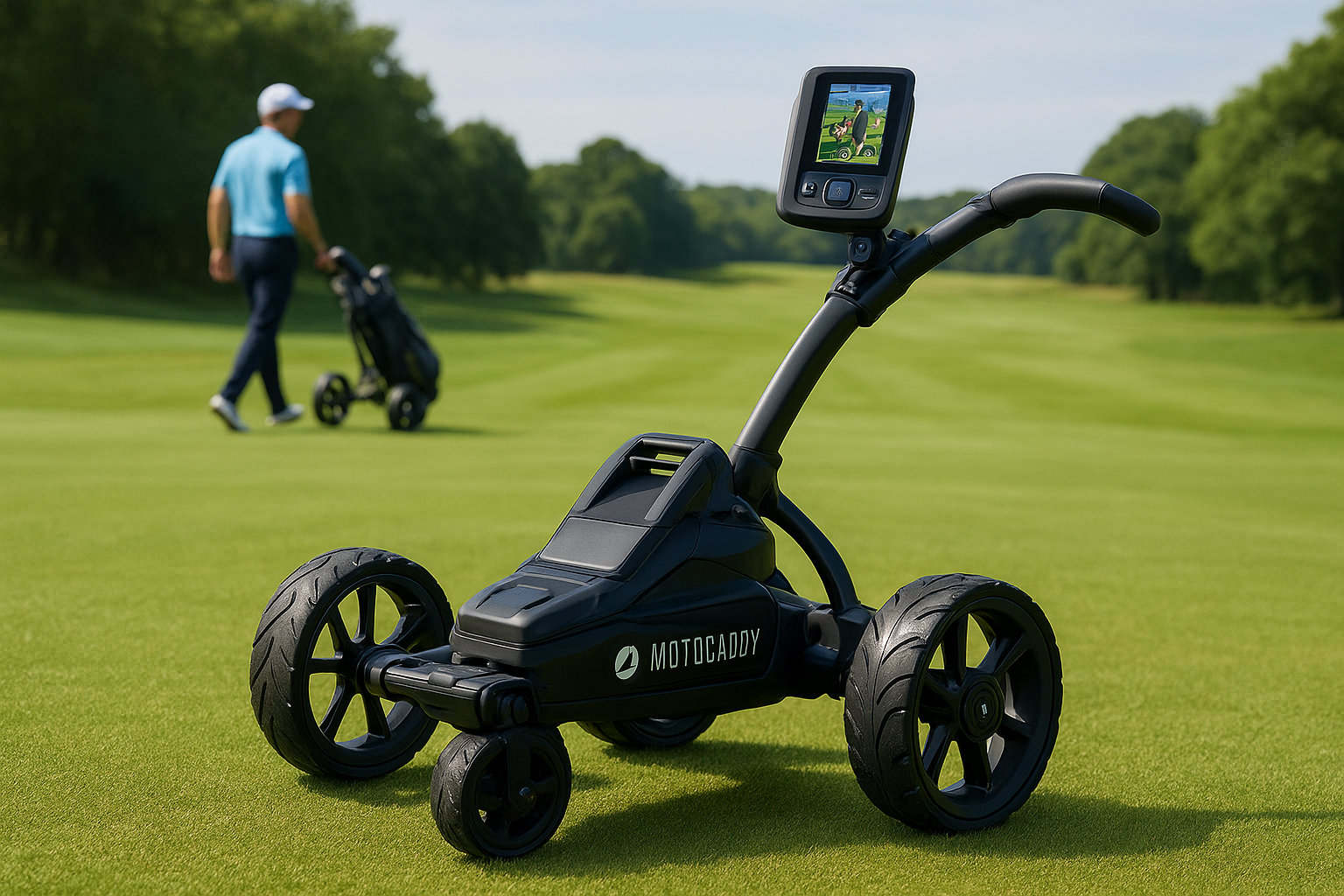
Motocaddy sits at the top of most golfers' shortlists when they start looking at remote control electric golf trolleys, and the M7 GPS Remote is the flagship reason why. It's the brand's premium four-wheel model, built for golfers who want a smooth ride on rough terrain and don't mind paying extra for it. The four-wheel chassis gives it real stability on side slopes, which is where cheaper three-wheelers tend to wobble or drift.
Key features
The standout feature is the built-in colour GPS screen, which shows hole layouts, distances to the green, and hazard positions without needing a separate rangefinder or phone app. It also folds down in under three seconds using Motocaddy's one-touch folding system, and the frame is finished in a scratch-resistant powder coat that holds up well after a few seasons of being thrown in a boot. USB charging ports on the console let you top up your phone mid-round, a small touch that regular users genuinely appreciate.
Remote control range and handling
The remote itself is where this trolley earns its reputation. It operates from up to 60 metres away, giving you plenty of room to walk ahead and read a green while the trolley catches up on its own. Steering is precise rather than jerky, with left, right, forward and stop commands responding almost instantly. On slopes, the auto-stabiliser system detects gradient changes and adjusts speed automatically, so it won't career off downhill if you look away for a second.
The M7 GPS Remote proves that a remote control golf trolley can genuinely replace a caddie, not just carry your bag.
Battery life
Motocaddy pairs the M7 with either an 18-hole lithium battery or an extended-round lithium option, and both comfortably outlast a full round even on hilly layouts. In real-world testing, the standard battery handles 18 holes with charge to spare, while the extended version is built for golfers who regularly play 27 or 36 holes across a weekend. Charging from empty takes around five hours, and the battery itself is rated for hundreds of charge cycles before performance drops off.
Best for
This model suits serious golfers who play regularly on undulating courses and want technology that takes real work off their hands. If you play twice a week or more and hate constantly checking a separate GPS device, the integrated screen alone justifies the upgrade. It's less suited to occasional players who mainly want something lightweight for the odd Sunday round.
Price
Expect to pay somewhere in the region of £1,000 to £1,200 for the M7 GPS Remote, depending on the battery option and any seasonal offers. It's firmly a premium purchase, but the GPS integration and build quality mean it holds its value well if you ever decide to sell it on secondhand.
2. Motocaddy M7 Remote
Drop the GPS screen from the M7 and you get the M7 Remote, a trolley that keeps the same premium four-wheel chassis and auto-stabilising remote control but at a friendlier price point. It's built for golfers who want the flagship handling without paying for satellite mapping they might already get from a watch or phone app. Motocaddy clearly designed this as the practical sibling rather than a cut-down budget option.
Key features
You still get the one-touch folding frame, USB charging port, and the scratch-resistant powder coating that makes the full-size M7 so durable. The console is simpler without the colour display, showing just battery level and speed settings, which some golfers actually prefer for fewer distractions. The four-wheel design remains unchanged, so stability on uneven ground and steep cambers stays identical to its GPS sibling.
Remote control range and handling
The remote control range matches the M7 GPS at up to 60 metres, and the handling feels just as responsive. Steering commands are instant, and the same automatic stabiliser adjusts speed on descents so the trolley won't run away from you on a downhill fairway.
If you already use a golf GPS watch, the M7 Remote gives you flagship handling without paying for a screen you won't use.
Battery life
Battery options mirror the GPS model, with standard and extended lithium packs available. The standard battery covers 18 holes reliably, while golfers doing back-to-back rounds should opt for the extended version for genuine peace of mind.
Best for
This suits golfers who already own a rangefinder or GPS watch and simply want the best remote control golf trolley for terrain handling. It's also a sensible choice if you find touchscreens fiddly with gloves on.
Price
Expect to pay around £800 to £950, roughly £200 less than the GPS version, making it strong value for the same chassis and remote performance.
3. Motocaddy ME Remote
Sitting below the M7 range, the Motocaddy ME Remote is the brand's entry-level three-wheel model, aimed at golfers who want remote control convenience without stretching to flagship prices. It's noticeably lighter than the four-wheel M-series, which makes it easier to lift into a boot but slightly less planted on steep side slopes. For most club golfers on reasonably flat courses, that trade-off is barely noticeable.
Key features
Three wheels keep the overall footprint compact, and the frame folds down quickly without needing tools or extra clips. Unlike the M7 range, there's no USB charging port or GPS screen here, just a straightforward console showing battery level and speed. Motocaddy's build quality still shines through in the materials, so it doesn't feel like a budget product despite the lower price tag.
Remote control range and handling
The remote control golf trolley functionality covers up to 50 metres, slightly less than the M7 models but still enough to walk ahead to the green and check your line. Steering is straightforward, with forward, stop and directional controls that respond quickly, though without the automatic slope stabilisation found on the pricier M7 range.
The ME Remote proves you don't need four wheels or GPS to get genuine remote control convenience on the course.
Battery life
A single lithium battery option comes as standard, comfortably managing 18 holes on typical UK courses. Golfers playing hillier layouts should expect slightly reduced range compared with flatter parkland courses.
Best for
This model suits occasional to regular players who want remote convenience on a budget, particularly those on flatter courses who don't need heavy-duty stabilisation. It's also a sensible choice for golfers upgrading from a manual trolley for the first time.
Price
Expect to pay roughly £550 to £650, making the ME Remote one of the more accessible entry points into remote controlled electric golf trolleys without sacrificing Motocaddy's reliability.
4. Stewart Golf V10 Remote
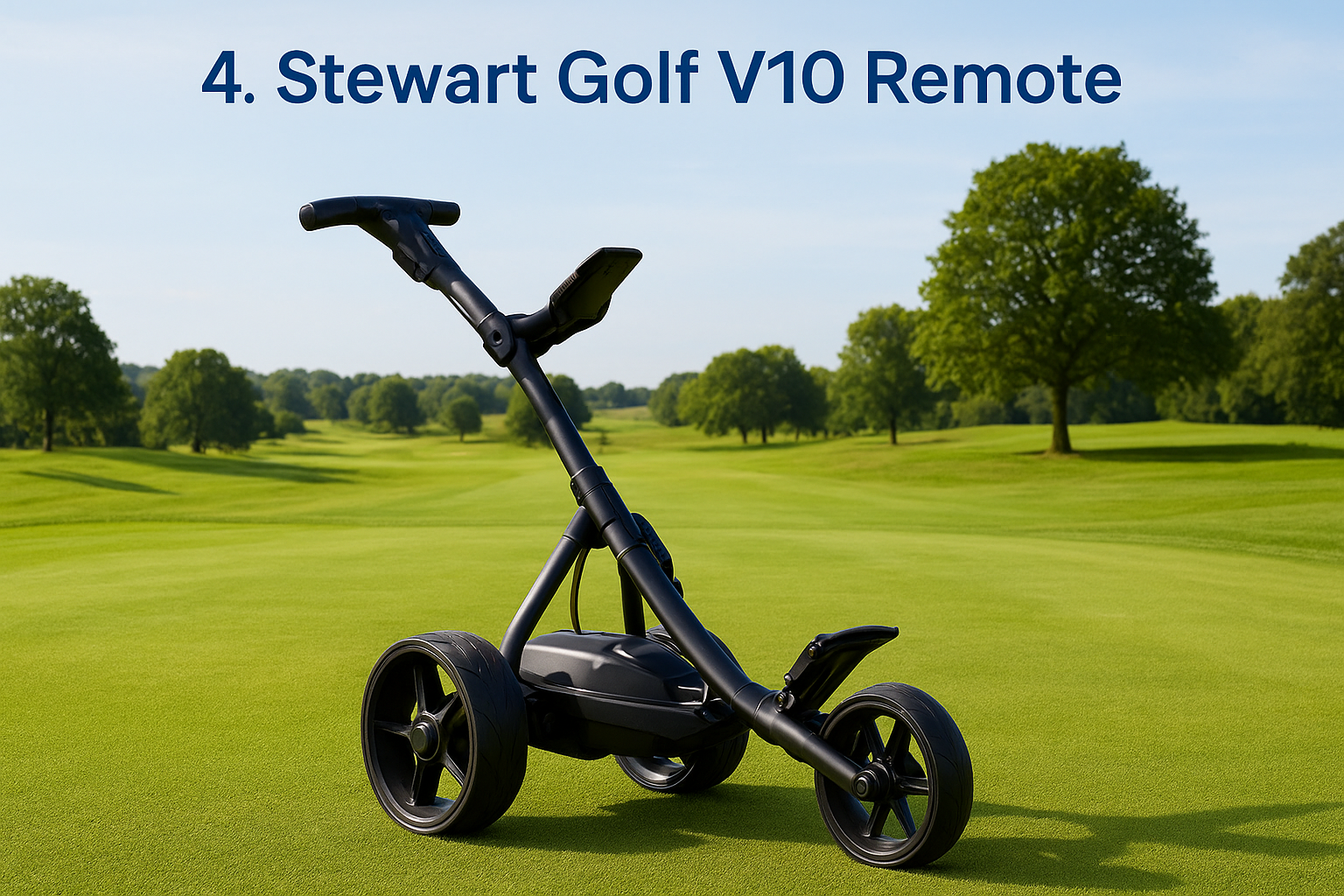
Stewart Golf built its reputation on precision engineering, and the V10 Remote is the clearest example of that in the remote control electric golf trolley market. It's a compact three-wheel trolley designed for golfers who want minimal footprint without sacrificing serious handling on the course. Where Motocaddy leans on bulk and stability, Stewart Golf leans on smart engineering to keep the frame small while still delivering strong performance.
Key features
Everything about the V10 folds down into a genuinely tiny package, smaller than almost any other trolley on this list, which matters if you drive a small hatchback or store your kit in a cramped garage. The precision-engineered chassis uses aircraft-grade aluminium, keeping weight low without making the frame feel flimsy. A detachable battery compartment and accessory mounts for umbrellas, scorecards, and drinks holders round out the practical touches.
Remote control range and handling
The remote works up to 50 metres away and gives noticeably fine-grained control over speed, useful when you're navigating narrow paths between bunkers. Turning circles are tighter than on four-wheel rivals, so tight dogleg fairways and crowded tee boxes are easier to manage.
Stewart Golf's V10 proves that compact engineering can outperform bulk when it comes to precise remote handling.
Battery life
Standard lithium batteries handle 18 holes without issue, and Stewart Golf's efficient motor design means the battery tends to outlast trolleys with similar capacity elsewhere. Charging takes around four to five hours from empty.
Best for
This model suits golfers with limited storage space or smaller cars who still want dependable remote handling. It also appeals to those who value premium engineering over flashy screens.
Price
Expect to pay around £1,300 to £1,500, placing it firmly at the premium end, reflecting Stewart Golf's reputation for build quality and precision manufacturing.
5. Stewart Golf Q Follow
Where the previous entries rely purely on remote control, the Stewart Golf Q Follow blends that with true auto-follow technology, tracking a wristband so the trolley trails a few paces behind you automatically. Golfers who want less to think about mid-round particularly like this hybrid approach, since you're not constantly pressing buttons to keep pace on the fairway. It still includes a manual remote control golf trolley function for tight spots where auto-follow isn't practical, giving you the best of both systems.
Key features
Infrared sensors and a wristband transmitter let the Q Follow track your movement without line-of-sight issues that plague some rival follow trolleys. Obstacle detection stops the trolley automatically if something crosses its path, and the frame folds compactly using Stewart Golf's usual precision hinges. A backlit console displays battery status and mode selection clearly, even in bright sunlight.
Remote control range and handling
Switch to manual mode and the remote reaches 45 metres, plenty for walking ahead to check a pin position. Handling feels tight and responsive, with the trolley correcting its own path smoothly rather than lurching between commands.
The Q Follow shows that remote controlled electric golf trolleys don't always need a handset in your palm to work brilliantly.
Battery life
A standard lithium battery covers 18 holes comfortably, though auto-follow mode draws slightly more power than pure remote use due to constant sensor activity. Recharging takes around five hours.
Best for
This suits golfers who dislike fiddling with buttons and want a more hands-free experience on the course, particularly those playing solo rounds where nobody's around to operate a remote for you.
Price
Expect to pay roughly £1,400 to £1,600, reflecting the added follow technology alongside Stewart Golf's usual premium engineering standards.
6. MGI Zip Navigator AT
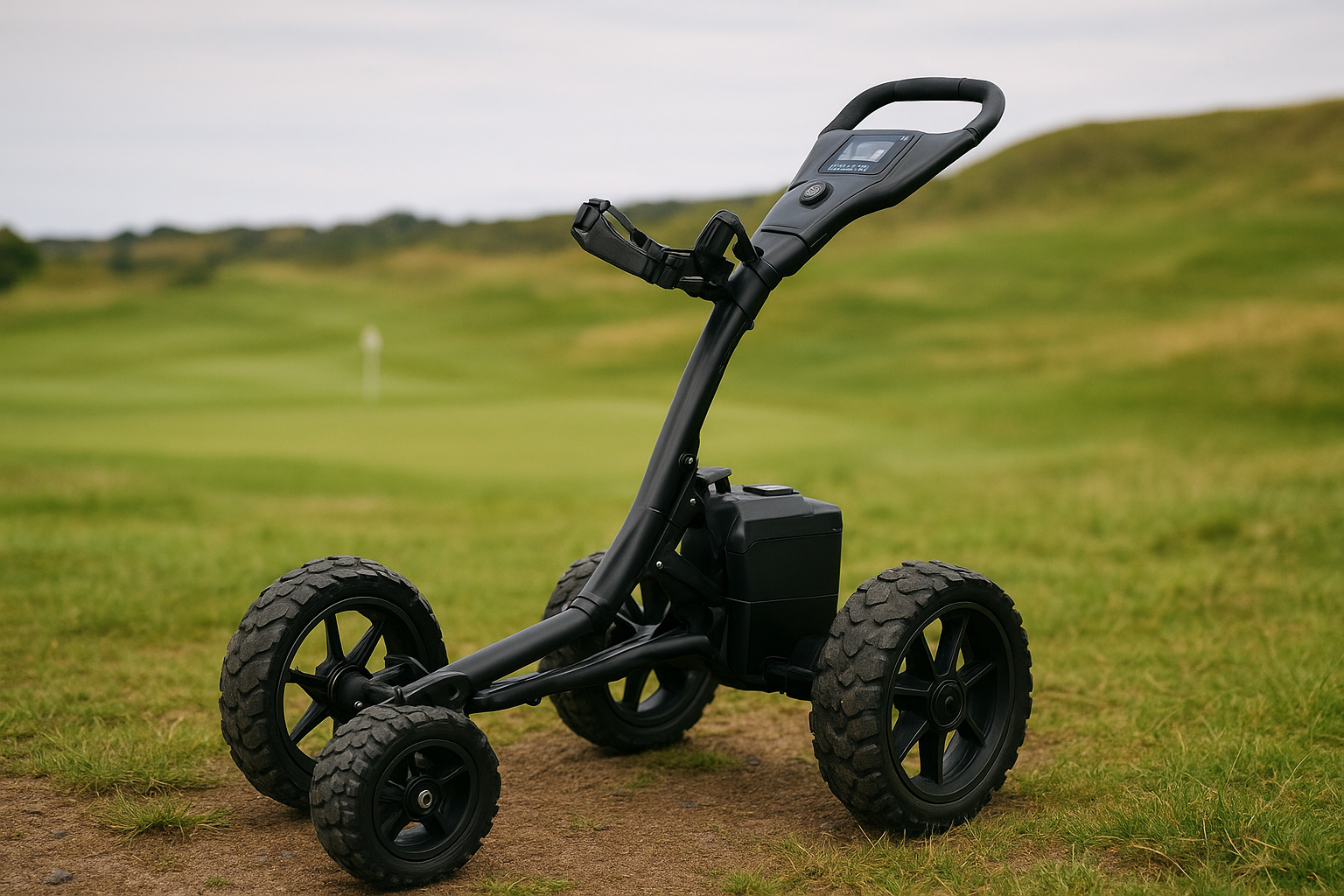
MGI built its name on all-terrain trolleys, and the Zip Navigator AT is the brand's answer to golfers who play on rougher, hillier courses where standard wheels struggle. Australian engineering underpins this model, and it shows in the chunky tyre design and reinforced frame that handles rough ground far better than most rivals on this list. Golfers who've battled soft fairways or gravel paths with a standard trolley will notice the difference immediately.
Key features
Oversized all-terrain wheels grip loose surfaces and soft ground without sinking, a genuine advantage on links courses or after heavy rain. The frame folds into a compact shape despite the larger wheels, and a detachable battery keeps the overall weight manageable when lifting it into a car boot. Accessory mounts for scorecards, umbrellas, and drink holders come as standard, and the console includes a simple digital display showing battery percentage clearly.
Remote control range and handling
The remote control trolley function covers up to 50 metres, giving enough room to walk ahead and read the green while the trolley follows behind. Handling stays smooth even on bumpy terrain thanks to the wider wheelbase, though tight turns require slightly more space than compact three-wheelers like the Stewart Golf V10.
The Zip Navigator AT proves that remote control golf trolleys can handle rough terrain just as confidently as manicured fairways.
Battery life
A standard lithium battery manages 18 holes without trouble, even on hilly or uneven courses where motors work harder. Charging from empty takes around five hours, and MGI's battery management system helps protect against overcharging damage.
Price
Expect to pay somewhere between £900 and £1,050, positioning it as a strong mid-range option for golfers who prioritise terrain handling over flashy extras. Anyone playing coastal or hilly courses regularly will likely find this justifies the cost quickly through reduced wear elsewhere.
Best for
This model particularly suits golfers on links or hilly courses where standard wheels bog down, or anyone whose local club has notoriously soft ground after rain.
7. Alphard Golf Cybercart
The Alphard Golf Cybercart brings a different design philosophy to remote control electric golf trolleys, built around a low-slung frame and a reputation for near-silent running. South Korean engineering drives this brand, and golfers who've tried one often mention how little noise it makes compared with rivals, useful if you play with partners who notice every whirr and click. It's a three-wheel design, but the wide track and low centre of gravity give it steadiness that some three-wheelers lack.
Key features
The quiet brushless motor is the headline feature, running smoother and quieter than most competitors at similar price points. A sturdy aluminium frame folds down compactly, and the battery sits low in the chassis rather than mounted on top, which helps keep the trolley planted on cambered fairways. Simple accessory mounts cover umbrellas and scorecards, though the console itself stays fairly basic compared with Motocaddy's offerings.
Remote control range and handling
The remote control golf trolley function covers roughly 45 metres, giving enough room to walk ahead and check distances. Steering feels precise at low speeds, though some users report it takes a session or two to get used to the sensitivity compared with chunkier competitor remotes.
The Cybercart shows that a quiet motor and low centre of gravity can matter just as much as raw power on the course.
Battery life
A standard lithium battery handles 18 holes without difficulty, and the low mounting position seems to help efficiency slightly compared with top-mounted alternatives. Charging takes around five hours from empty.
Best for
This model suits golfers who value quiet operation above all else, particularly those playing early morning rounds or courses where noise etiquette matters. It also appeals to anyone wanting a lower-profile trolley that doesn't tower over the bag.
Price
Expect to pay around £850 to £1,000, positioning it competitively against similarly specified three-wheel remote trolleys from bigger-name brands.
8. PowaKaddy RX Remote
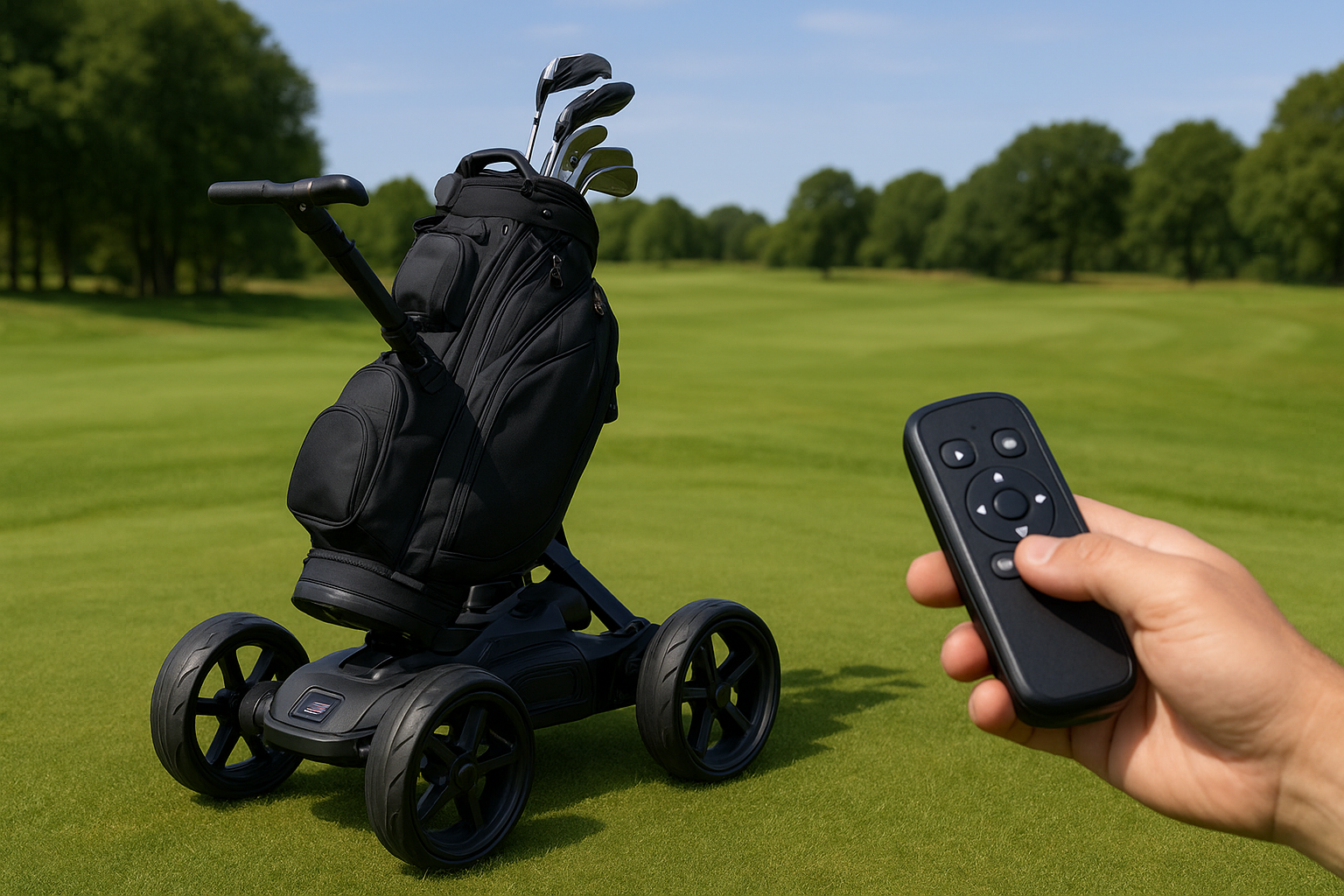
PowaKaddy has been building golf trolleys for decades, and the RX Remote is its flagship four-wheel model aimed squarely at golfers who want dependable performance without chasing gimmicks. It sits alongside Motocaddy's M7 range as one of the more established names in remote golf trolleys, and plenty of club members choose it simply because they've trusted the brand for years. The four-wheel chassis gives it a planted feel on undulating fairways, similar to the M7 but with PowaKaddy's own take on suspension and handling.
Key features
A lie-flat folding design is the headline here, letting the trolley collapse into a slim profile that fits easily into smaller car boots. The frame uses a rust-resistant finish, and the console includes a simple digital display showing battery level, speed setting, and distance travelled during the round. Accessory attachments for umbrellas, scorecards, and drinks holders come as standard, matching what you'd expect at this price point.
Remote control range and handling
This golf trolley with remote control operates up to 50 metres away, giving enough distance to walk ahead and check pin positions without losing connection. Steering commands feel smooth rather than twitchy, and the four-wheel base helps it track straight on gentle slopes without constant correction.
PowaKaddy's RX Remote earns its place through consistency rather than flashy extras, which is exactly what many golfers actually want.
Battery life
A standard lithium battery covers 18 holes reliably, with an extended option available for golfers regularly playing longer sessions. Charging takes around five hours from empty.
Best for
This suits golfers who want a trusted, no-nonsense trolley without needing GPS screens or follow technology, particularly those who've owned PowaKaddy products before.
Price
Expect to pay roughly £850 to £1,050, depending on battery choice, making it competitive against similarly specified four-wheel rivals.
9. NAVEE Birdie 3 Remote
NAVEE is a newer name in the remote control electric golf trolley market, but the Birdie 3 Remote has quickly built a following among golfers who want modern tech at a lower price than the established brands. It's a three-wheel design built around a sleek, minimalist frame, and it targets younger or tech-focused golfers who'd rather have smartphone-style controls than a chunky handset. Value is the clear selling point here, and NAVEE delivers a surprising amount of kit for the money.
Key features
A companion smartphone app lets you adjust speed, distance, and even track your round's statistics alongside the physical remote, which few rivals offer at this price. The frame folds down quickly using a single-action release, and LED indicator lights on the console make battery status easy to check even in bright sunlight. Build quality feels solid rather than premium, but that's expected given the price bracket.
Remote control range and handling
The electric golf trolley remote control reaches around 45 metres, comfortably enough to walk ahead and read greens. Handling is smooth on flat ground, though the lighter frame means it can feel slightly less planted than heavier four-wheel rivals on steep cross-slopes.
The Birdie 3 Remote proves you don't need a big brand name to get genuinely useful remote control features on a budget.
Battery life
A standard lithium battery covers 18 holes without trouble on typical parkland courses, though hillier rounds will eat into that margin faster than with heavier-duty models. Charging takes roughly four to five hours from empty.
Best for
This model suits budget-conscious golfers who still want app connectivity and remote convenience, particularly newer players building their first proper golf setup.
Price
Expect to pay around £500 to £600, making it one of the cheapest genuinely capable remote control golf trolleys on this list.
10. How to choose the right remote control trolley
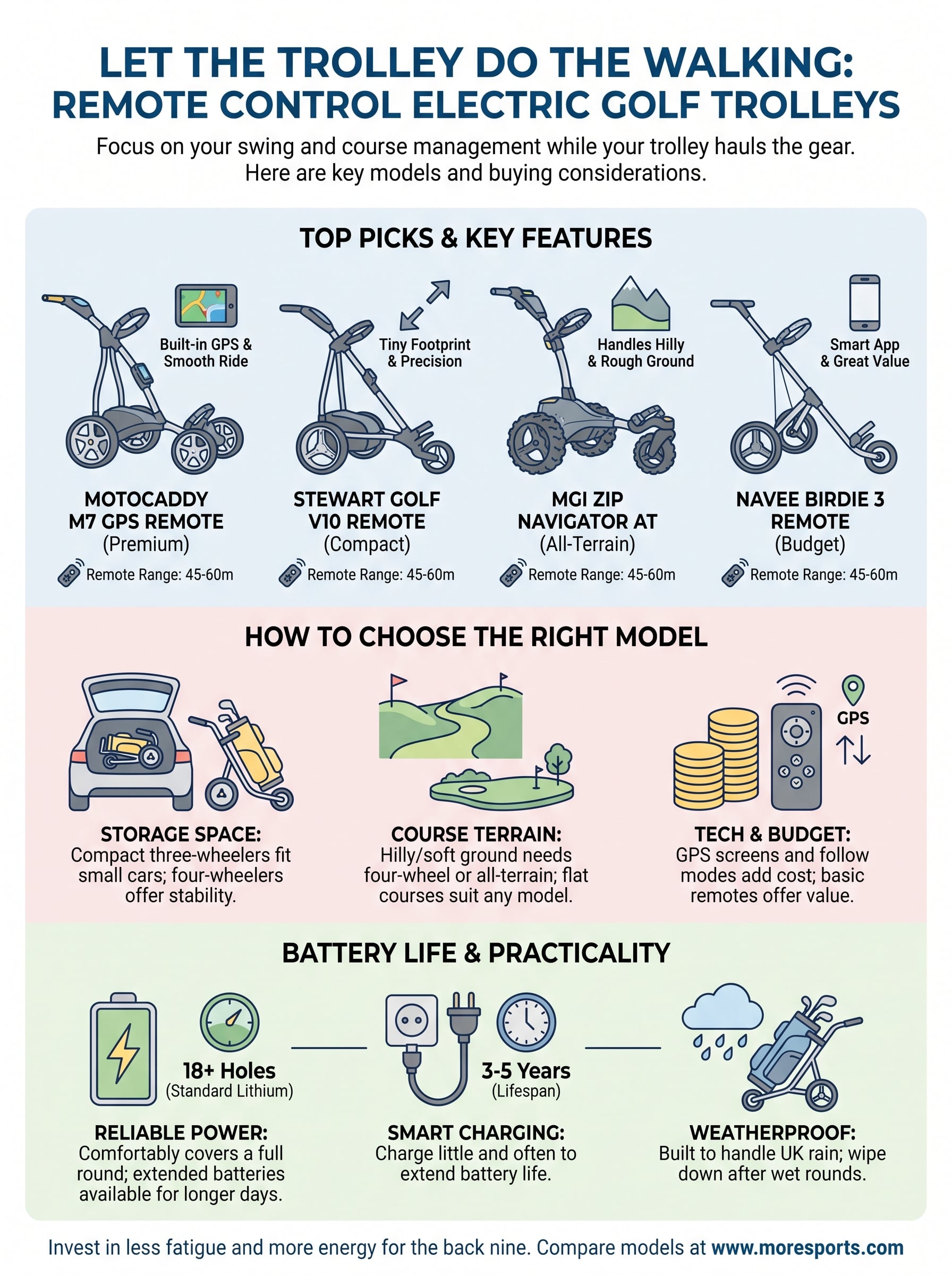
Weight matters more than most golfers expect before buying their first remote control electric golf trolley. A three-wheel model like the Stewart Golf V10 or NAVEE Birdie 3 folds smaller and lifts easier into a boot, but a four-wheeler like the Motocaddy M7 or PowaKaddy RX gives you steadier footing on slopes and cambered fairways. If you play mostly flat parkland courses, the lighter option saves your back without costing you much stability.
Gradient and terrain on your home course should shape your decision just as much as budget. Golfers on links courses or anywhere with soft, uneven ground benefit from wider, chunkier tyres like those on the MGI Zip Navigator AT, while manicured inland courses suit almost any model on this list. Range matters too: check whether the remote control range on offer, typically between 45 and 60 metres, actually covers how far ahead you tend to walk to read a green.
Buy for your home course first, and everything else on the spec sheet becomes secondary.
Battery capacity deserves proper attention if you regularly play more than 18 holes in a day. Standard lithium batteries handle a single round comfortably across every trolley here, but golfers doing back-to-back rounds or 36-hole club competitions should pay the extra for an extended battery rather than risk running flat on the back nine.
Consider these factors together before settling on a model:
- Storage space: smaller cars and tight garages favour compact three-wheel designs
- Course terrain: hilly or soft ground favours four-wheel or all-terrain models
- Extra tech: GPS screens and follow modes add cost but reduce what you carry mentally round the course
- Frequency of play: regular golfers benefit more from premium build quality and extended batteries
Setting a realistic budget rounds out the decision. Prices across this list span roughly £500 to £1,600, and paying more generally buys you better stability, longer battery life, or added tech rather than a fundamentally different experience. MoreSports stocks a wide range of golf trolleys and accessories if you want to compare current pricing and availability before you buy.
11. FAQs about remote control electric golf trolleys
Are remote control electric golf trolleys legal on all courses?
Most UK golf clubs allow remote control golf trolleys on their fairways, but a handful of private members' clubs restrict them during competitions or on certain protected areas near greens and tees. Check your club's local rules before your first round with a new trolley, especially if you're playing away from your home course. Championship venues sometimes ban powered trolleys entirely during tournament play, so it's worth a quick call if you're travelling somewhere unfamiliar.
How long do remote control golf trolley batteries actually last?
Batteries degrade gradually rather than failing suddenly, and most lithium packs across the models above hold usable charge for three to five years of regular play before you'll notice a real drop in range. Charging little and often, rather than letting the battery run completely flat every time, extends that lifespan considerably. Replacement batteries typically cost between £150 and £250 depending on brand and capacity.
Can you use a remote control trolley in the rain?
Yes, every trolley on this list is built to handle typical British weather, with sealed electronics and water-resistant consoles designed for wet fairways. Heavy downpours are fine, though submerging the battery compartment or leaving a trolley soaking in standing water overnight isn't advisable. Wipe down the frame and wheels after wet rounds to stop dirt building up in the folding mechanism.
Is a remote controlled electric golf trolley worth the extra cost over a manual one?
Genuinely, yes, if you play regularly or struggle with hills. The upfront cost feels steep next to a £100 manual trolley, but golfers who play twice weekly recover that investment quickly in reduced fatigue and faster rounds.
A remote control electric golf trolley pays for itself in energy saved long before it pays for itself in pounds.
Do remote trolleys work well for golfers with disabilities?
Definitely. Many golfers with mobility limitations or joint problems rely on remote electric golf trolleys specifically because they remove the physical strain of pushing or pulling a trolley uphill, letting them focus entirely on their game.
Making the right choice for your round
Nine trolleys, nine different priorities, but the choice really comes down to your course and how often you play. Golfers chasing GPS integration and premium handling should look at the Motocaddy M7 GPS Remote, while those wanting similar performance without the screen can save real money with the standard M7. Budget-conscious players and anyone building their first proper setup will find the NAVEE Birdie 3 or Motocaddy ME Remote hard to beat for value, and golfers battling links or hilly terrain should head straight for the MGI Zip Navigator AT.
Whatever fits your game, buying a remote control electric golf trolley means fewer sore backs and more energy left for your actual swing come the back nine. Match the model to your course conditions and storage space rather than chasing the flashiest spec sheet, and you'll get years of reliable use out of it.
Ready to compare current stock and pricing? Browse the full trolley range at MoreSports and find the right fit for your next round.