 No Duties or Customs Fees For EU & UK Customers
 Express Tracked UK Delivery On 1000s of Items
 90 Day Returns

Tennis Racket Grip Size Guide: Measure Your Hand In Minutes
RYPicking up a tennis racket with the wrong grip size is a bit like wearing shoes that don't fit, you can still move, but everything feels off. A grip that's too small forces your hand to work overtime, increasing the risk of tennis elbow. Too large, and you lose the wrist snap and control needed for accurate shots. That's why using a proper tennis racket grip size guide before you buy matters more than most players realise.
The good news? Measuring your hand takes minutes, and the process is straightforward. All you need is a ruler and your dominant hand. Once you have your measurement, matching it to the right size, whether that's the European L1–L5 system or US inches, becomes simple.
In this guide, we'll walk you through exactly how to measure your grip size at home using two reliable methods, explain what each size number actually means, and help you choose with confidence. At MoreSports, we stock tennis rackets from leading brands across a range of grip sizes, so once you know your measurement, you can find the right fit and get it delivered with free UK shipping on orders over £25.
Grip size basics and L1 to L5 explained
Grip size refers to the circumference of a racket's handle, measured in either inches or a numbered scale depending on where the racket was made. Most rackets sold in Europe and the UK use the L-number system (L1 through L5), while many American brands print the actual inch measurement directly on the handle. Both describe the same thing, so once you know how to read them, switching between the two is straightforward.
The L1 to L5 sizing system explained
The L scale runs from L1 (the smallest) to L5 (the largest), covering the full range needed to fit most adult hands. Each full size step is roughly 1/8 inch (about 3mm) in circumference, which sounds minor but creates a noticeable difference once the racket is in your hand. The table below maps each L size to its inch and millimetre equivalent, so you can compare measurements across brands without any guesswork.
| L Size | Circumference (inches) | Circumference (mm) | Typical fit |
|---|---|---|---|
| L1 | 4 1/8" | 105mm | Small adult hands |
| L2 | 4 1/4" | 108mm | Small to medium hands |
| L3 | 4 3/8" | 111mm | Medium hands (most common) |
| L4 | 4 1/2" | 114mm | Medium to large hands |
| L5 | 4 5/8" | 118mm | Large adult hands |
Most adult players fall between L2 and L4, with L3 being the most widely stocked size across brands. Children and juniors typically need something below L1, which most manufacturers label separately as junior or youth sizing.
If you are stuck between two sizes, go with the smaller one. You can always build up a grip using an overgrip, but you cannot shrink a handle that is already too large.
How grip size affects your game
Control and comfort are the two things most directly affected by getting grip size right or wrong. A grip that is too large limits your wrist movement, making it harder to generate topspin or redirect the ball quickly during rallies. A grip that is too small forces your fingers to squeeze the handle tighter to keep it stable, and that extra tension builds strain in your forearm muscles and tendons over time, often leading to discomfort or injury with regular play.
Your playing style and dominant hand both influence which end of the scale suits you best. Players who rely on heavy topspin and frequent wrist action often prefer a slightly smaller grip to give themselves more freedom of movement. Flat hitters and serve-and-volley players tend to perform better with a neutral to slightly larger size because added handle stability suits their game. Using a reliable tennis racket grip size guide like this one helps you connect those preferences to a measurement before you buy, rather than guessing at the point of purchase.
Step 1. Check your current racket grip
If you already own a racket, the quickest starting point is to check whether the current size suits you. Before reaching for a ruler, hold your racket in your dominant hand using your normal forehand grip. Pay attention to how the handle feels, specifically how much space sits between your fingertips and the base of your palm. That gap tells you a great deal before you take a single measurement.
Where to find the grip size on your racket
Most modern rackets print the grip size directly on the handle or on a sticker attached near the butt cap at the base. You'll typically see either a number like L2 or L3, or a measurement in inches such as 4 1/4" or 4 3/8". Some manufacturers also print the size on the throat of the frame or on the original packaging, so check those too if the handle marking has worn off or faded.
Write down the size you find, even if you plan to change it. Knowing your current size gives you a useful reference point when comparing new rackets.
What to do if there's no marking
Older or heavily used rackets sometimes have no visible grip marking at all, particularly if the original grip tape has been replaced several times. In that case, measure the handle directly using a soft tape measure or a piece of string. Wrap the string around the widest section of the handle, mark where it overlaps, then lay it flat against a ruler. Compare the result to the L-size table in the previous section to identify your current size.
Once you have this information written down, use it as your baseline. This tennis racket grip size guide works best when you combine this check with the hand measurement method in the next step, so you can confirm the size from two angles before committing to a purchase.
Step 2. Measure your hand with a ruler
This is the most reliable method for finding your correct grip size, and it works whether you are buying your first racket or replacing one you have used for years. You need a standard ruler (or a flexible tape measure), your dominant hand, and good lighting so you can read the measurement clearly.
How to position your hand and take the measurement
Open your dominant hand flat, with your fingers held together and your thumb pointing outward to the side. The key measurement runs from the tip of your ring finger down to the bottom horizontal crease on your palm, which is the crease closest to your wrist. This line, taken along the edge of your ring finger, is the standard reference point used across the tennis industry.
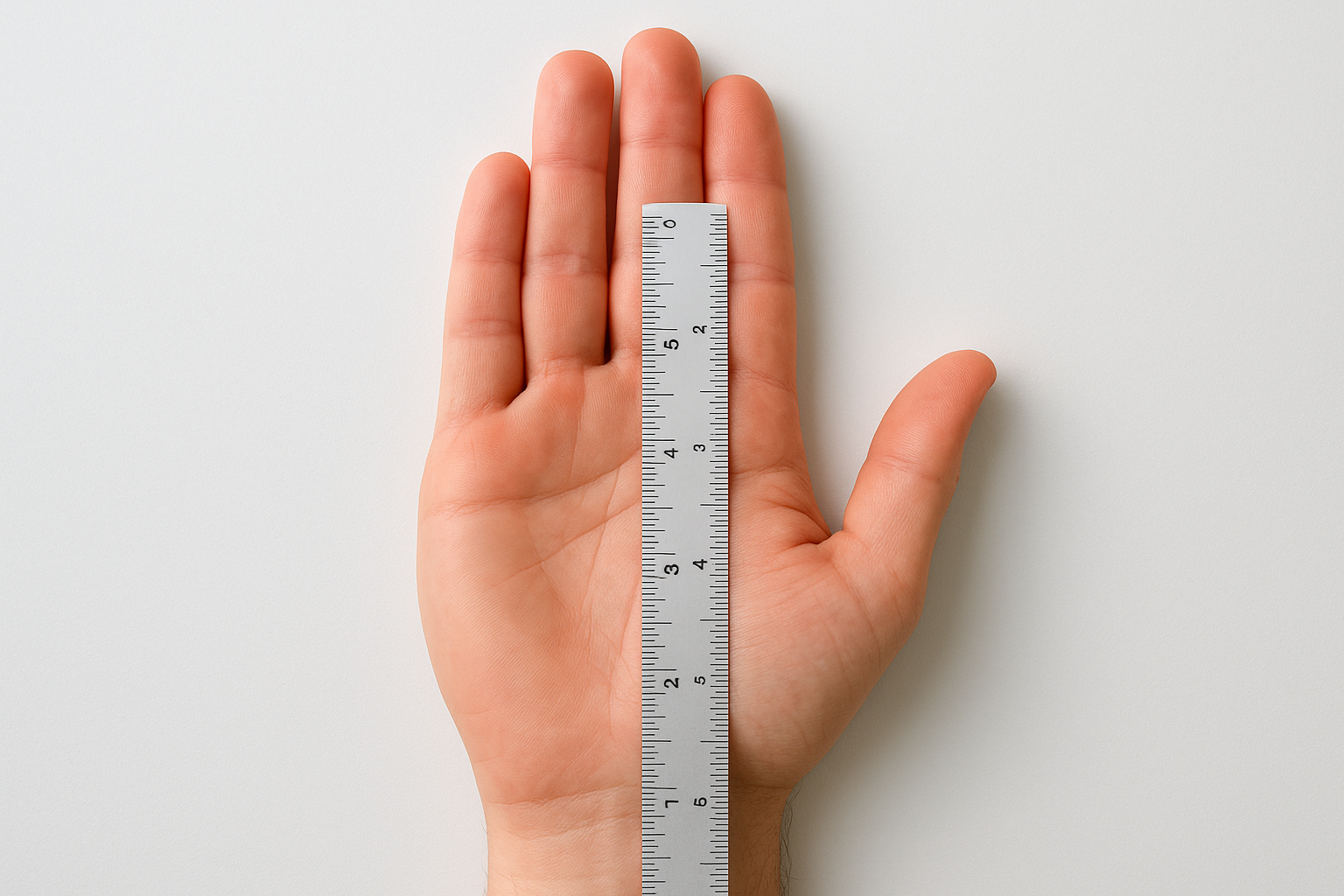
Follow these steps to get an accurate reading:
- Hold your hand flat and open, palm facing upward.
- Place the zero end of your ruler at the tip of your ring finger.
- Extend the ruler straight down the finger and across the palm.
- Read the measurement at the bottom crease of your palm, where the hand meets the wrist.
- Record the result in inches to match grip size charts directly.
Take the measurement at least twice to confirm consistency, as a small shift in ruler position can affect the result by a fraction of an inch.
Match your measurement to a grip size
Once you have your number, use this tennis racket grip size guide reference below to find the corresponding L size:
| Measurement (inches) | Grip size |
|---|---|
| 4 1/8" | L1 |
| 4 1/4" | L2 |
| 4 3/8" | L3 |
| 4 1/2" | L4 |
| 4 5/8" | L5 |
If your measurement falls between two sizes, always round down to the smaller grip. Building up a handle with an overgrip is easy, but there is no practical way to reduce a handle that is already too thick.
Step 3. Confirm with the index finger test
The ruler method gives you a starting number, but the index finger test lets you verify that measurement feels right in practice. This quick physical check takes only a few seconds and works with any racket you can hold in your hand, making it a useful final confirmation before you commit to a size.
How to perform the test
Hold the racket in your dominant hand using your standard forehand grip. Once your fingers are wrapped around the handle, slide the index finger of your non-dominant hand into the gap between your fingertips and the base of your thumb. You are checking how much space that finger occupies in the gap.
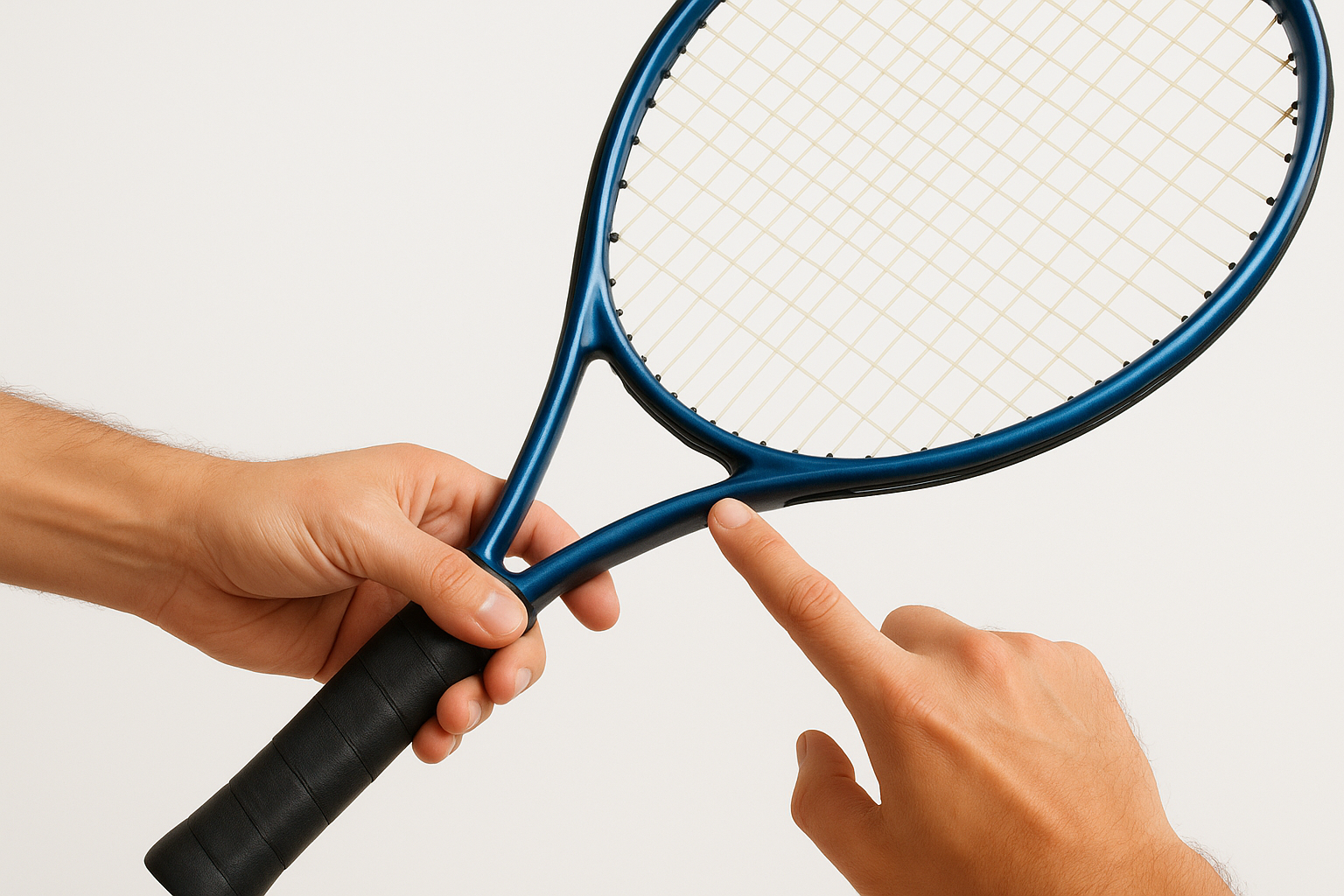
The result tells you a great deal:
- Index finger fits snugly with slight contact on both sides: the grip size is correct.
- Index finger slides in with noticeable room to spare: the grip is too large for your hand.
- Index finger cannot fit without forcing: the grip is too small, and you should try the next size down.
This test works best alongside a ruler measurement, not as a standalone check. Use both methods together for the most reliable result from this tennis racket grip size guide.
What to do when the result is unclear
Sometimes your index finger fits but feels loose, or just barely squeezes in without feeling truly snug. In that case, treat the test as pointing toward the smaller of the two sizes you are deciding between. A slightly loose gap means the handle is already on the large side, and adding an overgrip later will only push it further in the wrong direction.
If your current racket passes the test but your game still feels uncomfortable, the issue likely lies elsewhere, such as string tension, racket weight, or technique. Grip size alone does not solve every problem, but getting it right removes one variable that can quietly affect your comfort and shot consistency over time.
Step 4. Fine-tune fit with grips and overgrips
Even with a precise ruler measurement and a confirmed index finger test, your grip size may still need minor adjustments once you start playing regularly. Fortunately, grips and overgrips give you a practical way to dial in the fit without buying a new racket. Most players use this step to bridge the gap between sizes, and it works well whether you landed on a size that is slightly small or need to add some texture for better feel.
Adding an overgrip to increase size
An overgrip is a thin, self-adhesive wrap that you apply directly over the existing base grip. One layer adds roughly 1/16 inch (about 1.5mm) to the handle circumference, which is enough to nudge a grip from one size toward the next without going all the way. If your ruler measurement placed you between L2 and L3, fitting an L2 racket and adding a single overgrip gives you a comfortable in-between size that most players find ideal.
Apply the overgrip starting at the base of the handle and work upward in a tight spiral, overlapping each layer by about a third of the tape width. Trim any excess at the top and secure the end with the finishing tape included in the pack. Overgrips are inexpensive and replaceable, so you can swap them out as they wear down without affecting the racket itself.
Replace your overgrip every four to six hours of play, as worn tape loses its texture and affects your handle on the racket during fast exchanges.
Replacing the base grip to reduce size
If a racket feels too thick, removing the existing base grip and replacing it with a thinner one is your best option. Standard base grips run between 1.5mm and 1.8mm thick, so switching to a thinner replacement can recover enough circumference to bring the size back in line with what this tennis racket grip size guide recommends for your hand measurement.
Quick recap and buying checklist
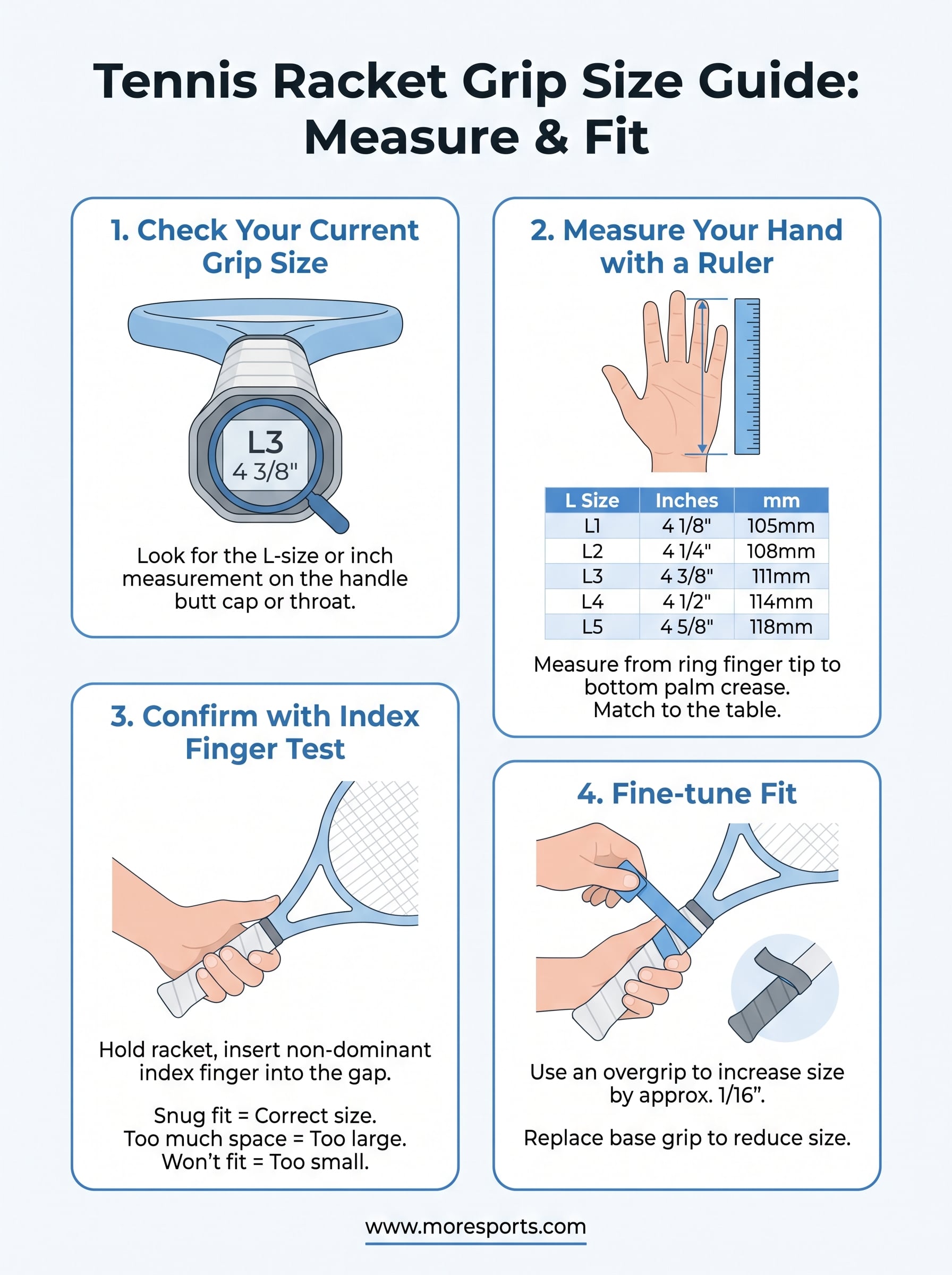
This tennis racket grip size guide covers everything you need to find the right fit before you buy. Start by checking your current racket for a printed size, then measure your hand from the tip of your ring finger to your bottom palm crease using a ruler. Confirm the result with the index finger test, and use overgrips or a replacement base grip to fine-tune the final feel.
Run through this checklist before you purchase:
- Check your current racket for a printed L size or inch measurement
- Measure your hand with a ruler and match it to the L1-L5 table
- Confirm with the index finger test for a physical fit check
- Go smaller if in doubt, then add an overgrip to build up
- Replace your overgrip regularly to maintain consistent feel
Ready to find the right racket? Browse the full range at MoreSports with free UK delivery on orders over £25.