 No Duties or Customs Fees For EU & UK Customers
 Express Tracked UK Delivery On 1000s of Items
 90 Day Returns

What Size Golf Umbrella Do I Need? Size Guide For Golfers
RYIf you've ever been caught in a downpour on the course with an umbrella that barely covers your shoulders, you've probably asked yourself: what size golf umbrella do I need? It's not a one-size-fits-all answer. The right canopy diameter depends on whether you're shielding just yourself, protecting your clubs and bag, or fitting the umbrella to a push cart or trolley.
Golf umbrellas typically range from 52 to 72 inches, and picking the wrong size means either lugging around unnecessary bulk or getting soaked when it counts. A few inches of canopy can make a genuine difference between staying dry and writing off the back nine.
At MoreSports, we stock golf umbrellas from top brands and help golfers across the UK, Ireland, and beyond find the right gear, no guesswork required. This guide breaks down every common golf umbrella size, explains what each one is best suited for, and gives you a straightforward way to choose the right one for how you actually play.
Golf umbrella sizing basics you must know
Golf umbrella sizing comes down to one measurement: canopy diameter. This is the distance straight across the open canopy, measured in inches, and it tells you exactly how much coverage you get when rain hits. Most golf umbrellas sit between 52 and 68 inches, though some larger tour-style models stretch to 72 inches. Understanding what these numbers mean in practice is the first step to answering what size golf umbrella do I need for your specific setup on the course.
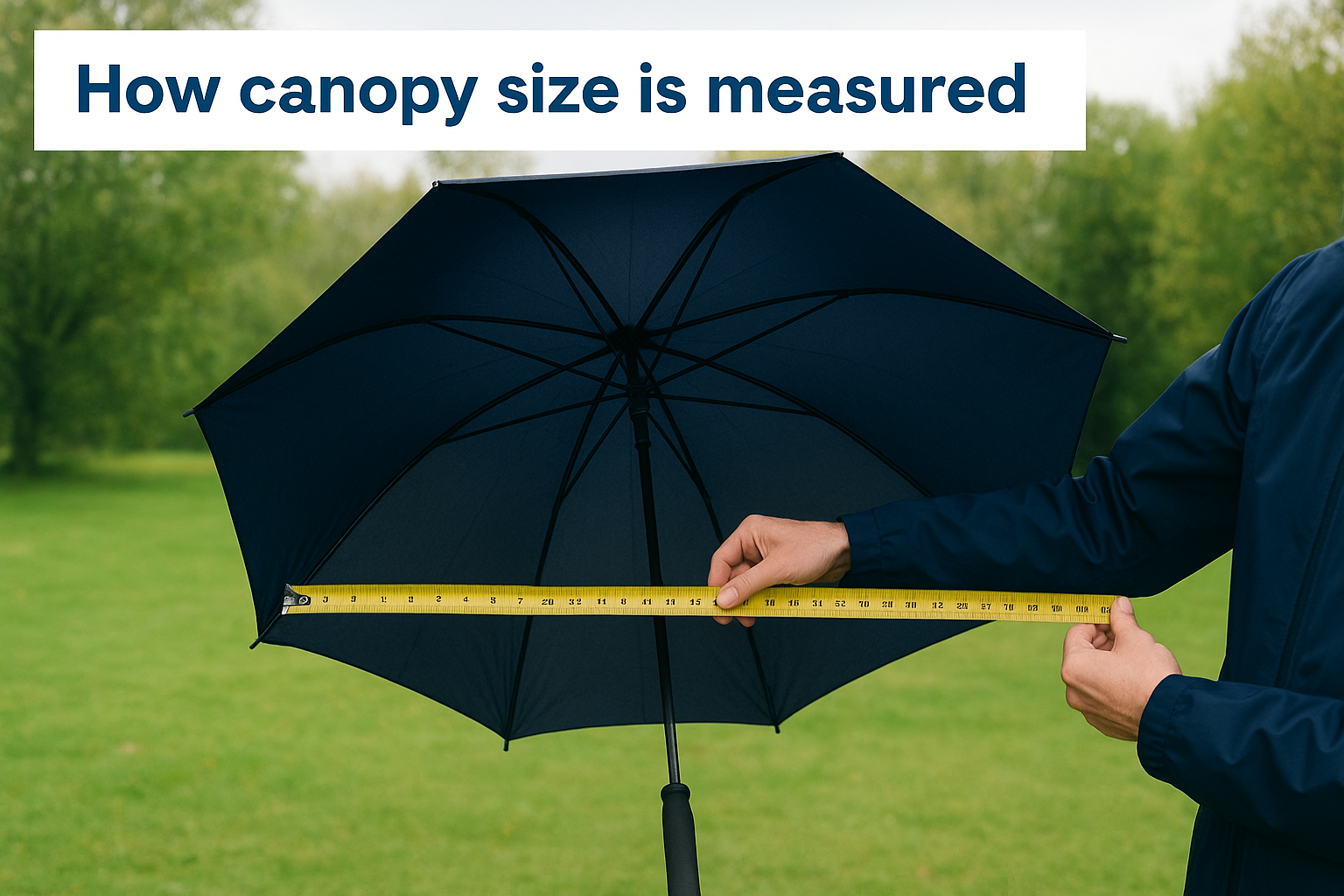
How canopy size is measured
Manufacturers measure the canopy across its full open diameter, from one edge to the other when the umbrella is fully open. So when a label says 62 inches, that is the actual width of coverage you get. The number of ribs (typically 8 or 16) affects how the canopy holds its shape and handles wind, but it does not change the core diameter figure. Always check the listed canopy diameter, not the folded length, since those are completely different measurements and the folded length tells you very little about how much you will actually stay dry.
Here is a quick overview of common size ranges and what they are suited for:
| Canopy Diameter | Coverage Width | Best Suited For |
|---|---|---|
| 52–54 inches | ~4.3–4.5 ft | Compact carry, solo use, light showers |
| 58–60 inches | ~4.8–5 ft | Solo use with comfortable bag coverage |
| 62–64 inches | ~5.1–5.3 ft | Two people or full trolley coverage |
| 68–72 inches | ~5.6–6 ft | Maximum coverage, links courses, heavy rain |
Why golf umbrellas are larger than standard ones
A standard street umbrella usually sits at 38 to 48 inches. Golf umbrellas are deliberately bigger because you are often standing still for extended periods, exposed on open fairways with no shelter nearby. You need a canopy wide enough to cover both you and your bag, and sometimes a playing partner standing nearby. The larger surface area also helps when rain comes in at an angle, which is common on exposed links and parkland courses across the UK.
The trade-off with a larger canopy is wind resistance and overall weight. A big canopy catches more air, which can flip a low-quality umbrella inside out on a gusty day. This is why well-made golf umbrellas use vented double-canopy designs or fibreglass ribs that flex under pressure rather than snapping. If you regularly play coastal or exposed courses, these construction features matter just as much as the size number itself.
What the size numbers actually mean on the course
A 52-inch canopy gives you roughly 4.3 feet of coverage. That is workable for a solo walk on a calm day, but add a stand bag on your back or a headwind and you will feel the limitations quickly. Move up to a 62-inch canopy and you gain nearly a full foot of extra width, which makes a real difference when rain is blowing in from the side and you are trying to keep both yourself and your grips dry.
The right canopy size depends on your height, how you carry your clubs, and the weather conditions you typically play in. Pick based on your actual setup, not simply the biggest number available.
Step 1. Decide what you need to cover
Before you look at any umbrella specs, figure out exactly what you need to keep dry. The answer to what size golf umbrella do I need starts here, because your coverage requirement sets your minimum canopy diameter. Buying too small means getting soaked on the fairway; buying too large means carrying unnecessary bulk for four hours. Work through the three scenarios below to identify your baseline size before you factor in anything else.
Solo use on a walking round
If you walk the course and carry your bag, a canopy between 52 and 60 inches covers most situations well. A 52-inch model is light and easy to handle on the move, but it leaves very little margin if your bag is wide or rain is hitting at an angle. Step up to 58 to 60 inches if you carry a stand bag or a heavier staff bag, which gives you enough coverage to keep both your shoulders and your grips protected at the same time without feeling like you are wrestling with a sail.
Pick the smallest canopy that covers both your head and your bag with a couple of inches to spare on each side, then account for angled rain by adding a size up if you play exposed courses.
Covering a push trolley or cart
A push trolley extends your footprint by two to three feet in front of you, which a compact canopy simply cannot bridge. If you use a trolley, treat 62 inches as your starting minimum. A 64-inch canopy gives you reliable overlap on both your head and your bag even when rain drives in from the side, and it stays manageable enough that you can still steer the trolley without fighting the canopy.
Covering two players
Sharing an umbrella is common in casual rounds and team formats. To cover two adults standing close together, with both bags nearby, you need at least 66 to 68 inches of canopy width. Anything smaller consistently leaves one person catching the edge of the rain. A 72-inch tour model provides the most comfortable shared coverage but adds real weight and wind resistance that you will notice on exposed holes.
Step 2. Pick a size that suits your height and carry style
Your height and the way you carry your clubs both affect how much canopy you actually need above you. A taller golfer holds the umbrella higher off the ground, which reduces the effective horizontal coverage. Understanding this before you commit to a size helps you avoid the frustration of realising on the first rainy round that the canopy misses your shoulders on both sides.
How your height affects canopy reach
When you hold an umbrella at full arm extension, the canopy sits further from your body than when it rests lower. Taller golfers above 6 feet lose more coverage this way and should add at least 4 to 6 inches to whatever minimum diameter they would otherwise choose. A golfer at 5 foot 8 inches can work comfortably with a 60-inch canopy in calm conditions, whereas someone at 6 foot 3 inches will find that same umbrella leaves their arms and bag exposed.
Use the table below as a starting point based on height alone, before factoring in your carry setup:
| Your Height | Recommended Minimum Canopy |
|---|---|
| Under 5'6" | 58 inches |
| 5'6" to 5'11" | 60 to 62 inches |
| 6'0" to 6'3" | 62 to 64 inches |
| Over 6'3" | 66 inches or larger |
These figures assume calm to moderate conditions. Add one size up if you regularly play in heavy or angled rain.
Carry style and its impact on size choice
If you carry a lightweight pencil bag, you have the most flexibility. You can hold the umbrella in one hand and keep your bag on your back with minimal coverage gap, so a 58 to 60-inch canopy handles most situations without adding unnecessary bulk to your walk. The lighter the load on your back, the easier it is to angle the umbrella into the wind and maintain solid coverage while moving.
Golfers using a cart bag or larger staff bag need to account for the extra width those bags add at shoulder height. A staff bag sitting on your back can extend your total width by 6 to 10 inches, which pushes your practical minimum up to 62 to 64 inches if you want the canopy to bridge across both you and the bag. This is the most common scenario where people ask what size golf umbrella do I need and underestimate the answer.
Step 3. Match canopy size to wind and weather
Weather conditions directly affect which canopy size you can control reliably on the course. A large umbrella that works perfectly in still conditions can become difficult to handle in a 20 mph crosswind, and understanding this trade-off is a core part of answering what size golf umbrella do I need for your local course.
Choosing size based on wind exposure
Exposed links courses and coastal layouts in the UK regularly produce gusts that make a 68-inch or larger canopy a genuine challenge to hold steady. On these courses, a 62 to 64-inch vented double-canopy model gives you the best balance between coverage and control. The vented design releases air through the top rather than forcing it under the canopy, which means the umbrella stays right-way-out rather than inverting mid-round. If you regularly play sheltered parkland courses with tree cover, you have more flexibility to go larger without losing control.
On exposed or coastal courses, prioritise a vented design and fibreglass ribs over maximum canopy size. A 62-inch umbrella you can hold steady covers more of you than a 68-inch one you cannot.
Rain intensity and coverage requirements
Light drizzle forgives a smaller canopy because it tends to fall vertically and you can adjust your position with ease. Heavy rain driven by wind behaves differently. It hits at sharp angles and exposes the sides of your body that a straight-down measurement does not account for. In those conditions, add at least 4 to 6 inches to your usual minimum size to maintain effective coverage across your shoulders and bag.
Use the guidance below to match canopy size to the typical conditions you play in:
| Conditions | Recommended Canopy Size |
|---|---|
| Light drizzle, sheltered course | 58 to 60 inches |
| Moderate rain, some wind | 62 to 64 inches |
| Heavy rain, exposed course | 64 to 66 inches |
| Strong wind and driving rain | 62 to 64 inches, vented only |
Avoid going above 66 inches in consistently windy conditions unless the umbrella has fibreglass ribs and a quality vented canopy. The size advantage disappears quickly once you lose control of the canopy in a gust.
Step 4. Make sure it fits your trolley or cart setup
Your trolley or cart setup introduces a physical constraint that most golfers overlook until they are on the first hole in the rain. Many push trolleys and electric trolleys include a built-in umbrella holder, but those holders are designed around a specific shaft diameter and mounting angle. If your umbrella shaft does not fit the clamp, or the canopy sits at the wrong angle to cover both you and your bag, the size you chose in the previous steps becomes irrelevant. Check your trolley's specifications before you buy.
Push trolley umbrella holders and canopy fit
Most push trolley umbrella holders accept shaft diameters between 8mm and 12mm and tilt to roughly 30 to 45 degrees from vertical. That tilt angle determines how far forward the canopy projects over your bag. If you use a 62-inch canopy on a standard push trolley with a front-mounted holder, the canopy should cover your bag adequately when the shaft is angled forward at about 30 degrees. Go below 60 inches and you will likely find the front of the bag catching rain while the back stays dry.
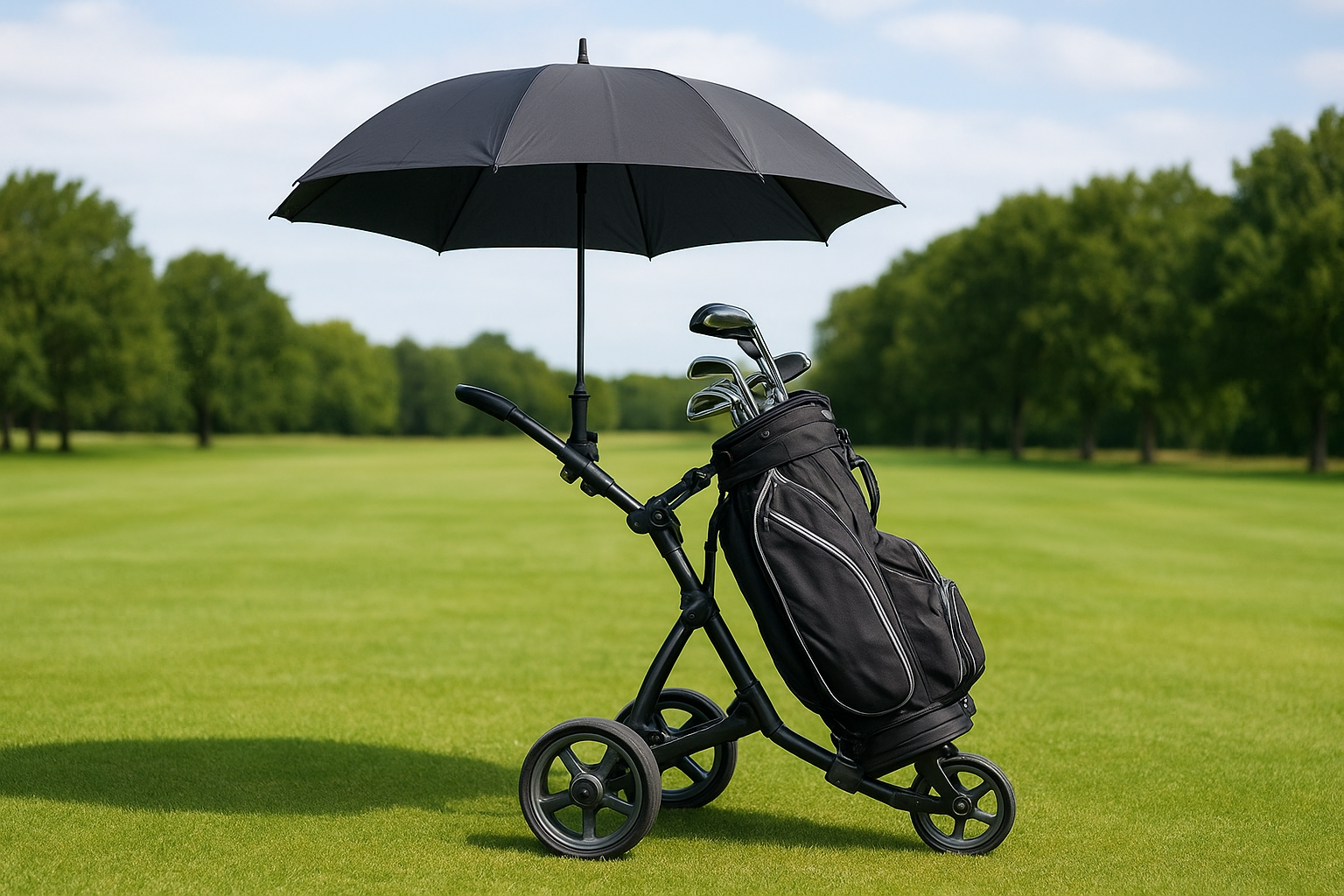
Before buying, measure your current trolley holder's clamp diameter and check that the umbrella shaft you are considering falls within that range.
Use the checklist below to confirm your trolley and umbrella are compatible before purchase:
- Shaft diameter on the umbrella: check it fits your holder's clamp (typically 8mm to 12mm)
- Canopy diameter: 62 inches minimum for push trolley coverage
- Holder tilt range: confirm it allows at least 30 degrees of forward angle
- Handle length: longer handles give more adjustment options when mounting
Electric trolley and ride-on buggy setups
Electric trolleys often have more rigid mounting systems than manual ones, and some lock the umbrella shaft at a fixed angle with no adjustment. On these setups, a 64-inch canopy performs better because the extra width compensates for a fixed angle that may not be optimally positioned for the rain direction. If you use a ride-on buggy, check whether the buggy has a dedicated umbrella bracket or whether you will need to hold the umbrella yourself, as that changes what size golf umbrella do I need entirely and brings you back to the height and carry considerations from Step 2.
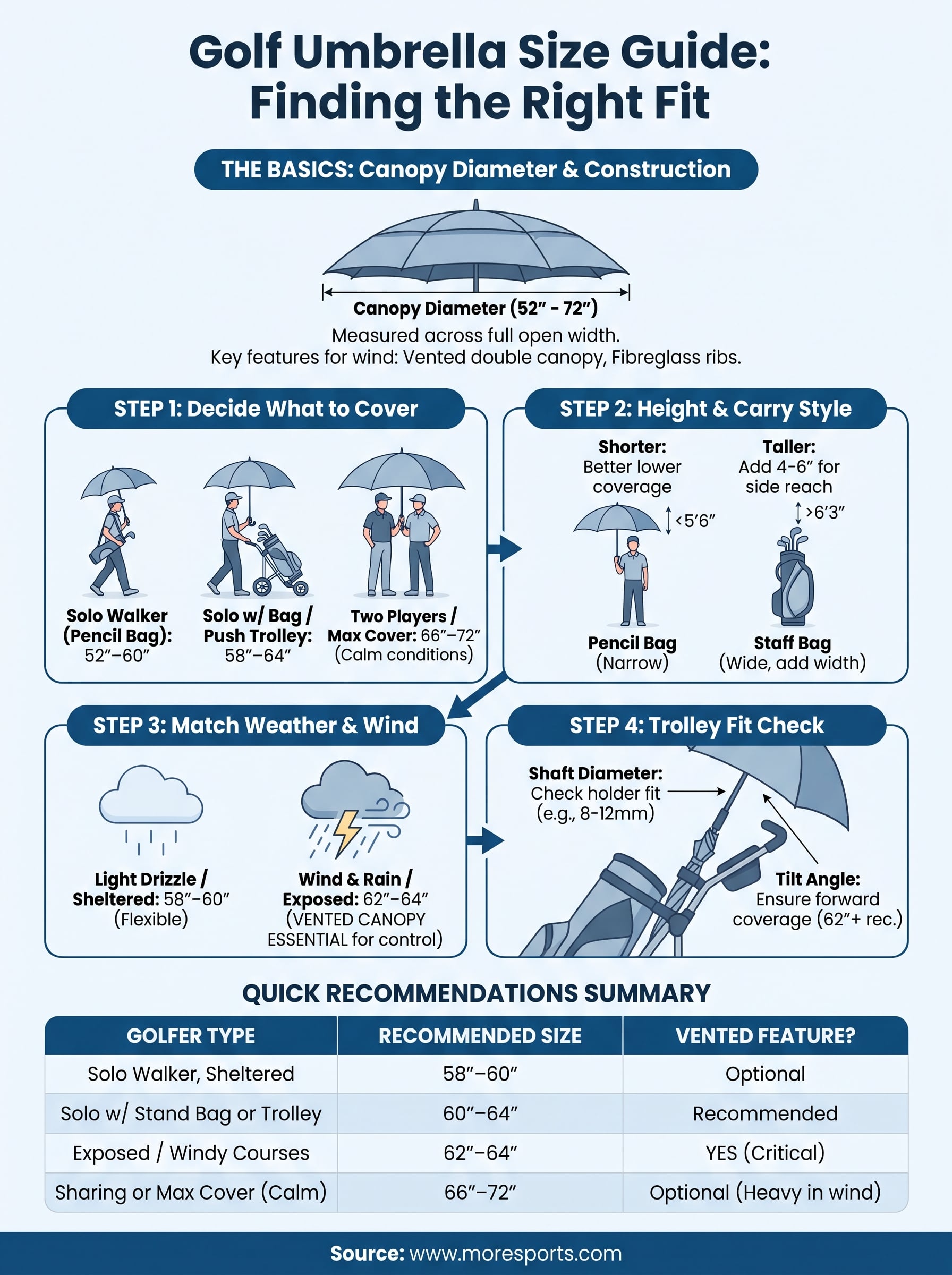
Golf umbrella size guide and quick recommendations
If you have worked through the four steps above, you now have a clear answer to what size golf umbrella do I need for your setup. This section pulls everything together into a fast reference so you can confirm your choice and buy with confidence. Use the guide below to match your situation to a specific size, then check the recommendations underneath for a starting point on quality features to look for.
Size guide by golfer type
Your playing style and equipment determine the right canopy size more than anything else. Use the table below to find your scenario, confirm the recommended size, and note whether a vented canopy is worth prioritising for your course type.
| Golfer Type | Recommended Canopy | Vented Canopy Needed? |
|---|---|---|
| Solo walker, pencil bag, sheltered course | 58 to 60 inches | Optional |
| Solo walker, stand bag, parkland course | 60 to 62 inches | Recommended |
| Solo walker, staff bag, any course | 62 to 64 inches | Recommended |
| Push trolley user, any bag | 62 to 64 inches | Recommended |
| Electric trolley user | 64 inches | Yes |
| Sharing with one other player | 66 to 68 inches | Yes |
| Links or coastal course, heavy wind | 62 to 64 inches, vented | Yes |
| Maximum coverage, calm conditions | 68 to 72 inches | Optional |
Quick recommendations for features at each size
A 58 to 62-inch umbrella suits most walking golfers and should have a sturdy fibreglass shaft to keep weight reasonable. Look for a handle with a soft grip or wrist strap, since you will hold it for extended stretches while managing your bag. At this size, a single canopy performs well on sheltered courses, but a vented double canopy adds meaningful wind protection without much extra bulk.
For 64 inches and above, focus on fibreglass ribs and a vented double canopy as non-negotiables rather than optional extras. At this size, a poor-quality canopy will invert in any sustained wind and leave you worse off than a smaller well-made alternative. A longer fibreglass shaft also gives you better leverage when the wind picks up, which makes a noticeable difference over an 18-hole round in exposed conditions.
Choose the size that fits your scenario from the table, then use the feature checklist to filter out models that cut corners on construction.
Quick recap and next step
The answer to what size golf umbrella do I need comes down to four practical factors: what you need to cover, your height and carry style, the weather conditions on your course, and whether your trolley setup imposes any physical constraints. A 58 to 60-inch canopy suits most solo walkers on sheltered courses, a 62 to 64-inch model handles push trolleys and heavier bags reliably, and anything above 66 inches suits shared coverage or maximum protection in calm conditions.
Focus on fibreglass ribs and a vented double canopy for any exposed or windy layout, since construction quality matters more than sheer size once the wind picks up. Now that you have a clear size in mind, browse the full range at MoreSports to find a golf umbrella that matches your setup, your course, and your budget, with free UK delivery on orders over £25.