 No Duties or Customs Fees For EU & UK Customers
 Express Tracked UK Delivery On 1000s of Items
 90 Day Returns

What Weight Darts Should I Use? Easy Guide To Dart Weights
RYIf you've ever asked yourself "what weight darts should I use?", you're not alone. It's one of the most common questions beginners face, and one that plenty of experienced players still get wrong. The truth is, dart weight affects everything from your throw arc to your grouping on the board, and picking the wrong weight can hold back your game without you even realising it.
Most darts range from 16g to 30g, and where you land in that spectrum depends on factors like your grip, throwing style, and how much force you naturally put behind each throw. There's no single "correct" answer, but there are clear starting points that make the selection process much simpler.
At MoreSports, we stock a wide range of darts and accessories from top brands, and we've helped thousands of customers find the right setup through our online store and our shop in Coleraine, Northern Ireland. In this guide, we'll walk you through how dart weight actually works, what the differences between light and heavy darts mean in practice, and how to find the weight that suits your throw. Whether you're buying your first set or switching things up, you'll leave with a clear answer.
What dart weight means and what it changes
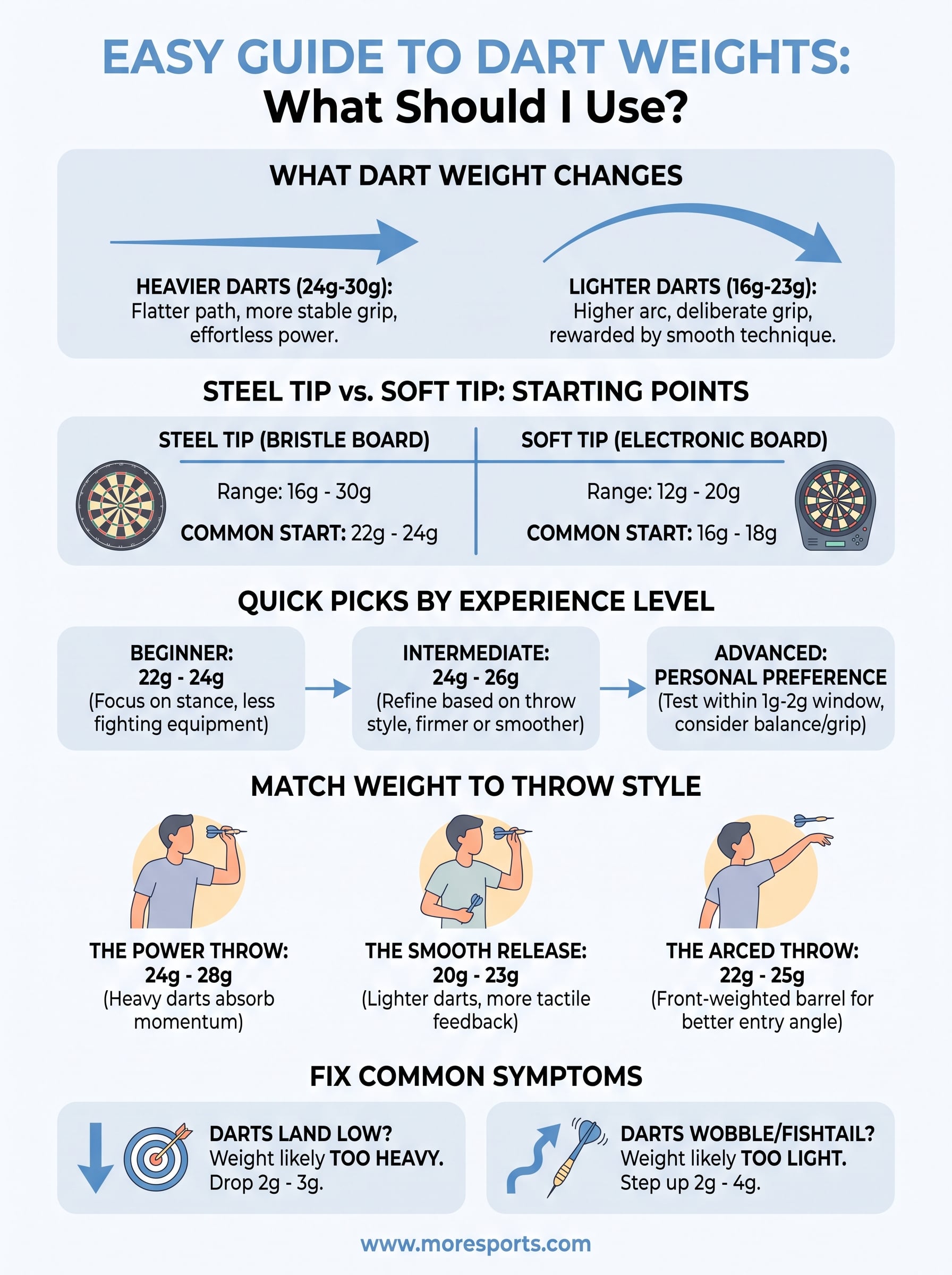
When you pick up a dart, its weight determines how much force you need to send it across the oche at the right speed and angle. Dart weight runs from roughly 16g at the light end to 30g at the heavy end, with the most popular range sitting between 22g and 26g. That spread might sound small, but even a 2g difference can noticeably change how a dart flies, how it sits in your hand, and how much effort your throw demands.
How weight changes the flight path
A dart's weight directly influences the arc it travels on. Heavier darts tend to fly on a flatter, more direct path because their mass carries them forward with less deviation. Lighter darts need more force to cover the same distance, which often produces a higher arc. If you throw with a lot of natural power, a heavier dart can feel effortless because it matches the momentum your arm generates. If you have a softer, more controlled throw, a lighter dart might fly more predictably for you.
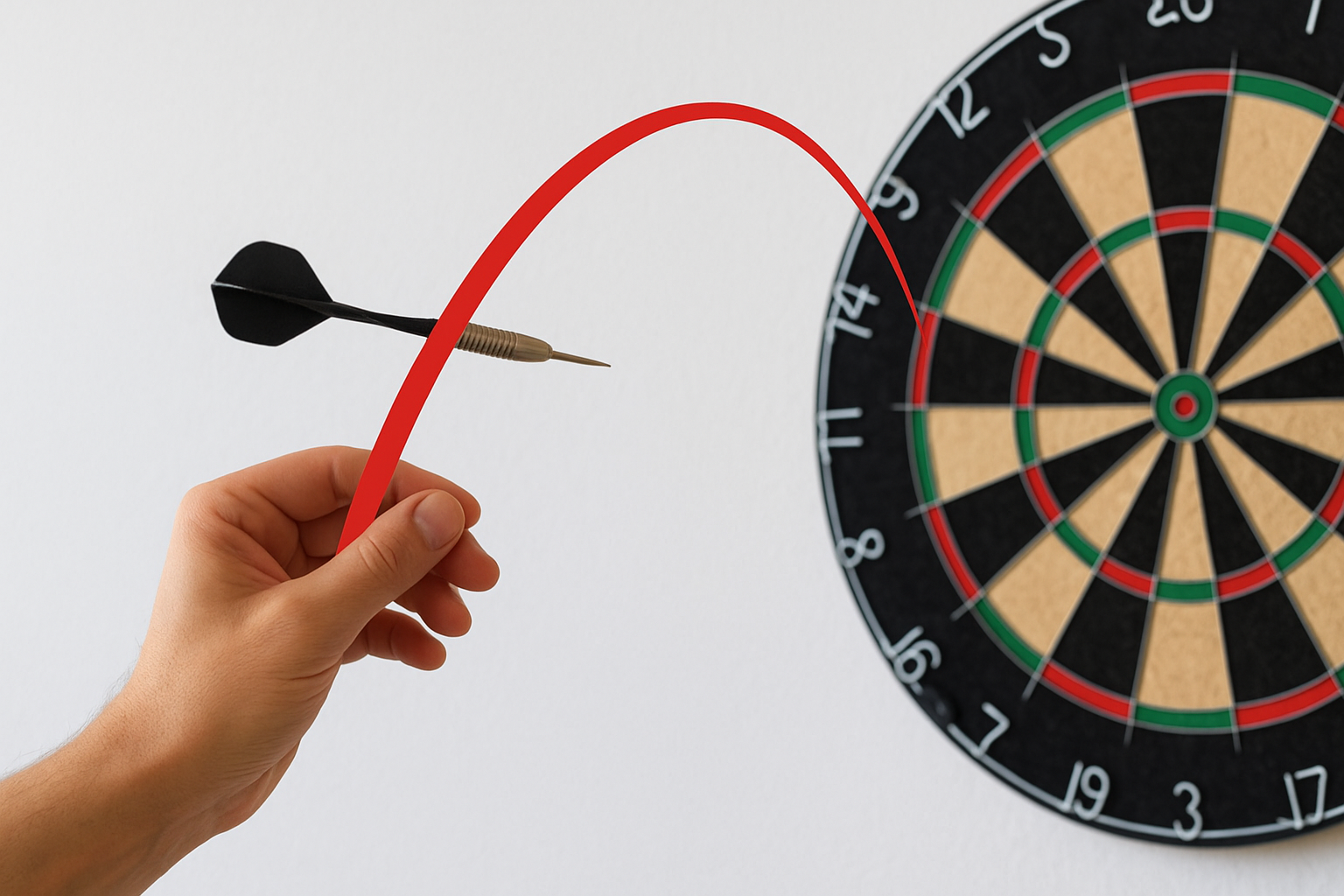
The arc your dart travels is not a flaw in your technique - it is a variable you control by choosing the right weight.
This matters because the angle at which a dart approaches the board affects where it lands relative to where you aimed. A steep arc means the dart hits the board at a sharp downward angle, which can push it low of your target. A flat arc means it arrives almost level, which suits tighter groupings around the treble 20 bed.
How weight affects your grip and release
Grip pressure and weight are directly linked. When you hold a heavier dart, your fingers naturally apply more contact to stabilise it, which many players find reassuring. With a lighter dart, you need a more deliberate grip to stop it slipping forward too early during your release. Neither approach is better by default, but if your darts flutter or wobble mid-flight, the mismatch between your natural grip pressure and your dart's weight is often the first thing to examine.
Your release point also shifts with weight. Heavier darts tend to leave your fingers cleanly because their momentum pulls them forward. Lighter darts can linger slightly, meaning a fraction of a second's hesitation changes the delivery angle more dramatically. If you find yourself asking what weight darts should I use, understanding your own release style is a practical starting point before you spend money on a new set.
How weight affects grouping and consistency
Consistency is the goal every darts player chases, and weight plays a significant role in how repeatable your throw feels. When a dart's weight suits your natural throw, you spend less mental energy compensating for the dart and more on your aim. Heavier darts are often easier to group tightly because small variations in release speed have less impact on their path. Lighter darts reward clean, smooth technique but punish inconsistency more harshly.
Think of weight as the foundation your throw is built on. Getting it right does not guarantee accuracy, but getting it wrong makes accuracy significantly harder to achieve. Every other adjustment you make, whether to your grip, stance, or follow-through, works better when the weight is already in the right range for you.
Steel tip vs soft tip: start in the right range
Before you can answer what weight darts should I use, you need to know which dart type you're throwing. Steel tip darts and soft tip darts operate in entirely different weight ranges by design, and mixing up those ranges is one of the quickest ways to end up with a dart that does not suit your game. Knowing your board type first narrows the field significantly and makes every other decision in this guide far more manageable.
Steel tip darts: the heavier standard
Steel tip darts are the format played on traditional bristle boards and what most people picture when they think of the sport. The standard weight range runs from 16g to 30g, with the majority of recreational and professional players settling somewhere between 22g and 26g. Beginners consistently find that starting at 22g to 24g gives them enough mass to throw with control without the dart feeling sluggish or difficult to direct. The steel tip itself contributes a small amount to the total weight, and that figure is already included in whatever number you see printed on the packaging.
If you play on a bristle board at home or in a pub league, steel tip darts are your category, and 22g to 24g is your most practical starting point.
Soft tip darts: lighter by design
Soft tip darts are built for electronic boards, where a plastic tip registers each throw through a small sensor hole. Because electronic boards require far less physical force to score, soft tip darts are deliberately lighter, and the weight ranges reflect that difference clearly.

| Format | Typical Weight Range | Common Starting Point |
|---|---|---|
| Steel tip | 16g to 30g | 22g to 24g |
| Soft tip | 12g to 20g | 16g to 18g |
Most soft tip players begin between 16g and 18g, which provides enough weight for a consistent release without putting excessive force into the board. If you regularly switch between bristle and electronic boards, resist the urge to use the same darts on both. The weight that works well on one format can actively undermine your accuracy on the other, so keeping separate sets is the cleaner and more effective approach.
Quick picks by experience level
Not everyone needs to work through a full testing process before picking a dart weight. Experience level gives you a strong shortcut, because the challenges beginners face are fundamentally different from those of seasoned players. The table below gives you a quick reference, and the breakdowns under each heading explain the reasoning behind each recommendation so you can move forward with confidence.
| Experience Level | Recommended Weight Range |
|---|---|
| Beginner | 22g to 24g |
| Intermediate | 24g to 26g |
| Advanced / Competitive | Personal preference, refined from testing |
Beginners: start at 22g to 24g
When you are new to darts, your throw is still forming. 22g to 24g steel tip darts give you enough mass to fly straight without demanding a precise, high-speed release. At this weight, small inconsistencies in your throw are less likely to send the dart wildly off course, which means you can focus on developing your stance and arm motion rather than fighting the equipment. Most beginners who start in this range report feeling noticeably more settled after only a handful of practice sessions compared to those who jump straight to heavier or lighter options.
Starting at 22g to 24g is not a compromise - it is the same range that many professional players have settled on after years of deliberate experimentation.
Intermediate players: move to 24g to 26g
Once you have thrown consistently for several months and your grouping has tightened, moving into the 24g to 26g range gives you a real opportunity to refine your game further. At this stage, you likely have a clearer sense of whether your throw is on the softer or more forceful side. Players with a firmer, more direct delivery often find that 25g or 26g rewards them with flatter flight and tighter groupings, while those with a smoother release may prefer to stay at 24g.
Advanced and competitive players: test within a narrow band
At this level, asking what weight darts should I use becomes less about finding a starting point and more about precision tuning. Most advanced players already know their preferred weight zone and are testing within a 1g to 2g window on either side of it. If you compete regularly, barrel shape, grip texture, and balance point often matter as much as the raw weight figure, so treat weight as one component in a broader setup review rather than an isolated variable to fix in isolation.
Match weight to your throw style
Your throw style is the most personal variable in the entire weight selection process. Two players at identical skill levels can throw entirely different weights and both perform well, because their individual mechanics demand different things from the dart. Before you commit to a weight, spend a few minutes identifying how you naturally throw, then use that information to direct your choice rather than relying solely on what someone else recommends.
The power throw
If you tend to put significant force into each dart, your arm generates high momentum that heavier darts absorb well. Players with a punchy, direct delivery typically perform better in the 24g to 28g range, because the dart's mass complements the speed coming off their fingers. Throwing a light dart with a power delivery often causes the dart to overshoot or arrive at the board too fast, which disrupts your grouping unpredictably and makes consistent scoring much harder to achieve.
Matching a heavier dart to a forceful throw is not about controlling aggression; it is about letting the dart work with your natural mechanics rather than against them.
The smooth or controlled release
If your throw is slower and more deliberate, a lighter dart in the 20g to 23g range will likely feel more responsive in your hand. With a smooth release, you have more time during the throw to feel exactly when the dart leaves your fingers, and a lighter barrel amplifies that tactile feedback without the dart drifting wide of your target. Players who consistently struggle to get enough forward momentum behind heavier darts often notice an immediate improvement in accuracy after dropping just 2g to 3g.
The arced throw
Some players naturally produce a pronounced arc, sending the dart on a curved path toward the board rather than a flat line. If this describes your delivery, barrel balance matters as much as weight. A front-weighted barrel in the 22g to 25g range keeps the tip angled forward through the arc, which improves your dart's angle of entry into the board. If you are still asking what weight darts should I use and your darts consistently land at a steep downward angle, experimenting with a front-heavy barrel at your current weight is a practical first move before you change the weight itself.
Run a simple 30-minute weight test
You don't need weeks of practice to know whether a dart weight suits your throw. A focused 30-minute session gives you enough throws to spot real patterns in your grouping, flight path, and how settled each dart feels at the point of release. The key is running the test with clear intention rather than throwing loosely and hoping an answer presents itself.
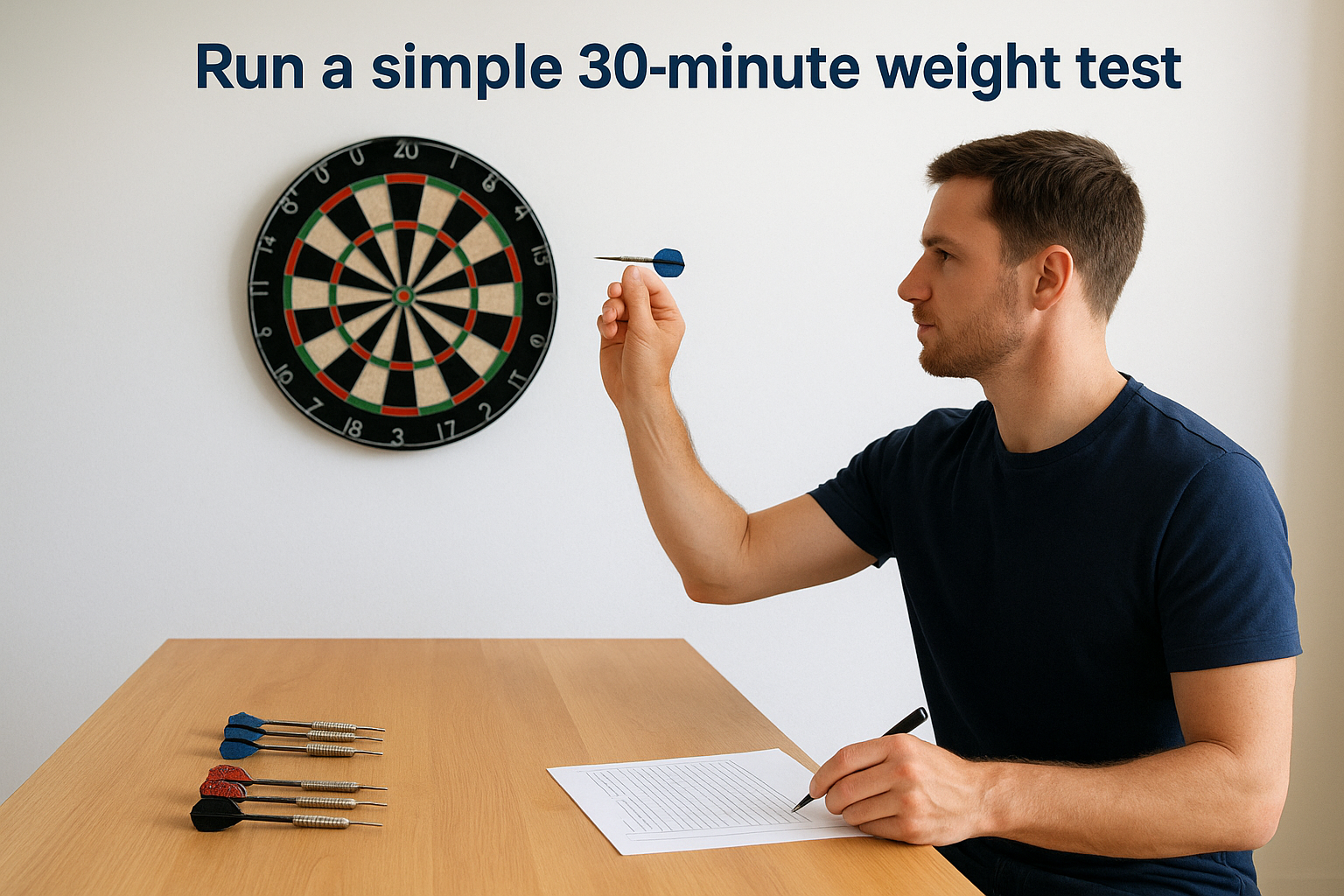
Set up the test properly
You need two or three dart sets at different weights, ideally spaced 2g to 3g apart from each other. If you only have one set available, run the test across separate sessions on consecutive days, but testing multiple weights on the same day gives you a far cleaner comparison because your arm is in the same condition throughout. Stand at the regulation oche distance of 2.37 metres, use a standard bristle board, and throw in blocks of 10 darts per weight so your results stay consistent and comparable.
For each weight, record the following:
- How many darts land in your intended target zone out of 10
- Whether the dart flies flat or on a pronounced arc
- How natural the grip and release feel, rated from 1 to 5
- How much physical effort each throw demands
Read the results
Once you have thrown all three weights and written down your notes, look for the set that scored highest across all four criteria combined, not just on accuracy alone. A dart that hits the target but demands uncomfortable effort on every throw will let you down during longer practice sessions or competitive matches. The weight that feels most repeatable without extra concentration is the one your natural throw is asking for.
If two weights feel equally comfortable after the test, choose the heavier of the two and throw it consistently for another week before making a final call.
When you finish the session and still find yourself wondering what weight darts should I use, check your arc notes specifically. If your darts arc high across all three weights, your throwing speed may need attention before weight alone can solve the problem. If one weight produced a noticeably flatter flight path, stay in that range and treat barrel shape and balance as your next variable to explore.
Fix the common symptoms when weight is wrong
Wrong weight rarely announces itself with an obvious label. Instead, it shows up as a pattern of frustrating misses that you struggle to explain, no matter how much you practise. Knowing how to read these symptoms saves you from wasting time fixing your technique when the real problem is sitting in your hand.
Darts consistently land low of your target
When your darts repeatedly drop below where you aimed, the dart is losing momentum before it reaches the board. This almost always points to a dart that is too heavy for your throwing speed. Your arm cannot generate enough force to keep the dart on a flat path, so gravity pulls it down before it arrives. If you have been wondering what weight darts should I use and your scores are suffering because of low landing patterns, dropping 2g to 3g is your most direct fix. Try 22g if you are currently throwing 24g or 25g, and run the 30-minute test from the previous section to confirm the change is working.
A dart landing low is nearly always a weight problem, not a technique problem, so adjust your equipment before adjusting your stance.
Darts wobble or fishtail in flight
Wobbling or fishtailing during flight means the dart is not stable as it travels through the air. This happens when a dart is too light for your delivery. A forceful throw pushes a light dart faster than its flight and shaft can handle, causing it to spin or yaw sideways mid-trajectory. Stepping up by 2g to 4g gives the barrel enough mass to cut cleanly through the air and arrive at the board point-first every time.
Your grouping scatters unpredictably
Scattered groupings are the hardest symptom to diagnose because they can look like a technique problem on the surface. When your darts land all over the board with no clear pattern, the weight is likely at the edge of your comfortable range rather than firmly inside it. Small differences in your release speed from throw to throw have a much bigger impact when the dart weight is not a natural fit.
Check your grouping across three consecutive legs. If the scatter is random rather than consistent in one direction, move one step down the weight range and repeat the test before changing anything else about your setup.
Fine-tune without buying new barrels
Before you spend money on a completely new set of darts, it's worth knowing that several components around your barrel can shift how a dart performs without touching the barrel weight itself. Shafts, flights, and weight rings each play a direct role in how the dart feels and flies, and adjusting them is faster and cheaper than starting again from scratch. If you are still unsure what weight darts should I use after your initial tests, these adjustments can close the gap considerably.
Change your shaft length first
Shaft length alters the balance point of your dart, which changes how it sits in your hand and how it exits your fingers at release. A shorter shaft shifts the balance toward the front of the dart, giving it a tip-heavy feel that suits players with an arced throw. A longer shaft moves the balance rearward, which works better for smoother, more level deliveries. Most darts manufacturers offer shafts in at least four lengths: short, medium, long, and extra-long. Start by dropping one length shorter than your current shaft if your darts are landing with the tail high, or move one length longer if the tip is dropping too steeply on arrival.
Changing shaft length costs less than £5 and can replicate the feel of switching to a dart 2g heavier or lighter without touching your barrel.
Adjust your flight size and shape
Larger flights create more air resistance, which slows the dart slightly and lifts the tail during flight. This makes a dart behave in a way that feels closer to a heavier option, even though the barrel weight has not changed. Switching from a slim flight to a standard teardrop flight is a straightforward way to add stability if your current darts feel too fast or skittish mid-flight. Smaller slim flights suit faster, more direct throws where you want minimal drag pulling the tail up.
Use weight rings to test a heavier feel
Weight rings are small metal rings that slide onto your barrel or shaft joint and add between 0.5g and 2g to your total dart weight. They cost very little and let you test a heavier setup using your existing barrels before committing to a new purchase. If the added weight improves your grouping noticeably over a full practice session, you have a clear signal that a heavier barrel is your next step.
Picking your weight and moving on
By this point, you have everything you need to answer what weight darts should I use with confidence. Start in the 22g to 24g range if you throw steel tip darts, run the 30-minute test described earlier, and read your grouping patterns honestly before you make any changes. If something feels off, check your shaft length and flights before assuming the barrel weight is the problem.
Do not let the decision drag on longer than it needs to. Pick a starting weight, throw it consistently for two weeks, and let your results guide the next adjustment. Most players find their ideal weight within one or two small moves from where they started, and the process itself improves your understanding of your own throw.
When you are ready to find your next set, browse the full range of darts and darts accessories at MoreSports and get the right setup delivered straight to your door.