 No Duties or Customs Fees For EU & UK Customers
 Free UK Delivery On Orders Over £60
 90 Day Returns

Game Improvement Vs Players Irons: Which Should You Play?
RYChoosing between game improvement vs players irons is one of the most important decisions you'll make when building your bag. Pick the wrong category and you're either leaving performance on the table or fighting a club that demands more skill than you currently have. Either way, your scores suffer, and the game feels harder than it needs to be.
The differences between these two iron types go well beyond looks at address. Head size, sole width, offset, centre of gravity, they're all engineered differently, and each design choice directly affects how the ball launches, how far it carries, and how punishing your mishits feel. Understanding what separates them helps you match your irons to your actual ability, not your ego.
At MoreSports, we stock irons from brands like TaylorMade, Callaway, and MacGregor across both categories, so we see firsthand how the right fit transforms a golfer's confidence. This guide breaks down exactly how game improvement and players irons differ, who each type suits best, and how to decide which belongs in your bag.
Why the right iron category changes your scores
Iron selection is not just about preference. The category you play directly shapes how often you make clean contact, how far your ball carries, and how consistently you hit your target distances. Most golfers underestimate this connection. They assume a more skilled-looking club will push their game forward, but if the design works against your current swing, you spend rounds fighting the club instead of focusing on course management. Understanding the game improvement vs players irons debate starts with recognising how much each category affects your actual scorecard.
How forgiveness affects your contact quality
Mishits are inevitable, even for low-handicap golfers. The real difference between iron categories is what happens when you don't strike the ball from the centre of the face. Game improvement irons spread impact energy across a larger sweet spot, so a strike half an inch toward the toe or heel still produces a usable shot. Players irons concentrate mass behind a smaller hitting area, meaning the same off-centre strike loses significant distance and can send the ball sideways.
If you miss the sweet spot more than three or four times per round, a game improvement iron will likely save you several shots over a full season.
For mid-to-high handicappers, contact consistency is the single biggest factor in scoring. Using a players iron before your ball-striking is genuinely reliable adds unnecessary penalty to every imperfect swing without giving you anything in return.
Why launch angle matters more than most golfers think
Ball flight determines how your iron behaves when it lands on a green. Game improvement irons are built with a lower centre of gravity, which helps the ball climb steeply and come down softly. Players irons require a more precise, descending strike to generate that same high launch, because the design trusts the golfer to create it naturally through technique.
If you struggle to hold greens, the launch conditions your irons produce are likely part of the problem. A game improvement iron gives you the height your swing currently needs, while a players iron may be producing low, running shots that roll through greens and leave you chipping from awkward positions.
Why your iron choice affects your mental approach
Confidence changes your swing. When you stand over a shot knowing your iron is working with your ability rather than against it, you commit more fully. Hesitation, even small amounts of it, kills tempo and leads to the exact mis-strikes you were trying to avoid in the first place.
Players irons carry a psychological weight for many golfers too. Many club golfers feel pressure to perform when playing a blade or compact iron, which adds tension at exactly the wrong moment. Matching your iron category to your actual skill level removes that friction, and the mental clarity alone can improve your scores without changing a single thing about your technique.
The design differences between game improvement and players irons
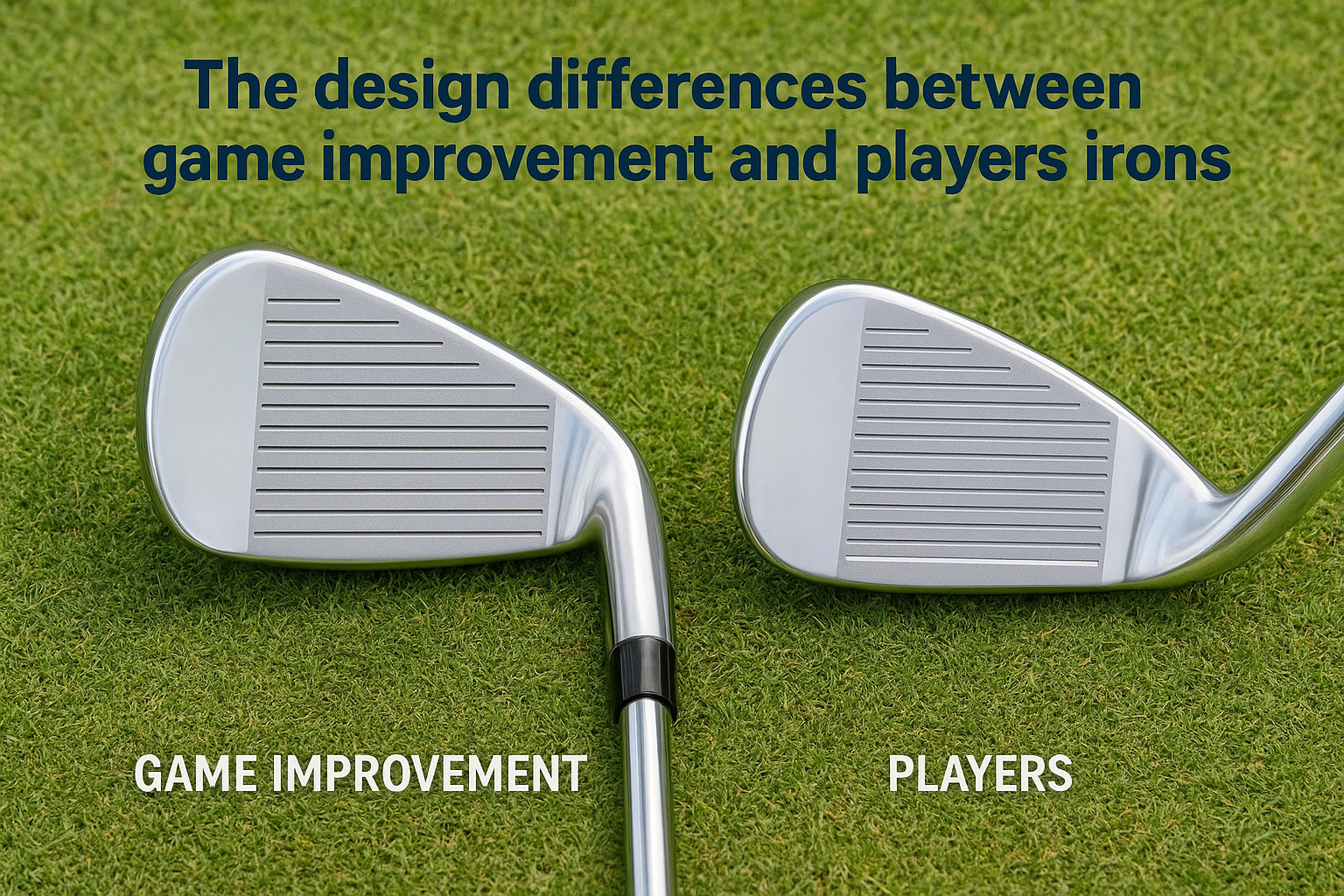
When you pick up a game improvement iron and a players iron side by side, the physical differences are obvious. Game improvement irons feature a larger club head, a wider sole, and more visible offset at the hosel, while players irons are noticeably more compact, thinner-soled, and sit closer to the ground. These are not cosmetic choices. Every dimension is engineered to serve a specific type of golfer.
Head size and sole width
The larger head on a game improvement iron distributes weight around the perimeter of the face, which increases the moment of inertia and reduces twisting on off-centre strikes. A wider sole also helps the club glide through turf rather than digging in, which matters when your angle of attack is shallow or inconsistent. Players irons use a smaller, muscle-back or cavity-back head with a thinner sole, which demands a steeper, more controlled strike to perform correctly.
The sole width difference between categories is one of the easiest ways to identify which iron belongs in your bag based on how you currently strike the ball.
Offset and centre of gravity
Offset refers to how far the leading edge of the face sits behind the hosel, and game improvement irons use more of it. This extra offset gives your hands more time to rotate through impact, which helps square the face and reduces a slice. Players irons carry minimal offset, trusting the golfer to square the face independently through practised technique.
Centre of gravity also sits differently in each design. Game improvement irons position the CG lower and deeper, encouraging higher launch without extra swing speed. In players irons, the CG sits higher and closer to the face, giving better players the workability and shot-shaping control they want from the game improvement vs players irons comparison.
How they perform differently in real golf shots
On the course, the performance gap between these two iron categories becomes immediately clear. Game improvement irons produce higher, softer-landing shots with noticeably more carry, while players irons reward a precise strike with exceptional control and shot-shaping ability. Knowing how each category behaves across different shot types helps you understand which design serves your game right now.
Ball flight and carry distance
Game improvement irons generate higher ball flight by default, even with a moderate swing speed, because the low, deep centre of gravity does the heavy lifting for you. You get more carry, softer landings, and better stopping power on approach shots without needing to strike down aggressively. For most mid-to-high handicappers, this means holding more greens and facing shorter putts.
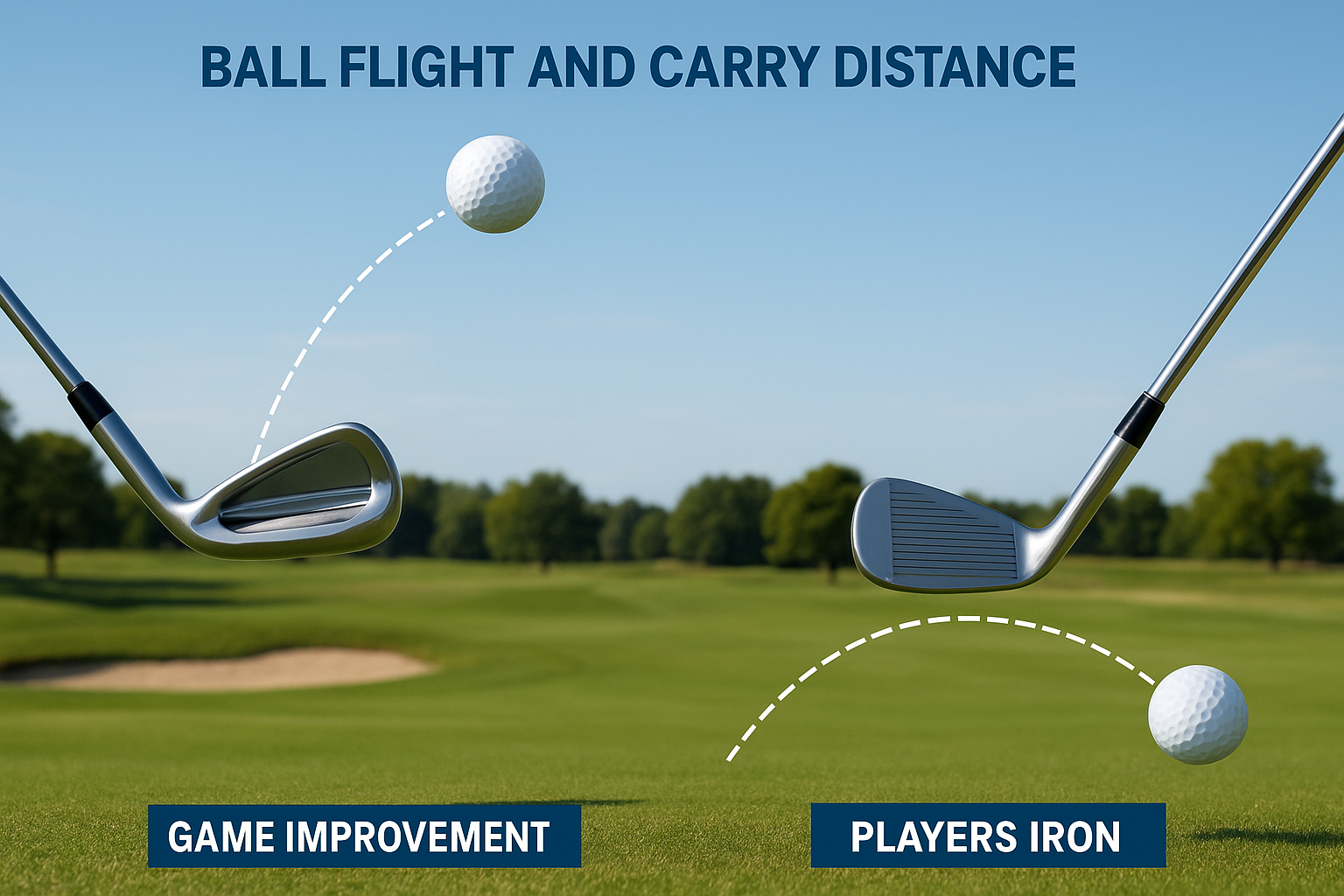
If you regularly struggle to stop the ball on firm greens, switching from a players iron to a game improvement iron can solve that problem without changing your swing at all.
Players irons, by contrast, launch lower and require a committed, descending blow to produce the same carry distance. Skilled golfers generate that ball flight intentionally, but if your attack angle is shallow or inconsistent, a players iron will produce flat, running shots that are difficult to control.
Shot shaping and workability
Players irons give you genuine workability, meaning you can deliberately move the ball left or right when the situation calls for it. The compact head and precise weight placement respond to subtle swing adjustments, letting better golfers shape shots around obstacles. In the game improvement vs players irons comparison, this is where players irons earn their reputation among lower handicappers.
Game improvement irons are designed to resist those same movements, which is actually a benefit if you are still building consistency. The inherent stability keeps your misses tighter and your dispersion narrower, so you find more fairways and leave yourself better approach angles round after round.
How to choose the right irons for your game
The most reliable way to navigate the game improvement vs players irons decision is honest self-assessment. Forget what your playing partners carry or what you see professionals use on television. Your irons need to match your current swing, not the version of your swing you expect to have in two years' time.
Start with your handicap and contact consistency
Your handicap gives you a solid starting point, but your ball-striking quality matters just as much. Golfers carrying a handicap above 12 will almost always benefit from game improvement irons, because the forgiveness and launch assistance built into that design directly compensates for the contact variability that comes with an developing swing. Players with a handicap between 5 and 12 sit in a genuine grey area and can often play either category, depending on how repeatable their strike already is.
The quickest honest test is to look at your divot pattern after a range session. If your divots point in different directions or vary significantly in depth, a game improvement iron will help your scores far more than extra practice time alone.
Use the table below as a rough guide:
| Handicap range | Recommended iron type |
|---|---|
| 18 and above | Game improvement or super game improvement |
| 10 to 17 | Game improvement |
| 5 to 9 | Game improvement or players distance |
| 0 to 4 | Players or players distance |
Think about what you actually want from your irons
Consider your real priorities during a round. If holding greens and tightening your dispersion are the goals, game improvement irons deliver those results more reliably at most skill levels. If shot shaping and precise distance control matter more to you and your contact is already consistent, players irons provide the feedback and workability that better golfers genuinely need.
Buying ahead of your ability rarely accelerates improvement. Match your equipment to where you are now and move into a more demanding iron category when your contact genuinely earns it.
Common myths and quick answers golfers need
Several persistent misconceptions cloud the game improvement vs players irons debate and push golfers toward the wrong choice. Clearing up these myths gives you a cleaner path to a decision that actually fits your game.
Players irons will speed up your improvement
This is one of the most common beliefs in the sport, and it has no evidence behind it. The theory goes that if you force yourself to use a more demanding club, your technique will sharpen faster. In practice, the opposite tends to happen. Repeated mishits without useful feedback reinforce poor habits, and the discouragement that comes with thin, low, or offline shots leads many golfers to practise less, not more.
Improvement comes from quality repetition and useful feedback, not from making the game unnecessarily difficult with equipment that works against your current ability.
Choosing the right iron for your skill level removes a barrier to good contact and lets you focus on what actually builds your game: consistent swing mechanics and repeatable ball-striking.
Game improvement irons are only for beginners
Many scratch golfers and club professionals play game improvement or players distance irons, particularly for longer irons where forgiveness matters even at elite levels. The label "game improvement" describes a design philosophy, not a ceiling on who can benefit from it. Distance, launch, and forgiveness advantages apply across the skill spectrum, and choosing a club based on what the design delivers for your game is far smarter than avoiding a category because of how it sounds.
Some of the best-performing irons currently available sit in the game improvement category and offer workability and feel that rival traditional players irons. Your job is to find the design that helps you score lower, not the one that looks the most impressive in your bag.
Where to go from here
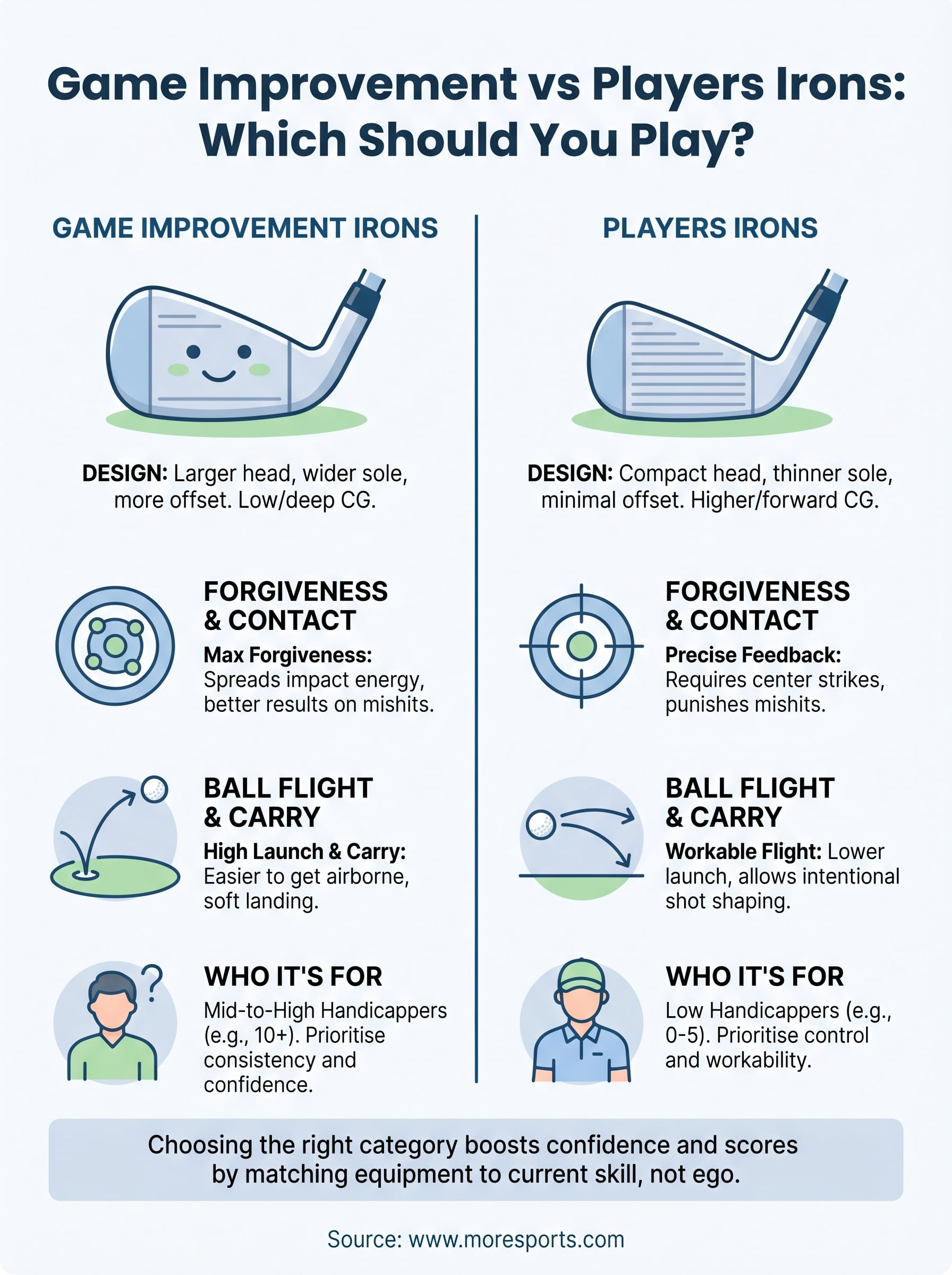
The game improvement vs players irons decision comes down to one straightforward principle: choose the iron that matches your current game, not the one you think you should aspire to. Honest self-assessment beats ego every single time, and the golfer who plays the right category of iron for their skill level will always outscore the one fighting a club that demands more than their swing currently delivers.
Now that you understand the core differences in design, launch, forgiveness, and workability, you have everything you need to make a confident, well-informed choice. Your next step is finding the specific model that fits your budget and your preferred brand. Browse the full range of irons available at MoreSports, where you will find options from TaylorMade, Callaway, MacGregor, and more across both categories, with competitive UK prices and free delivery on orders over £25.