 No Duties or Customs Fees For EU & UK Customers
 Express Tracked UK Delivery On 1000s of Items
 90 Day Returns


If you search for golf clubs near me, the best pick is the type of venue that matches how often you play, not just the closest pin on the map. Pay-and-play courses suit beginners and occasional golfers. Members' clubs suit anyone playing 20 or more rounds a year. Nine-hole courses suit golfers short on time. Golf centres suit players who want lessons before their first round. Championship courses suit a special day out.
The trouble with a map search is that it returns every golf pin together. A private club that rarely takes visitors sits next to a public course that books tee times online, and the listing rarely tells you which is which. This article sorts those results into five types. For each one it explains how to find it, how to book it, who it suits and what it costs to play or join.
MoreSports began as Dunluce Golf, an online seller of golf equipment, so getting people onto a course is something we care about. The advice below also covers what to check before you drive to a venue, so you do not turn up and find the wrong kind of welcome.
1. Pay-and-play public courses
A pay-and-play course lets you book a round and pay a green fee with no membership. It is the quickest way to get on a course near you, and the easiest answer to "where can I book a tee time today".

How to find and book one
Search a map app for "pay and play golf" rather than "golf club", because the second phrase surfaces private venues first. Open each listing's website and look for a tee-time booking page. Most public courses take bookings online or by phone through the pro shop, and some accept walk-up players at quiet times.
Search for "pay and play" first, because it filters out clubs that do not take casual bookings.
Before you set off, confirm the number of holes, whether buggies or hire clubs are available, and whether there is a dress code. Weekend mornings fill first, so book those slots early.
Who it suits and what you pay
These courses suit beginners, occasional players and visitors without a handicap. You pay a green fee per round, which is usually lower at twilight or midweek. There is no joining fee and no annual commitment. The trade-off is a busier course and slower play at peak times.
2. Members' clubs
A members' club is a golf club run by its members, and it is the right choice if you want a regular home course, a handicap and competitions. Most also accept visitors on certain days.
How to find and book one
Start with the club's own website and look for the "visitors" and "membership" pages. Many members' clubs admit visitors only on set days or times. Some ask for a handicap certificate or proof that you belong to another club. The national golf union for your part of the UK or Ireland is a good place to check which clubs are affiliated.
Treat a visitor round as a trial: if you like the course, the pace and the people, ask about joining.
To join, contact the club manager or secretary. Ask about waiting lists, any joining fee, whether a taster membership is offered, and which days and times your membership covers.
Who it suits and what you pay
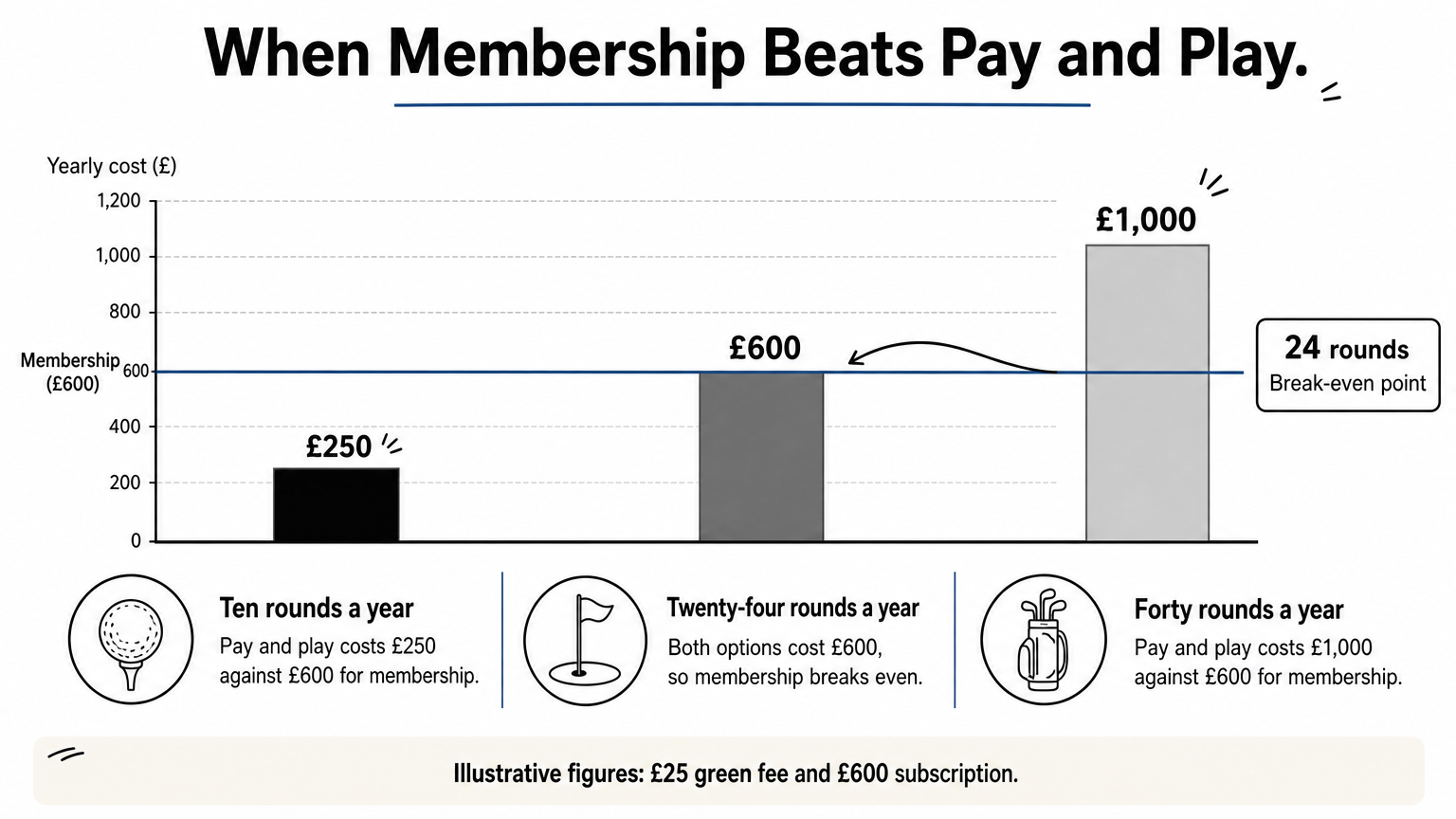
Members' clubs suit golfers who play weekly. You pay an annual subscription, sometimes plus a joining fee, and many clubs let you pay monthly. Student and junior rates are common. The figures below are illustrative, using a £25 green fee and a £600 subscription.
| Rounds per year | Pay and play at £25 | Membership at £600 |
|---|---|---|
| 10 | £250 | £600 |
| 24 | £600 | £600 |
| 40 | £1,000 | £600 |
In this example, membership breaks even at 24 rounds. Add any joining fee to the membership figure before you compare.
3. Nine-hole and short courses
A nine-hole or par-3 course is the lowest-pressure way to play. It gives you real golf on a real course in around two hours instead of the four or so that 18 holes can take.
How to find and book one
Search "9 hole golf course", "par 3 course" or "short course" on a map app, then check the course's website for booking details. Many take online bookings, and some also let you turn up and wait for a gap. If you want a full round, ask whether you can play the nine twice, as many courses allow.
A nine-hole round takes about half the time of 18, which makes it the easiest golf to fit around work and family.
Who it suits and what you pay
Short courses suit beginners and juniors who are learning pace of play and course etiquette. They also suit returning players rebuilding their game and anyone who can only spare a lunch break or an evening. The fee is lower than for 18 holes, so you can play more often for the same money.
4. Golf centres with driving ranges
A golf centre combines a driving range with practice areas and often coaching. It is the best place to start if you have never played a round, or if you want to fix a swing fault before paying for a full course.

How to find and book one
Search "driving range" or "golf centre" near you, then check the website for floodlit bays, short-game areas and lesson information. Some centres have their own course too. Bays are often first come, first served, but lessons are booked directly with the PGA professional or coach, so phone or message ahead.
Learn the basics on a range first, and your first round on a course will be far more enjoyable.
Who it suits and what you pay
Golf centres suit new golfers and players tuning up before a round. You usually pay per bucket of balls or per bay session, and lessons are charged per session. Ask whether clubs can be hired, and whether block-booked lessons cost less. Trainers are usually fine on a range.
5. Championship courses and golf-day venues
Championship and parkland courses are the right choice for a birthday round, a group of friends or a corporate day. They are often the best-maintained courses in an area, and they run structured visitor and group-golf bookings.
How to find and book one
Search "golf day venue", "society golf" or "stay and play", then open the club's visitors and group-golf pages. Groups normally deal with an events team, and summer weekends can sell out weeks ahead. Check handicap limits, the maximum group size and whether a handicap certificate is needed.
For a group booking, ask about handicap limits and dress code before you confirm the date.
Who it suits and what you pay
These venues suit special occasions, societies and golfers who want to play a well-known course. Expect the highest green fees of the five types, and ask whether a package includes food or a buggy. Dress codes are usually stricter, so pack a collared shirt and soft-spike golf shoes.
Pick the venue, then book the round
The right golf club near you depends on how you play. Choose pay and play for flexibility, a members' club if you will play at least 20 rounds a year, a nine-hole course for short rounds and a golf centre to learn. Book a championship course for a special day. Check booking rules, handicap requirements and dress code before you travel.
Once you have a tee time, kit matters. Golf clothing, footwear and equipment from MoreSports covers shoes, waterproofs and clubs from brands such as FootJoy, TaylorMade and adidas, and UK delivery is free on orders over £25. Book the round, pack the bag and get out on the course.
0 comments