 No Duties or Customs Fees For EU & UK Customers
 Express Tracked UK Delivery On 1000s of Items
 90 Day Returns

Golf Handicap Explained: Levelling Play in the UK
BLGTrying to make sense of your golf scores but feeling lost when it comes to handicaps? Understanding your golf handicap is key to enjoying fair competition, whether you play at local UK clubs or test yourself at different courses. For beginner and intermediate players, getting to grips with terms like Handicap Index and Course Handicap helps you spot real progress and play on a level field with all abilities. You will clear up common myths and learn how to use your handicap as a powerful tool for tracking your game.
Table of Contents
- Golf Handicap Basics And Key Misconceptions
- Types Of Handicap: Index And Course Handicap
- How The World Handicap System Works In The UK
- Obtaining And Maintaining Your Golf Handicap
- Role Of Handicaps In Competitions And Social Play
- Common Mistakes And Pitfalls To Avoid
Key Takeaways
| Point | Details |
|---|---|
| Understanding Handicaps | A golf handicap represents a player’s ability, adjusting for course difficulty, allowing fair competitions among different skill levels. |
| Types of Handicaps | The Handicap Index reflects overall ability, while Course Handicap adjusts for specific courses, impacting net scores in competitions. |
| WHS Inclusivity | The World Handicap System enables all golfers to track their handicap without mandatory club membership, incorporating scores from casual play. |
| Regular Submissions | Submit all qualifying scores consistently to maintain an accurate handicap, as neglecting to do so leads to stale and misleading indices. |
Golf handicap basics and key misconceptions
A golf handicap is a numerical measurement of your playing ability that allows golfers of different skill levels to compete fairly against each other. Rather than just comparing raw scores, your handicap adjusts for the difficulty of the course you’re playing on, meaning a 15-handicap golfer can have a genuine competitive match against a scratch golfer (zero handicap). What a handicap represents and why it matters goes beyond simple scorecard comparison.
The calculation involves three key elements. Your Handicap Index is your baseline number, calculated from your best scores over time. Course Rating tells you how difficult a course is for a scratch golfer, whilst Slope Rating shows how much harder the course becomes for average players. When you play, these ratings combine with your score to produce your net score, which is what really counts in handicapped competitions.
Misconception number one: your handicap is just your average score. It’s not. Your handicap improves through consistent good play and typically reflects your best performances rather than every single round. Submitting scores from casual rounds actually helps because they build a more complete picture of your true ability.
Another common myth is that you need an official club membership to get a handicap. Many UK golf clubs now offer online handicap services, and you don’t always need to play exclusively at one club. However, you will need to submit scorecards from recognised courses for your handicap to be official and accepted in competitions.
People often think handicaps are fixed and unchanging. They’re not. Your handicap updates regularly based on new scores you submit. Play better golf consistently and your handicap will improve. This fluidity is what makes handicaps such powerful tools for tracking genuine improvement over months and years of play.
Pro tip: When submitting scores for your handicap, always use your actual scores from measured courses rather than casual rounds at par-3 tracks, as official handicaps require scores from full-length rated courses.
Types of handicap: index and course handicap
You’ll come across two different handicap numbers in golf, and understanding the distinction between them is crucial for competition. Your Handicap Index is your personal ability benchmark that stays with you no matter where you play. It’s calculated from your best eight scores out of your most recent twenty rounds, giving you a standardised, portable measurement of your true playing standard across different courses.
The Course Handicap is where things get practical. This is your Handicap Index adjusted specifically for the course and tee set you’re playing that day. Handicap Index versus Course Handicap differences matter because a course can be significantly harder or easier than another. Your Handicap Index might be 12, but your Course Handicap at a difficult championship course could be 15, whilst at an easier par-3 layout it might drop to 9.
The calculation uses two course-specific ratings. Course Rating tells you how many strokes a scratch golfer would score on that course under normal conditions. Slope Rating shows how much the course difficulty changes for average players. A steep slope means the course punishes higher handicappers more severely, so your advantage in strokes increases accordingly.
Why does this matter? When you enter a competition, your actual score gets adjusted by your Course Handicap to produce your net score. This is what gets compared against other players. Two golfers shooting 85 on the same course might have completely different net scores because their Course Handicaps differ based on their abilities.
Think of it this way. Your Handicap Index is your passport showing your overall ability. Your Course Handicap is your boarding pass adjusted for that specific destination.
Here’s a comparison of Handicap Index and Course Handicap to clarify their roles:
| Feature | Handicap Index | Course Handicap |
|---|---|---|
| Purpose | Measures overall playing ability | Calculates strokes for a specific course |
| Calculation basis | Best 8 scores from last 20 rounds | Adjusted using Course Rating and Slope Rating |
| Stays the same when… | Playing anywhere | Varies with each course and tee |
| Used for competitions | Entry qualification and personal standard | Determines net scores and handicap allowances |
Pro tip: Before any competition, check the course and tee set being used, then calculate your exact Course Handicap using the slope and rating figures, as different tees on the same course produce different handicaps.
How the World Handicap System works in the UK
The World Handicap System (WHS) arrived in England in November 2020, replacing the previous regional systems with a single, unified global standard. This means your handicap is now portable across borders and comparable with golfers worldwide. No more confusion about different regional calculations or systems. Your handicap is your handicap, whether you’re playing in Scotland, Spain, or South Africa.
Unlike older systems, the WHS welcomes all golfers. You don’t need to be a club member to participate. Casual players can now track their handicap through platforms like iGolf, which means your weekend rounds with friends count towards your official handicap. This inclusivity has opened golf to thousands of players who previously had no way to measure their progress.
The calculation method is straightforward but precise. The World Handicap System explains how your Handicap Index comes from the average of your best eight scores from your most recent twenty rounds. Each score gets adjusted based on the course difficulty using Course Rating and Slope Rating. This fairness factor means a low score at a difficult course helps your handicap more than the same score at an easy course.
What makes the WHS particularly clever is the maximum score per hole rule. This prevents one disastrous hole from dragging down your entire handicap, which keeps things genuinely representative of your ability. Your index updates daily as new scores are submitted, meaning you can see your improvement almost in real time.
The system also handles different playing formats. Whether you shoot 18 holes, play nine, or compete in a scramble, your score can count towards your handicap if it meets WHS criteria. This flexibility reflects modern golf’s reality.
Pro tip: Submit scores from all your rounds, not just competitions, because the WHS uses your best eight from twenty, so more rounds give a clearer picture of your true playing ability.
Obtaining and maintaining your golf handicap
Getting your first handicap requires submitting at least 54 holes of golf from recognised courses. This is three full rounds of 18 holes, or six nine-hole rounds if that’s what you play. You don’t need to be a club member to start. Services like iGolf, operated by England Golf, let independent golfers establish handicaps without traditional membership fees.
Joining an affiliated golf club remains the traditional route. Most UK clubs will help you submit your opening scores and guide you through the process. The advantage here is having access to competition play and a community of golfers. Your scores get verified by the club to ensure accuracy before being submitted to the governing body.
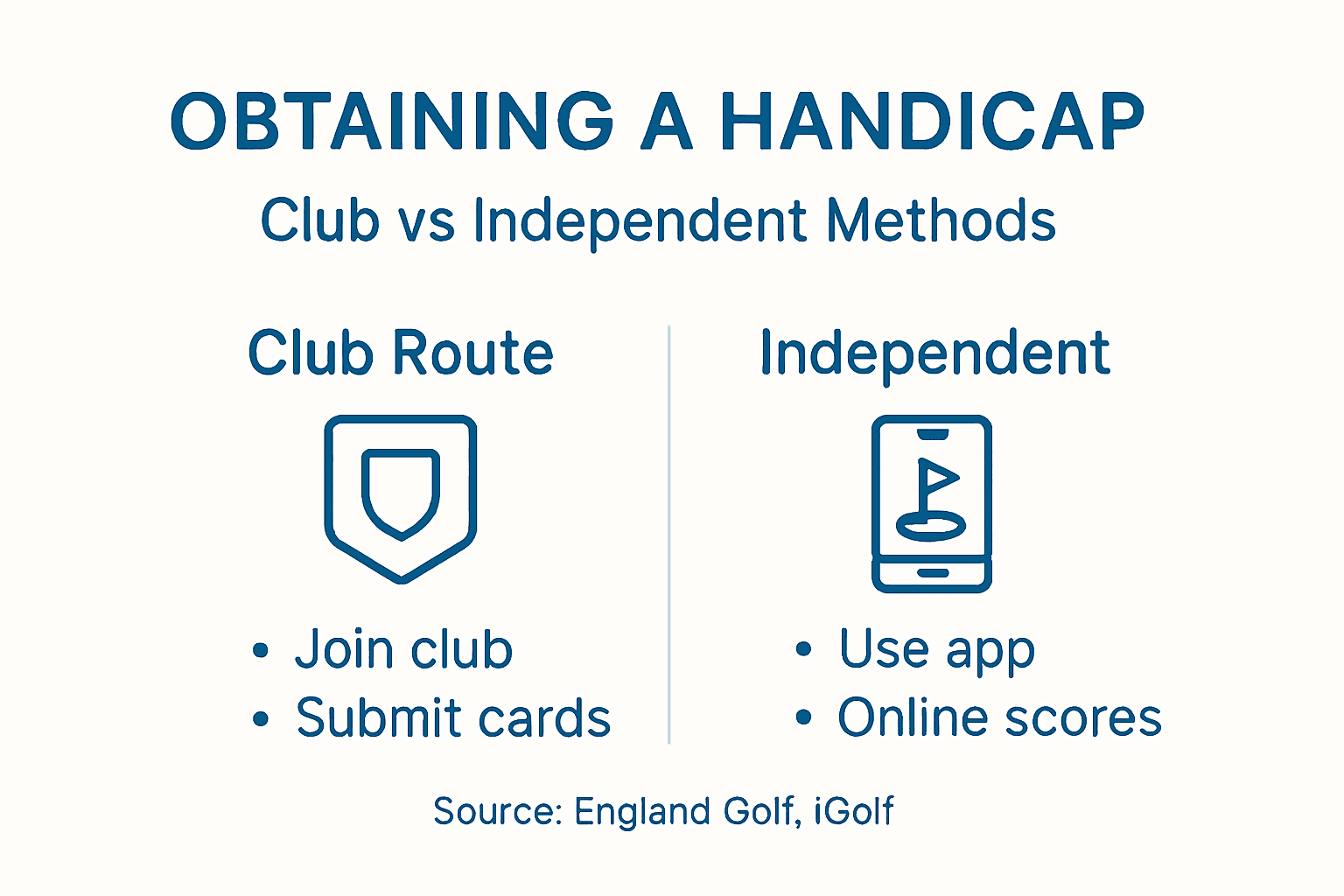
For those preferring independence, non-club platforms offer genuine alternatives. Getting a golf handicap without club membership is now straightforward through iGolf subscriptions. You simply use the MyEG app to record your scores from any recognised course, and they feed directly into your official handicap record. This flexibility has transformed golf for nomadic players and those who prefer playing different courses.
The table below summarises key differences between traditional club-based and new independent handicap services in the UK:
| Aspect | Club-Based Handicap | Independent Services (e.g., iGolf) |
|---|---|---|
| Membership required | Yes, with annual fees | No club membership needed |
| Competition access | Club events and tournaments | Some open competitions only |
| Score verification | Club officials verify entries | Digital or self-verification via app |
| Use of multiple courses | Restricted to club course often | Any recognised UK course |
Once established, maintaining your handicap means submitting scores regularly. The system uses your best eight scores from your most recent twenty rounds, so consistency matters more than perfection. Submit every score you play in competition or serious social rounds. This continuous flow of data keeps your handicap accurate and reflective of your actual playing ability.
Updates happen automatically. Your Handicap Index adjusts daily as new scores are processed, giving you real time feedback on your progress. Watch it improve as your game sharpens, or climb if you’re struggling. It’s transparent and honest.
Pro tip: Keep your handicap accurate by submitting all qualifying scores promptly through your chosen platform, whether club or iGolf, because delays in submission can mean a stale handicap that doesn’t reflect your current form.
Role of handicaps in competitions and social play
Handicaps transform golf from a sport where only players of identical ability can compete fairly into one where anyone can play anyone. A 20-handicap golfer genuinely competing against a scratch golfer is now possible because handicaps adjust scores based on playing ability. This levelling effect is what makes golf unique amongst competitive sports.
In social play with friends, handicaps create genuine matches regardless of skill differences. When you play a friendly round with a better golfer, your handicap strokes are subtracted from your score to produce a net result. Suddenly, the match is genuinely competitive. Using handicaps for fair play across course difficulty levels means your social rounds stay interesting and close.
Competitions work similarly but with additional structure. Your Course Handicap converts to a Playing Handicap depending on the competition format and any handicap allowances the club applies. A singles competition might use 100 percent of your Course Handicap, meaning you get all your strokes. A fourball format might use 90 percent, creating tighter competition amongst teams of four.
Different formats require different approaches. Stableford competitions award points based on net score performance rather than pure strokeplay. Match play competitions work hole by hole rather than card totals. In all cases, handicaps ensure a golfer shooting 85 has a genuine chance against someone shooting 75, because net scores determine the winner.
Clubs can adjust handicap allowances to suit their membership. Some clubs increase allowances to make competitions more inclusive for higher handicappers. Others reduce them to increase competitiveness amongst lower handicappers. These adjustments keep club competitions engaging for all ability levels.
Social scores matter too. You can submit scores from casual rounds with friends, meaning every time you play counts towards your handicap. This inclusivity means competition and social golf merge seamlessly.
Pro tip: Before entering any competition, check the specific handicap allowances and format your club applies, as different events use different percentages of your Course Handicap, affecting how many strokes you actually receive.
Common mistakes and pitfalls to avoid
One of the biggest handicap mistakes golfers make is neglecting to submit scores regularly. Your handicap only reflects what you put in. Missing submissions means your index becomes stale and no longer represents your actual ability. If you’ve improved significantly but haven’t recorded those rounds, your handicap stays artificially high, costing you strokes in competitions.
Another critical error is submitting inaccurate scores. Double check your card before submitting. A simple arithmetic error or misrecorded hole score can skew your entire handicap calculation. Avoiding common handicap calculation mistakes means verifying your figures before they’re officially recorded.
Failing to understand Course Handicap conversion trips up many golfers. Your Handicap Index is just the starting point. Each course has different ratings and slopes, so your actual playing handicap changes depending where you play. Playing at a difficult course with an incorrect handicap understanding means you might miss strokes you’re entitled to, or claim strokes you shouldn’t have.
Some golfers only submit competition scores, ignoring social rounds. The WHS welcomes all qualifying scores. Submitting casual rounds actually gives a more complete picture of your ability and prevents your handicap becoming inflated from only recording your best competition days. Play regularly and submit everything.
Confusing your Handicap Index with your Course Handicap causes real problems. Your Index stays constant across all courses. Your Course Handicap changes. Know which number applies where. A common pitfall is using your Index when you need your Course Handicap for a specific event.
Forgetting to check competition format rules before playing is costly. Different formats apply different handicap allowances. Entering an event thinking you get your full Course Handicap when the club uses 90 percent allowances means you’ve miscalculated your expected score entirely.
Pro tip: Always verify your submitted scores are correct before they process, keep records of all rounds you submit, and double check the specific handicap allowance your club applies for each competition format.
Gear Up for Genuine Improvement with MoreSports
Understanding your golf handicap is the first step towards levelling the playing field and truly tracking your progress. Whether you are just establishing your Handicap Index or fine-tuning your Course Handicap for competitive play, having the right golf equipment and apparel can make a tangible difference in your comfort and performance. MoreSports offers a wide range of quality golf gear from trusted brands so you can feel confident every time you step onto the course.

Take control of your game today by choosing from our extensive selection at MoreSports. Enjoy competitive prices, free UK delivery on orders over £25, and a 90-day return policy that puts your satisfaction first. Exploring our golf gear range helps ensure you are equipped to play at your best and maintain your handicap accurately. Start shopping now and turn your handicap into your personal success story.
Frequently Asked Questions
What is a golf handicap and why is it important?
A golf handicap is a numerical representation of a golfer’s playing ability, allowing players of different skill levels to compete fairly. It adjusts scores based on course difficulty, making matches more competitive regardless of the participants’ skill levels.
How is a golf handicap calculated?
A golf handicap is calculated using a Handicap Index derived from your best eight scores from the last twenty rounds, adjusted by the Course Rating and Slope Rating of the course you are playing. This method ensures your handicap reflects your true ability while factoring in course difficulty.
Do I need to be a member of a golf club to obtain a handicap?
No, you do not need to be a member of a golf club to obtain a handicap. There are independent platforms like iGolf that allow you to establish and maintain a handicap without traditional club membership.
How often does my golf handicap update?
Your golf handicap updates regularly, typically on a daily basis, each time you submit a new score. This ensures your Handicap Index accurately reflects your current playing ability based on the best eight scores out of your last twenty rounds.