 No Duties or Customs Fees For EU & UK Customers
 Express Tracked UK Delivery On 1000s of Items
 90 Day Returns

Golf Putter Length Guide: Chart, Fit Tips, Measurements
RYA putter that's too long forces you to stand unnaturally upright; too short, and you're hunching over every putt. Either way, your stroke suffers. Getting your golf putter length guidelines right is one of the simplest changes you can make to sink more putts consistently, yet most golfers never bother to check.
The correct putter length depends on your height, arm length, and natural putting posture. There's no single answer, but there is a straightforward process to find yours. In this guide, we'll walk you through height-to-length charts, wrist-to-floor measurements, and practical fitting tips so you can choose the right putter length with confidence.
At MoreSports, we stock putters from brands like TaylorMade and MacGregor in a range of lengths and styles. Whether you're buying your first putter or replacing one that's never felt quite right, understanding proper putter fit will help you make a smarter purchase, and a real difference on the green. Let's get into the numbers and methods that matter.
What putter length changes in your setup
Putter length affects far more than how comfortable you feel at address. It directly influences your posture, your eye position, and the path your stroke takes. When any of these three things are off, you'll struggle to start the ball on the line you're aiming at, no matter how sound your technique is.
How length affects your posture
A putter that's too long pushes your hands too high, which forces your arms to angle upward and your shoulders to tilt awkwardly. You'll instinctively stand taller to compensate, shifting your weight back and changing your balance. A putter that's too short pulls your hands low, causing you to hunch forward, drop your shoulders, and put unnecessary strain on your lower back over the course of a full round.
The ideal length allows your arms to hang naturally from your shoulders, with a slight bend at the elbows and your hands sitting directly below your shoulder joints. That natural hanging position is what gives you the most consistent, repeatable stroke.
Getting your posture right at address is the single biggest thing putter length controls, and it's the foundation for every other part of a sound putting stroke.
How length affects your stroke path
Your stroke path follows directly from your posture. Good posture creates a pendulum motion driven by the shoulders, where the putter swings back and through on a consistent arc. A putter that forces you into a cramped or extended position breaks that pendulum, introducing wrist interference or a push-pull motion that makes direction and distance control unpredictable.
When you use a putter matched to your build, your stroke becomes simpler to repeat. Your shoulders do the work, your wrists stay quiet, and the face stays square through impact more naturally.
How length affects your eye position and aim
Your eye position at address determines whether you see the target line accurately. The ideal setup places your eyes directly over the ball, or just fractionally inside the line. A putter that's too long shifts your eyes outside the ball, making the line appear to curve left. A putter that's too short brings your eyes too far inside, producing a false read in the opposite direction.
This is why a proper fitting process, like the one in this golf putter length guide, starts with physical measurements rather than guesswork. Small misalignments at address stack up across 30 or 40 putts per round, and the wrong putter length is often the root cause of errors that golfers mistakenly attribute to their stroke.
Step 1. Measure height and wrist-to-floor
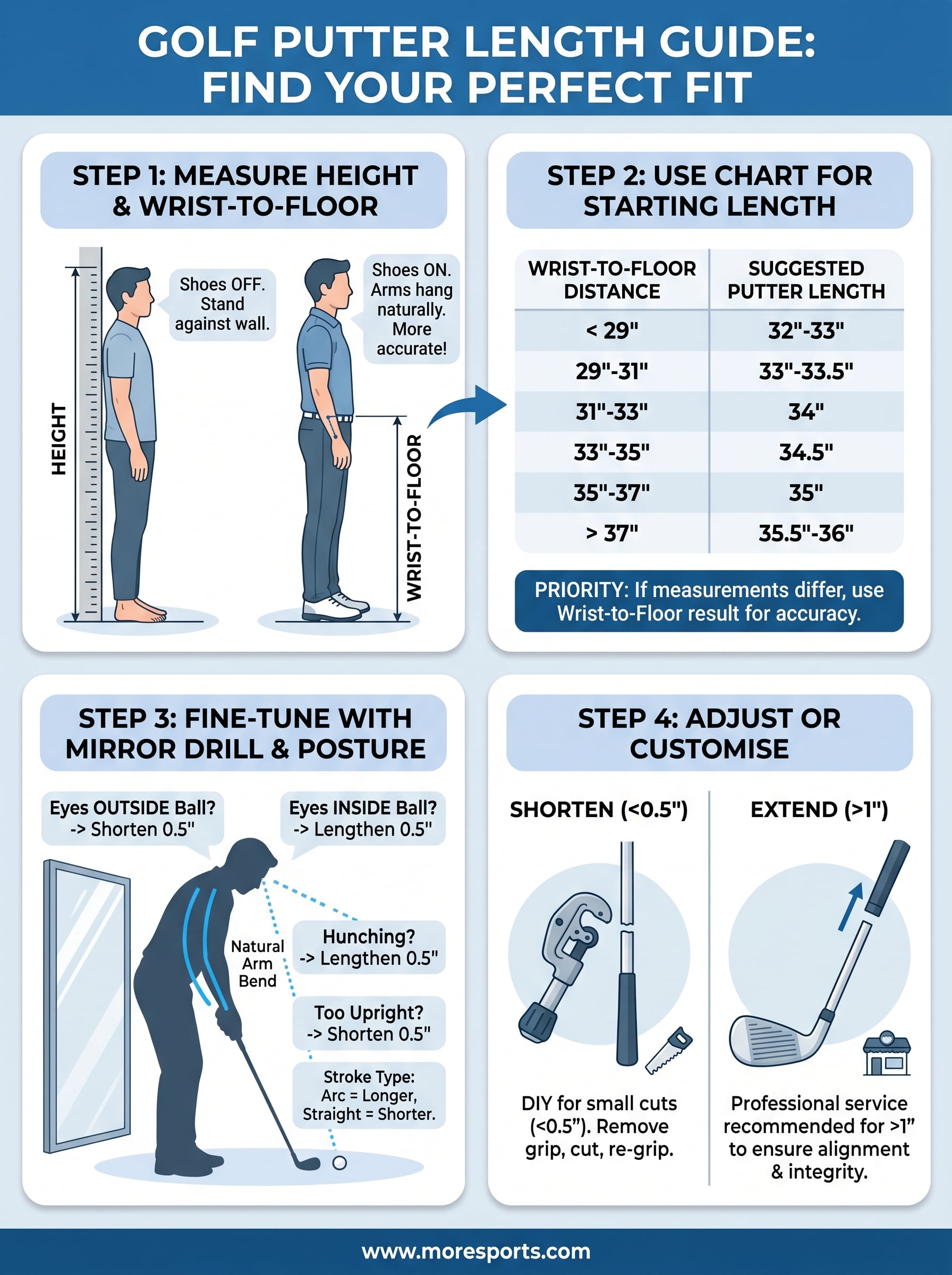
Two measurements give you the data you need to find your correct putter length: your standing height and your wrist-to-floor distance. Height alone gives a rough starting point, but the wrist-to-floor measurement accounts for individual differences in arm length and build that height charts can't capture on their own. Both take under two minutes to complete.
How to measure your height
Stand against a wall in flat shoes or bare feet, as golf shoes add height that could skew your result. Have someone place a flat object, like a book or ruler, level on the top of your head and against the wall, then mark the point. Measure from the floor to that mark in centimetres or inches and note it down.
Write the number down immediately rather than relying on memory, because you'll be using both measurements together in the next step. If you're measuring alone, a doorframe and a pencil work just as well as a helper.
How to take a wrist-to-floor measurement
This is the most accurate input in any golf putter length guide because it reflects how far your hands naturally hang from the ground. To take it correctly, follow these steps:
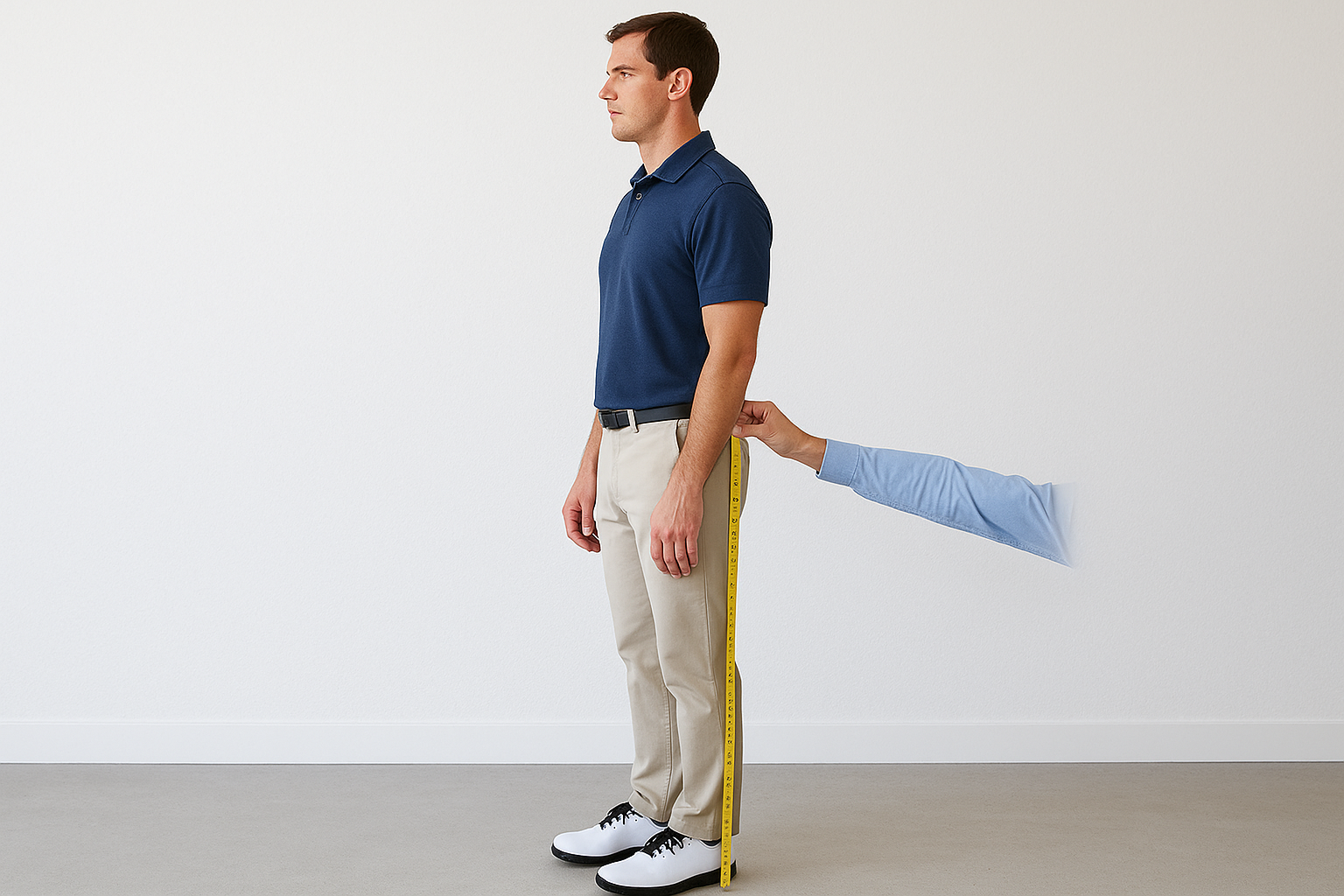
- Put on your golf shoes, as you'll wear them on the course.
- Stand upright on a flat, hard surface with your arms hanging naturally at your sides.
- Let your wrists relax so your hands fall into their natural resting position.
- Have someone measure from the crease of your wrist straight down to the floor.
- Record the result in inches, as most putter length charts use imperial measurements.
The wrist-to-floor number matters more than height alone, so take it carefully and repeat it once to confirm accuracy.
Both figures together give you a reliable foundation for the chart in the next step.
Step 2. Use the chart to pick a starting length
With both measurements recorded, you can now cross-reference them against a standard fitting chart to identify your starting putter length. Treat this number as a baseline rather than a definitive answer. As any solid golf putter length guide will tell you, the chart gets you close, and the fine-tuning in the next step gets you exact.
Height-to-length chart
Your standing height gives you a broad starting point that works well for most golfers with average arm length proportions. Use the table below to find your initial putter length.
| Your Height | Suggested Putter Length |
|---|---|
| Under 5'0" (under 152 cm) | 32" |
| 5'0" to 5'4" (152 to 163 cm) | 33" |
| 5'4" to 5'6" (163 to 168 cm) | 33.5" |
| 5'6" to 5'8" (168 to 173 cm) | 34" |
| 5'8" to 6'0" (173 to 183 cm) | 34.5" |
| 6'0" to 6'2" (183 to 188 cm) | 35" |
| Over 6'2" (over 188 cm) | 35.5" to 36" |
Wrist-to-floor refinement chart
Your wrist-to-floor measurement often shifts the height-based figure by half an inch in either direction. Golfers with longer arms than average for their height should drop down slightly; those with shorter arms should go up. Check your wrist-to-floor number against the table below.
| Wrist-to-Floor Distance | Suggested Putter Length |
|---|---|
| Under 29" | 32" to 33" |
| 29" to 31" | 33" to 33.5" |
| 31" to 33" | 34" |
| 33" to 35" | 34.5" |
| 35" to 37" | 35" |
| Over 37" | 35.5" to 36" |
If the two charts point to different lengths, prioritise the wrist-to-floor result, as it reflects your actual anatomy more precisely than height alone.
Where both measurements agree, you have a confident starting length to take into the next step.
Step 3. Fine-tune length for posture and stroke
The chart gives you a solid starting point, but your natural putting posture and stroke style often call for a small adjustment of half an inch or so. This step shows you how to test your starting length in real conditions and identify whether you need to go slightly longer or shorter before committing to a purchase.
Test your setup with a simple mirror drill
Stand in your natural putting stance in front of a full-length mirror or large window. Hold your putter with your regular grip and address an imaginary ball. Check three things: your eye position (should be directly over or fractionally inside the target line), your arms (should hang with a slight elbow bend), and your shoulders (should sit level, not tilted). If any of these look off, your length needs adjusting.
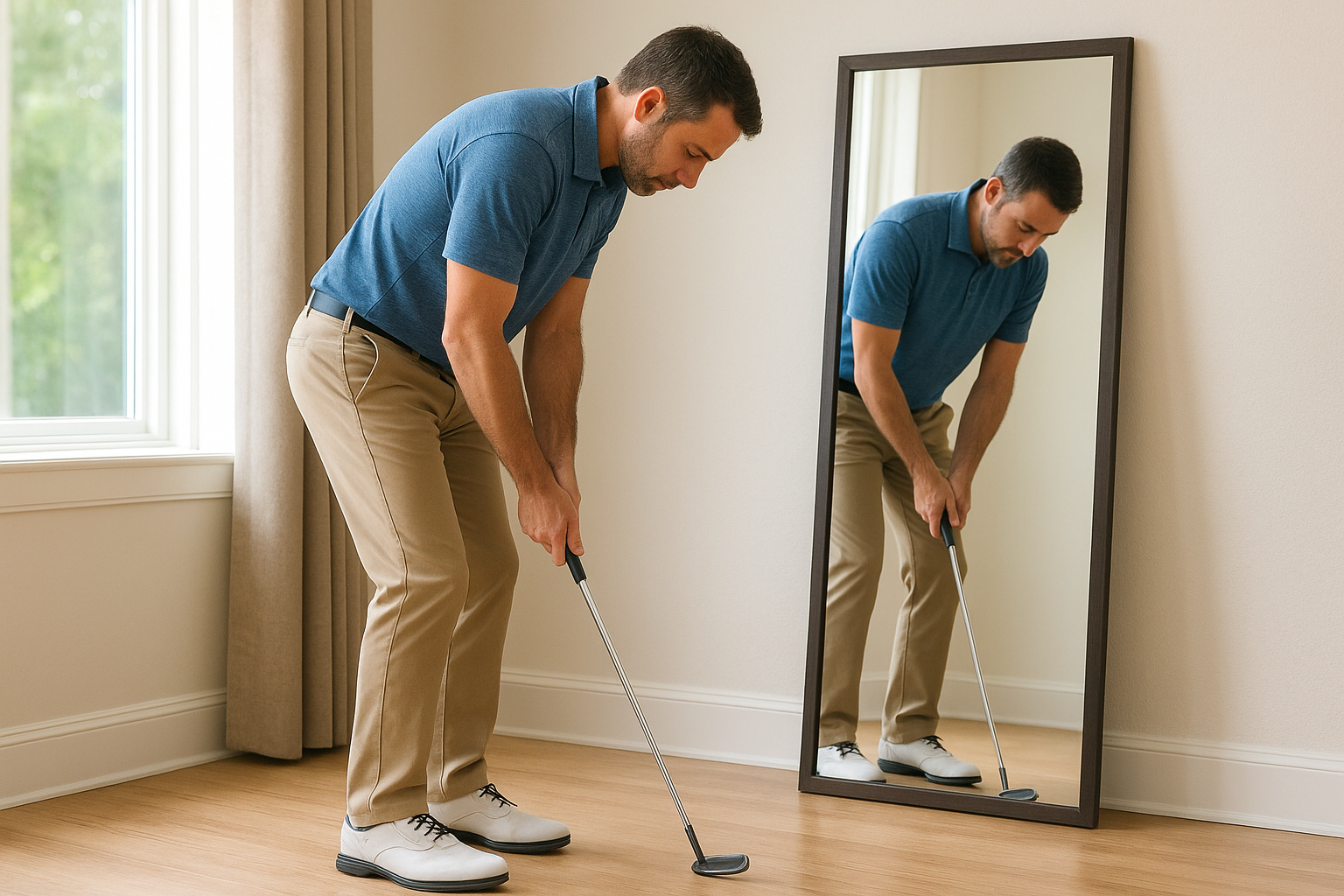
- Eyes outside the ball: drop 0.5" in length
- Arms stretched or elbows locked: drop 0.5" in length
- Hunching forward noticeably: add 0.5" in length
- Standing too upright with hands high: drop 0.5" in length
Account for your stroke style
Your stroke type influences the ideal length as much as your build does. An arc stroke, where the putter swings slightly inside on the backswing, suits a more upright posture, which often means a slightly longer putter works well. A straight-back-straight-through stroke suits a more bent-over address position, which often works better with a slightly shorter length.
If you putt with a pronounced arc, try the longer end of your chart range; if your stroke is straight, lean toward the shorter end.
Any solid golf putter length guide will tell you these adjustments are minor, but half an inch in the wrong direction can be the difference between a consistent stroke and one that breaks down under pressure.
Step 4. Adjust or customise your current putter
You don't always need to buy a new putter to get the right length. If your current model is close to your ideal measurement but slightly off, adjusting it is often quicker, cheaper, and more straightforward than starting fresh. This step covers the two most practical options: shortening a putter yourself and getting one extended through a professional.
Shortening your putter at home
Cutting a putter down is a job most golfers can do at home with basic tools. You'll need a pipe cutter or hacksaw, a vice or grip strip to hold the shaft, new grip tape, and a replacement grip if the existing one won't slide back cleanly. Follow these steps:
- Remove the grip by cutting it away or using compressed air.
- Strip old grip tape from the shaft.
- Mark the shaft at your target length using a permanent marker, measuring from the bottom of the hosel.
- Clamp the shaft securely and cut along your mark with a pipe cutter or fine-tooth hacksaw.
- Smooth any rough edges with fine sandpaper.
- Apply fresh grip tape, let it set, and re-grip.
Only cut a putter if you're removing half an inch or less; anything more risks changing the swing weight noticeably.
Getting a putter extended
Adding length requires a shaft extension, which is a short section of steel or graphite rod inserted into the top of the shaft before re-gripping. Most golf retailers and club repair workshops carry these, and fitting one takes under 30 minutes. You can also buy extension rods to do it yourself, but this golf putter length guide strongly recommends a professional fitting service if you're adding more than an inch, as alignment and shaft integrity both need checking before you use the putter on the course.
Final checks before you commit
Before you buy or modify anything, run through three quick checks. First, confirm your wrist-to-floor measurement matches your chart result from Step 2. Second, verify that your posture drill in Step 3 showed your eyes sitting over the ball with your arms hanging naturally. Third, if you're adjusting an existing putter, double-check that the new length still balances comfortably in your hands at a normal grip pressure. If all three boxes are ticked, you're ready to commit with confidence.
This golf putter length guide gives you everything you need to find your ideal fit without guesswork. A putter matched to your build, posture, and stroke style removes one of the most common and correctable sources of error on the green. When you're ready to shop, browse our full range of putters and golf equipment at MoreSports and find the right model at a competitive price.