 No Duties or Customs Fees For EU & UK Customers
 Free UK Delivery On Orders Over £30
 90 Day Returns

Golf Shaft Flex Guide: Charts, Swing Speed, And Fit Tips
RYChoosing the wrong shaft flex can quietly sabotage your game. Too stiff, and you'll struggle to generate consistent ball flight. Too whippy, and accuracy goes out the window. That's exactly why a proper golf shaft flex guide matters, it gives you the data you need to match your equipment to your actual swing, not someone else's. Whether you're upgrading a driver or building a full set, shaft flex is one of the most impactful fitting decisions you'll make.
This guide breaks down each flex category, from Ladies through to Extra Stiff, and pairs them with swing speed benchmarks and comparison charts so you can see where you fit. We'll also cover how factors like tempo and transition affect your ideal flex beyond raw speed numbers alone. It's the kind of detail that separates a good club fitting from a great one, and it's something we help golfers with every day at MoreSports, where we stock shafts and clubs across all flex options from brands like TaylorMade, Titleist, and Callaway.
Let's get into the specifics so you can find your best match.
What shaft flex means and what affects it
Shaft flex refers to how much the shaft bends during your swing. Every shaft, whether it's in a driver, iron, or wedge, has a degree of stiffness built into it. When you swing, that shaft loads and unloads energy at a specific point in your downswing, and that timing directly influences where the clubface is at the moment of impact. Get it right, and the face squares up cleanly. Get it wrong, and you're compensating without knowing why, often blaming your swing for a problem that started in your equipment.
The flex categories explained
Most shaft manufacturers use five standard flex categories: Ladies (L), Senior (A), Regular (R), Stiff (S), and Extra Stiff (X). Some brands also produce an intermediate Regular-Stiff (R/S) option, particularly for mid-handicap players who sit between categories. The table below gives you a quick-reference overview of each flex and the type of player it's generally designed for.
| Flex | Label | Typical Player Profile |
|---|---|---|
| Ladies | L | Slower swing speeds, often beginners or casual players |
| Senior | A | Moderate swing speeds, older or less powerful swingers |
| Regular | R | Average amateur with a smooth, moderate-paced swing |
| Stiff | S | Stronger amateur or low-handicap player with faster tempo |
| Extra Stiff | X | Tour-level or high-speed players with aggressive transitions |
Worth noting: these labels are not standardised across brands, so an "S" flex from one manufacturer may feel noticeably different from an "S" flex from another. That inconsistency is one reason this golf shaft flex guide focuses on swing speed data and measurable benchmarks rather than flex labels alone, because the label by itself tells you very little about how the shaft will actually perform in your hands.
Always cross-reference flex labels with swing speed data, because the label alone gives you an incomplete picture of how a shaft will actually behave.
What actually controls your ideal flex
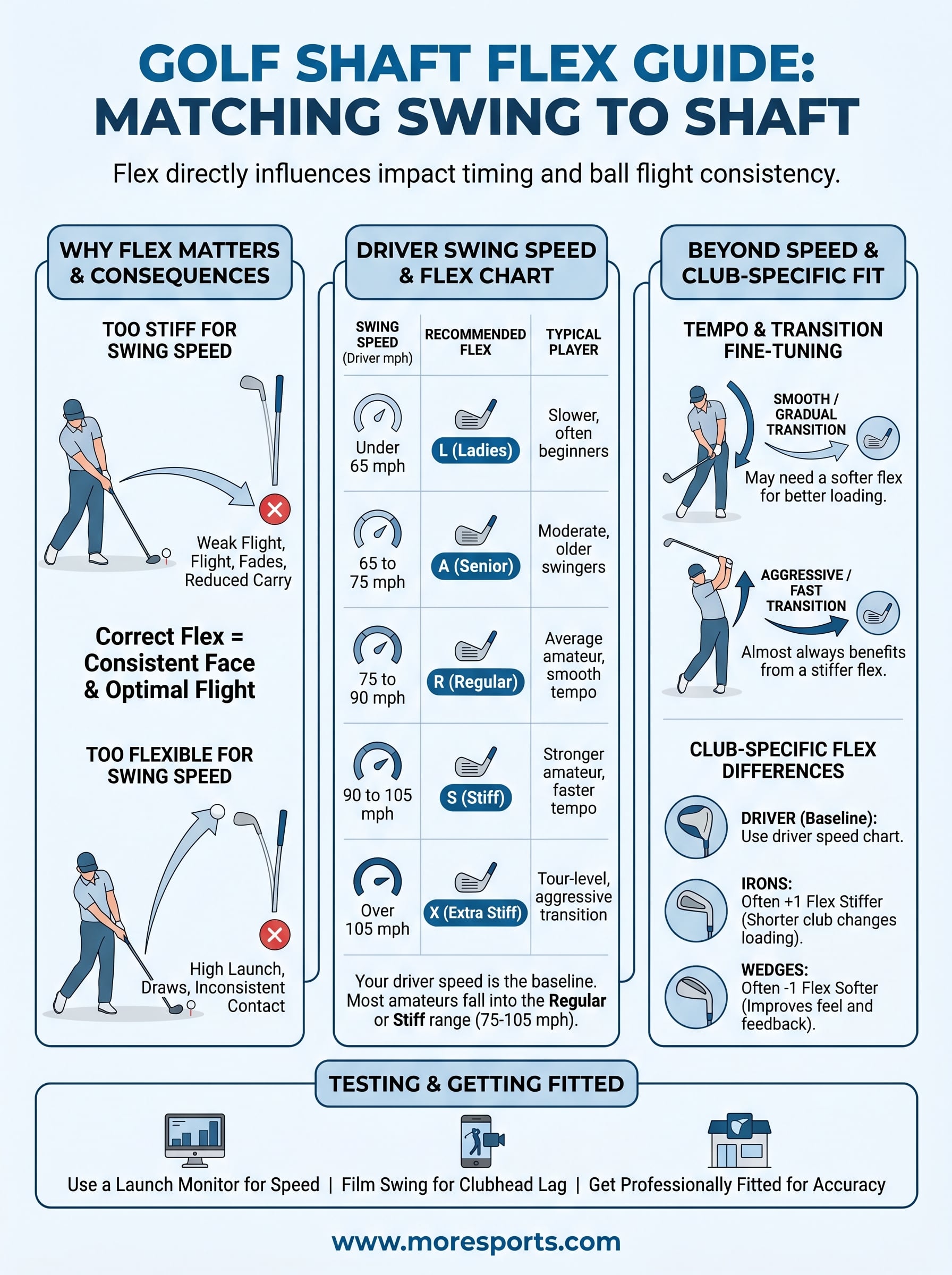
Swing speed is the primary factor, and we'll cover the specific numbers in the chart section below. But speed alone does not tell the full story. Your tempo and transition play a significant role too. A player who swings at 90 mph with a smooth, gradual transition will often perform better with a Regular shaft, while someone at the same speed who fires aggressively from the top of the backswing may need Stiff to prevent the shaft from over-loading through impact.
Your attack angle and release point also influence how the shaft behaves at the bottom of the swing arc. A steep downswing loads the shaft earlier and more abruptly, which generally calls for a stiffer option to maintain control. A shallower, sweeping action tends to load the shaft later in the downswing, which often suits a softer flex. These nuances are exactly why a proper fitting, even a basic one, delivers far more reliable results than guessing based on your handicap or the flex your playing partner uses.
Why shaft flex changes your ball flight
The shaft doesn't just connect your hands to the clubhead; it stores and releases energy throughout your downswing. As you transition from backswing to downswing, the shaft bends backward slightly, then snaps forward through impact. The timing of that release determines the exact position of the clubface when it meets the ball, and that position controls your launch angle, spin rate, and shot direction.
How shaft loading affects impact
During your downswing, the shaft flexes toward the target as the clubhead lags behind your hands. At the moment of impact, a correctly matched shaft will have fully released, squaring the face and adding a small amount of dynamic loft to the shot. A shaft that matches your swing speed and tempo completes this cycle at exactly the right moment, which is why this golf shaft flex guide focuses so heavily on measurable numbers rather than generic label recommendations.
The shaft flex that suits you best is the one that completes its release cycle at impact, not a fraction before or after.
What happens when flex is wrong
If your shaft is too stiff for your swing speed, it will not fully load and release during the downswing. The result is a weak ball flight that often fades or cuts, a lower-than-expected launch, and reduced carry distance. You might blame your swing for a problem that actually starts with your equipment.

When the shaft is too flexible, it over-loads through the downswing and releases too early. That produces excess dynamic loft, a higher spinning ball flight, and a tendency to draw or hook. Some players also experience inconsistent contact because the clubhead moves slightly off-plane through impact, making it very difficult to repeat the same shot shape under pressure.
Shaft flex chart by swing speed
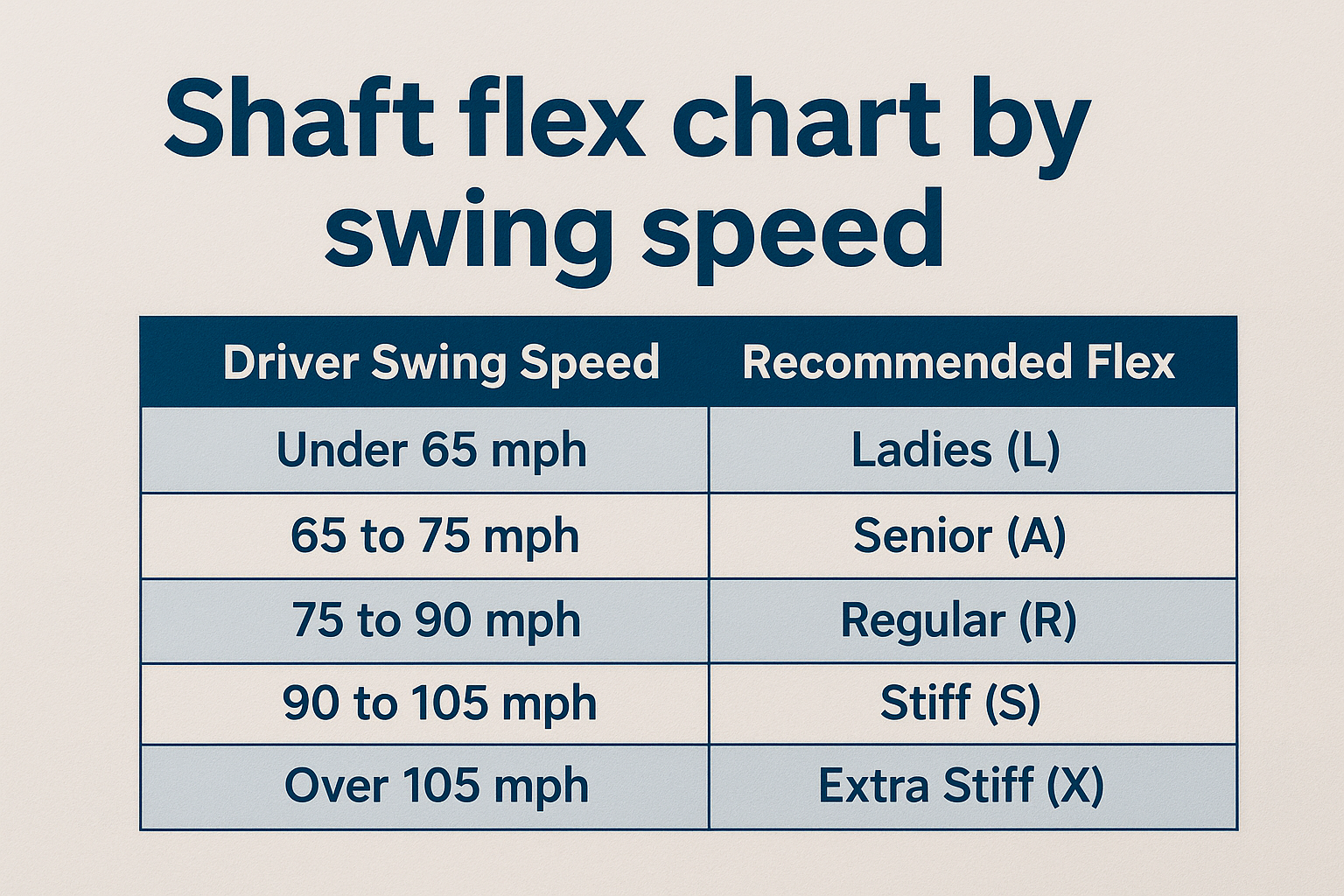
Swing speed is the most reliable starting point in any golf shaft flex guide, because it gives you a measurable number to work with rather than a vague sense of how hard you swing. The figures below are based on driver swing speed, which is the standard metric used across the fitting industry. If you only know your 6-iron speed, multiply it by roughly 1.2 to get a close estimate of your driver speed.
Reading the numbers correctly
The table below maps driver swing speeds to their recommended shaft flex. These ranges represent the middle of each flex category, so if your speed lands right at a boundary, other factors like tempo and transition will help you decide which way to lean.
| Driver Swing Speed | Recommended Flex |
|---|---|
| Under 65 mph | Ladies (L) |
| 65 to 75 mph | Senior (A) |
| 75 to 90 mph | Regular (R) |
| 90 to 105 mph | Stiff (S) |
| Over 105 mph | Extra Stiff (X) |
Your swing speed is a guide, not a guarantee, so treat the chart as your starting point rather than your final answer.
Most amateur golfers fall into the Regular or Stiff range, which covers the 75 to 105 mph bracket. If you play regularly and have never had your speed measured, a launch monitor session at a fitting centre or even a short range visit with a basic device will give you a reliable number within minutes.
When your speed sits between categories
Sitting between two flex categories is very common, and it is where your tempo and transition style become the deciding factor. If your speed reads at 90 mph with a smooth, unhurried transition, Regular flex will typically load and release more cleanly than Stiff. An aggressive, fast transition at the same speed almost always benefits from moving up to Stiff instead.
How to choose the right flex for each club
Shaft flex is not a single decision you make once for your whole bag. Different clubs load and release differently, which means your ideal flex can vary depending on the club you are swinging. Most golfers assume that whatever flex works in their driver should apply across everything, but that overlooks some important mechanical differences between club types.
Driver and fairway woods
Your driver shaft is the longest club in your bag, which amplifies the effect of any mismatch between your swing and the shaft. A longer shaft creates more tip deflection during the downswing, so even a small error in flex selection produces a more visible result in ball flight. Use your driver swing speed as the primary reference point in any golf shaft flex guide, since the driver chart you have already reviewed applies directly here. Fairway woods are shorter, which reduces tip movement slightly, so some players find they can play the same flex in both. Others prefer to move up half a flex in their fairway wood shaft for added control on tighter shots from the turf.
Your driver flex sets the baseline for your fitting, but test your fairway woods separately if you regularly miss with them despite a well-fitted driver.
Irons and wedges
Iron shafts behave differently from wood shafts because the club is shorter, heavier, and swung on a steeper plane. Most standard iron fittings recommend moving one flex stiffer than your driver flex as a rough starting point, since the shorter length changes how the shaft loads. If your driver flex is Regular, you might find Regular or even Stiff works better in your irons depending on your transition speed. Wedges are a different case altogether. Because you rarely swing wedges at full speed, a softer flex in wedges actually improves feel and feedback without sacrificing control, and most players benefit from going one step softer than their iron flex in the scoring clubs.
Fitting and testing tips at home and in store
You do not need to spend a fortune to start gathering useful data about your shaft flex. A basic launch monitor session at a local golf retailer or driving range gives you your swing speed within minutes, and many golf shops offer this service for free as part of a product consultation. Pairing that speed with the benchmarks in this golf shaft flex guide gives you a solid foundation before you spend anything on new equipment.
Testing at home
Filmed slow-motion video of your swing is one of the most accessible home testing methods available. Record yourself from face-on and down-the-line using your phone, then look for clubhead lag and shaft lean at impact. If the shaft appears to bow heavily through the hitting zone, the flex may be too soft for your speed. If the shaft looks almost perfectly straight with minimal forward lean, it may be too stiff to load properly.
Pay close attention to your ball flight patterns across multiple practice sessions as well. Consistent fades or weak carries often point to a shaft that is too stiff, while persistent draws or high, ballooning shots tend to suggest too much flex. Neither observation tells the full story on its own, but together they build a clear and useful picture.
Tracking your miss patterns over several rounds gives you more reliable data than any single range session alone.
Getting fitted in store
A professional fitting session removes the guesswork entirely. A trained fitter will measure your swing speed, tempo, and launch data simultaneously, which is far more accurate than speed alone. Ask the fitter to test at least two flex options back to back so you can feel the difference directly. Comparing ball flight and dispersion data side by side, rather than relying on feel alone, makes it much easier to commit to the right shaft with real confidence.
Next steps to dial in your shaft
You now have everything you need from this golf shaft flex guide to make an informed decision about your next shaft. Start by measuring your driver swing speed if you have not already done so, since every recommendation in this guide flows from that single number. From there, layer in your tempo and transition style to narrow down your category, then test at least two options back to back before committing.
Once you have a clear target flex in mind, focus on getting the right shaft into the right club rather than changing your whole bag at once. A single well-fitted driver shaft can shift your confidence and consistency faster than any other equipment change. If you are ready to browse clubs and shafts from brands like TaylorMade, Titleist, and Callaway, head over to MoreSports where you will find a wide selection across all flex options at competitive UK prices.