 No Duties or Customs Fees For EU & UK Customers
 Express Tracked UK Delivery On 1000s of Items
 90 Day Returns

How To Choose A Golf Rangefinder: A Simple Buying Guide
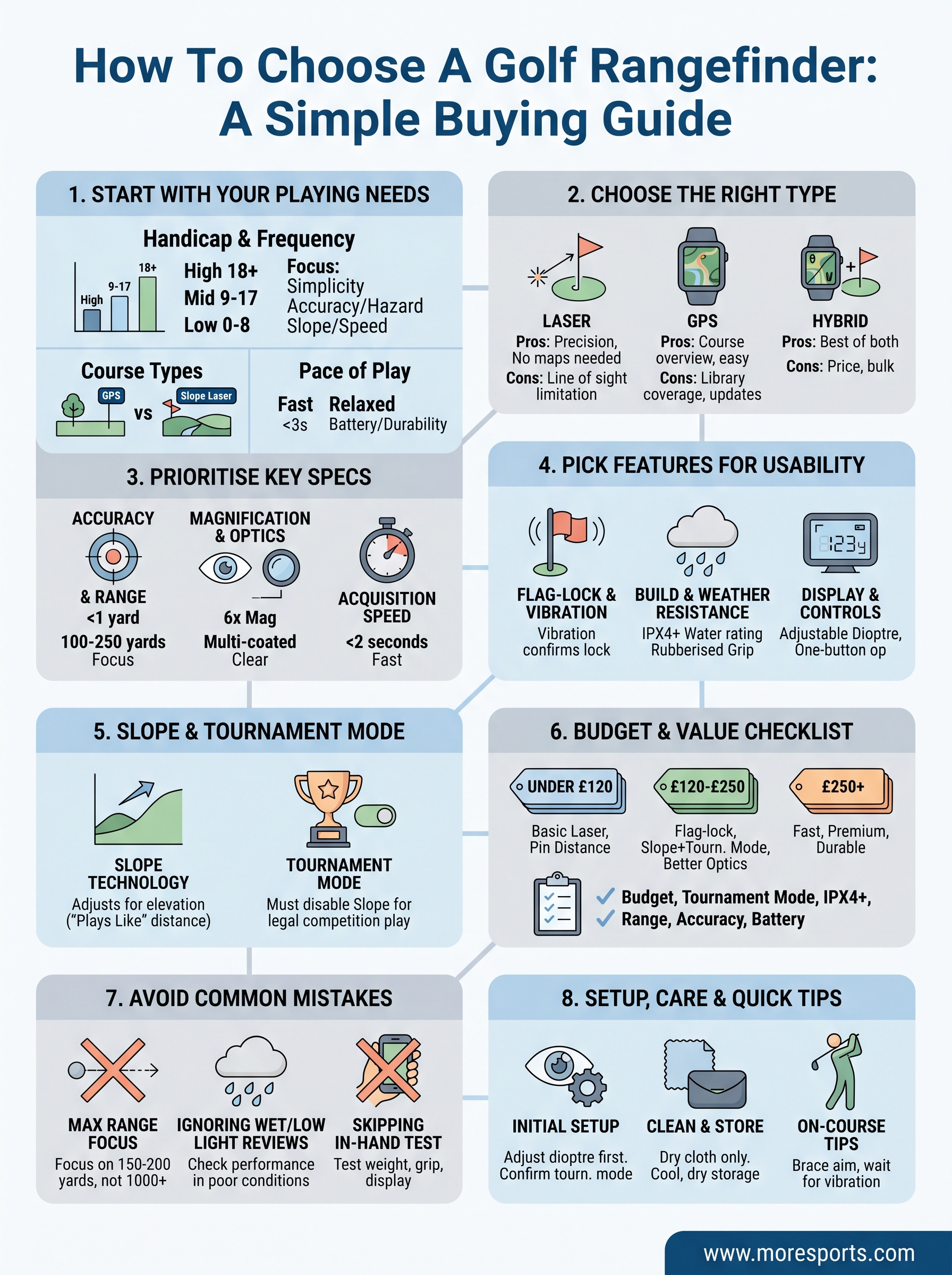
RYKnowing how to choose a golf rangefinder can save you from wasting money on a device that doesn't match your game. With models ranging from under £100 to well over £500, the differences in accuracy, features, and build quality are significant, and those differences directly affect your performance on the course.
A good rangefinder gives you exact yardages to pins, hazards, and layup points, removing the guesswork that costs strokes. But between laser vs. GPS, slope vs. non-slope, and a dozen other specs, the buying process can feel overwhelming. It doesn't need to be. Once you understand what actually matters, and what's just marketing noise, picking the right one becomes straightforward.
At MoreSports, we've helped over 500,000 customers find the right golf gear, from clubs and clothing to the tech that sharpens your game. We stock rangefinders and accessories from trusted brands, and our team knows what works because we use this equipment ourselves.
This guide breaks down every feature worth considering, compares the main types of rangefinders, and gives you clear recommendations based on budget and skill level. By the end, you'll know exactly which rangefinder suits your game, and why.
Start with your playing needs
Before you look at specs or price tags, you need to take an honest look at your own game. Your handicap, how often you play, and the types of courses you visit all shape which rangefinder will actually help you. A device loaded with advanced features might overwhelm a beginner, while a basic model can frustrate a low-handicapper who relies on precise layup data on tight fairways. Getting this step right is the foundation of knowing how to choose a golf rangefinder that genuinely improves your rounds rather than complicates them.
Know your handicap and how often you play
Your current skill level tells you a great deal about what you need from a rangefinder. High-handicap golfers (18 and above) benefit most from simplicity: a clear distance to the flag and basic hazard awareness. At that stage, shaving strokes comes from swing consistency, not from measuring slope-adjusted yardages to the nearest half yard. A straightforward model in the lower price range fits that profile well and won't feel like unnecessary complexity.
Mid-handicap players (9 to 18) start to benefit from extra data. You're making more informed decisions about club selection, so features like hazard distances and flag-lock technology become genuinely useful rather than a marketing extra. At this level, a rangefinder with solid accuracy, typically within one yard, pays for itself quickly through better shot planning.
If you play fewer than ten rounds a year, a premium rangefinder with advanced slope technology is unlikely to give you a meaningful return on the investment.
Low-handicap golfers and scratch players need the full picture: pin-seeking modes, slope-adjusted yardages, fast target acquisition, and a compact build that doesn't slow down play. Use this quick self-assessment to find where you sit before you start comparing models:
| Handicap range | Rounds per year | Recommended focus |
|---|---|---|
| 18+ | Any | Simplicity, pin distance, ease of use |
| 9 to 17 | 10+ | Accuracy, hazard data, flag-lock |
| 0 to 8 | 15+ | Slope, speed, precision, compact build |
Think about the courses you play most
The layout of your home course and the types of venues you visit regularly should shape your decision. Flat parkland courses with clear sightlines work well with a basic GPS unit because distances to greens are easy to read and elevation changes rarely affect club selection. A laser adds precision on these courses but may not feel essential for most rounds.
Hilly or links-style terrain changes the situation considerably. On undulating ground, the straight-line distance to a flag can mislead your club choice by several yards. A slope-enabled rangefinder gives you a "plays like" distance that accounts for elevation change, which directly improves your decision-making. If you regularly play on courses where uphill and downhill shots are common, slope functionality moves from optional to genuinely important.
Also think about how many different courses you play throughout the year. GPS devices rely on pre-loaded course maps, so the depth of the course library matters if you travel to new venues regularly. Laser rangefinders work anywhere without needing course data at all, which gives you flexibility no GPS model can match out of the box.
Match the device to your pace of play
Some golfers prioritise speed above everything else. If you play in competitions or busy society rounds where pace of play is monitored, you need a rangefinder that delivers a reading in under three seconds without multiple attempts. Flag-lock vibration confirms you've locked onto the pin rather than a tree behind it, which removes hesitation and keeps your group moving.
Casual golfers playing relaxed weekend rounds can afford a slightly slower device without it becoming a real problem. In that case, spending more on battery life and durability rather than raw speed makes more practical sense. Think honestly about the situations you'll use the device in most often, and let that guide which performance traits you actually need versus those that just look good in a spec sheet.
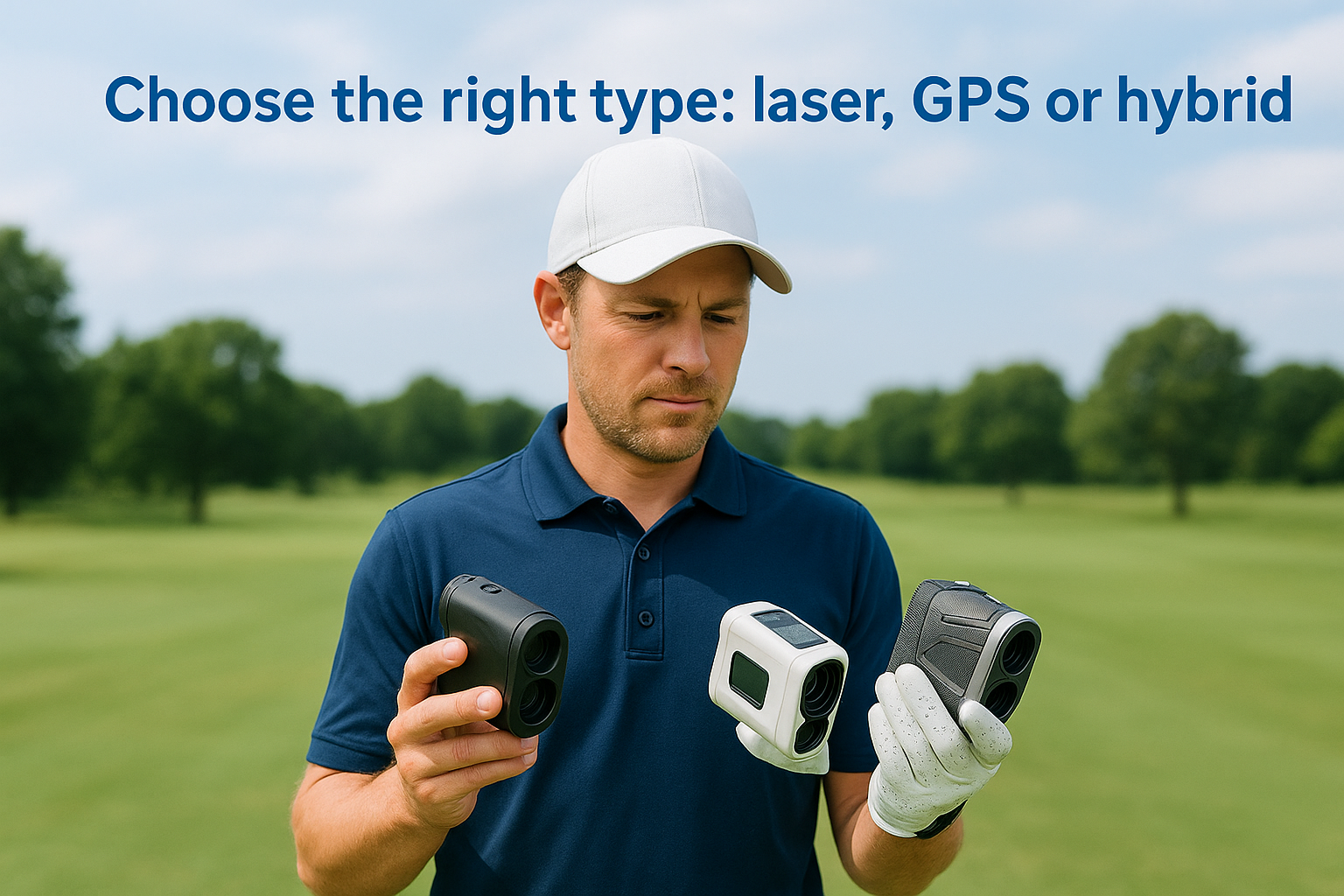
Choose the right type: laser, GPS or hybrid
Once you understand your playing needs, the next decision that shapes how to choose a golf rangefinder is the technology itself. The three main types, laser, GPS, and hybrid, work differently and suit different golfers. Picking the wrong category means you'll either overspend on features you never use or miss the ones you actually rely on every round.
Laser rangefinders: precision on demand
Laser rangefinders work by firing an invisible beam at your target and measuring the time it takes to bounce back. That process gives you an exact distance, typically accurate to within one yard, and it works on any course in the world without needing pre-loaded maps or a mobile signal. You point, press, and get a reading in seconds.
The main limitation is line of sight. If a tree, ridge, or other obstruction sits between you and the flag, the device can struggle to lock onto the right target. On tight or heavily wooded layouts, you may need to attempt a reading from multiple positions before you get a clean result. For most open courses, though, a laser delivers the most reliable pin distance available in a handheld device, which is why it remains the most popular choice among regular golfers.
GPS rangefinders: course overview at a glance
GPS units pull pre-loaded course maps from a built-in database and display distances to the front, middle, and back of greens, along with hazard positions, without you needing to aim at anything. You glance at the screen as you walk to your ball and the yardages are already there, which keeps your pre-shot routine smooth and uninterrupted.
GPS works particularly well for beginners or high-handicappers who find aiming a laser mid-round disruptive to their rhythm.
The trade-off is course library coverage and update frequency. Most reputable GPS devices cover tens of thousands of courses worldwide, but you should confirm your regular venues are included before buying. Some older map files may also not reflect recent course redesigns, so check how frequently the manufacturer pushes updates.
Hybrid rangefinders: best of both worlds
Hybrid devices combine laser accuracy with GPS course mapping in a single unit. You get exact pin distances when you need precision and overhead hole layouts when you want a broader view of the hole ahead. They suit golfers who play a mix of familiar home courses and unfamiliar venues throughout the season.
The downside is price and bulk. Hybrids are typically the most expensive option and can feel heavier than a dedicated laser or GPS unit. If you play frequently at varied venues and want one device to handle every situation, the premium is often justified.
Prioritise the specs that affect accuracy
Once you've settled on the type of rangefinder that suits your game, the specs come down to one core question when deciding how to choose a golf rangefinder: how accurately does it measure distance, and how reliably can you acquire the target you actually want? Two devices can both claim laser accuracy while delivering noticeably different results in the field. Understanding which specs drive real performance stops you from being misled by headline numbers on a product page.
Measurement tolerance and maximum range
Measurement tolerance is the spec that tells you how close to the true distance your reading will be. Most quality laser rangefinders advertise accuracy within plus or minus one yard, and for course use, that's precise enough to make a genuine difference in club selection. Anything wider than one yard introduces the same uncertainty you'd get from eyeballing a yardage marker.
Maximum range matters less than manufacturers suggest. A device rated to 1,000 yards sounds impressive, but the longest shot you'll measure in golf is rarely beyond 250 yards. Focus on how well the unit performs in the 100 to 250-yard range, because that's where you need it most. Look for reviews that test accuracy under varied lighting conditions, not just on a clear day at a static target.
A rangefinder that reads within half a yard on a calm day but drifts to three yards in low light is not a precision tool.
Magnification and optical quality
Magnification determines how clearly you see the target through the eyepiece, which directly affects your ability to aim accurately. A 6x magnification is the standard for golf rangefinders and gives you enough zoom to pick out a flag at 200 yards without over-magnifying to the point where hand tremor disrupts your aim.
Lens quality matters alongside the magnification figure. Multi-coated lenses reduce glare and improve brightness, keeping your view sharp in early morning rounds or overcast conditions. Check whether the optics use fully multi-coated glass rather than single-coated, as the difference in clarity is noticeable when you're trying to settle a beam precisely on a small flag.
Target acquisition speed
Target acquisition speed is how quickly the device locks onto your chosen target after you press the button. Fast acquisition, typically under two seconds, keeps your pre-shot routine smooth and prevents you from holding an awkward stance while waiting for a reading. Pin-seeking modes help by filtering out background objects like trees or grandstands and prioritising the closest reflective target, which is almost always the flag.
Pick features that make it easier to use
Accuracy specs tell you how precise a rangefinder is under ideal conditions, but usability features determine whether you'll actually reach for it on every hole. When considering how to choose a golf rangefinder, it's worth thinking about the practical details that affect your experience round after round: how it feels in your hand, how quickly you can operate it, and whether it holds up to a wet British autumn on the course.
Flag-lock and vibration confirmation
Flag-lock technology filters out background objects like trees or spectator areas and fixes the beam on the closest target in the line of sight, which in golf is nearly always the pin. Once locked, most quality rangefinders vibrate briefly in your hand to confirm the reading. That tactile feedback removes hesitation because you don't need to second-guess whether you've measured the flag or the tree line behind it.
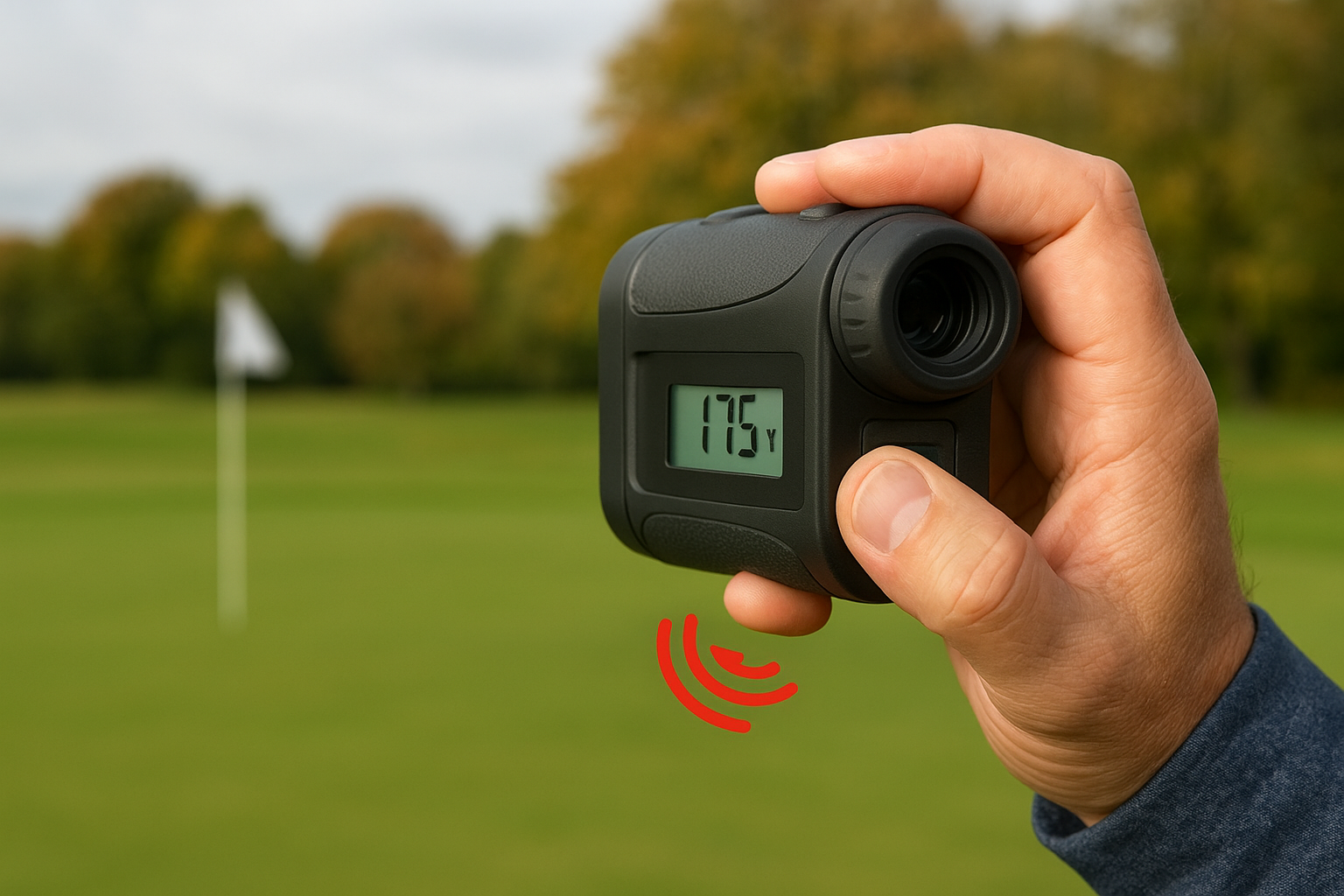
Without vibration confirmation, you risk acting on a false reading, which can cost you a club selection error at a critical moment.
Look for models that describe their flag-lock as "pin-seeking" or "flag-seeker" in the product name or spec sheet. These terms indicate the feature is built into the targeting algorithm rather than being a basic proximity filter added as an afterthought.
Build quality and weather resistance
A rangefinder that fails in light rain is a liability, not an asset. Water resistance ratings vary significantly across models, so check whether the device carries an IPX4 rating or higher before you buy. IPX4 covers splashing from any direction, which handles a typical rainy round without issue. Some premium models reach IPX6 or IPX7, offering protection against heavier rain and brief submersion.
Grip texture and weight also affect how confidently you handle the device mid-round. A rubberised exterior keeps the unit stable in wet or cold hands, while a weight below 200 grams prevents fatigue if you're carrying it between shots throughout an 18-hole round.
Display clarity and one-button operation
Your display needs to be legible in both bright sunlight and overcast conditions. Adjustable dioptre settings let you sharpen the internal readout to match your eyesight without needing reading glasses, which speeds up every reading you take. Large, clear numerals matter far more than a cluttered interface showing multiple data points at once.
Controls should be minimal. A single button to activate and lock keeps your focus on the target rather than on managing the device. Before buying, check user reviews specifically for ease of operation in cold or gloved hands, as button placement that works on a showroom table can feel awkward on a January morning.
Decide if you need slope and tournament mode
Slope and tournament mode are two of the most misunderstood features in any rangefinder buying decision. Understanding them properly is a key part of knowing how to choose a golf rangefinder that works for every round you play, whether that's a casual Saturday stableford or a club championship where the rules of golf apply strictly.
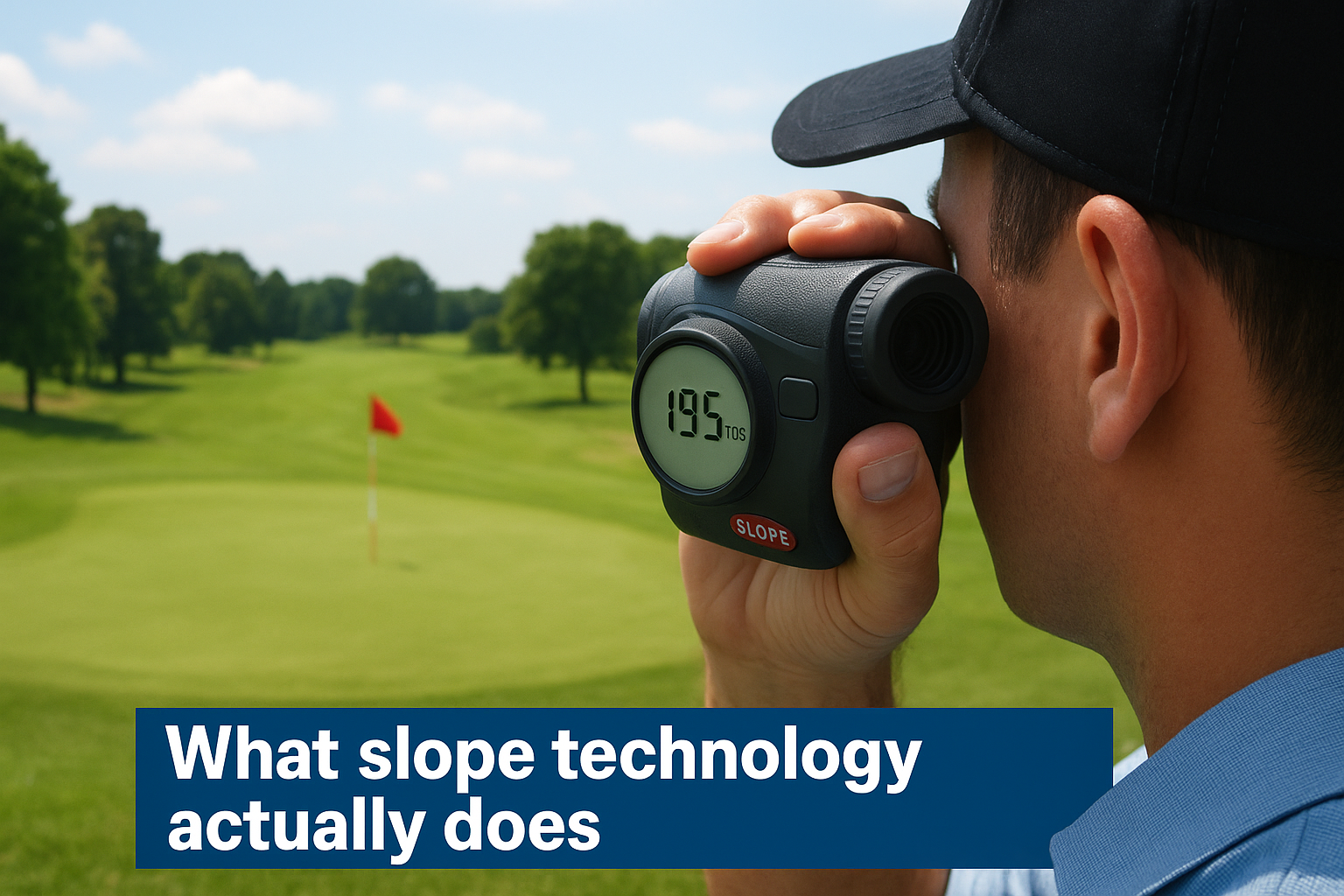
What slope technology actually does
Slope technology measures the angle between you and your target and converts the straight-line distance into an adjusted "plays like" figure. If you're hitting 180 yards uphill at a steep incline, a slope-enabled rangefinder might display 195 yards as the effective distance. That adjusted number is what you use to pick your club, which removes one of the most common errors in amateur club selection.
The benefit becomes most obvious on courses with significant elevation change. On a flat links course, slope adds very little because the adjusted yardage and the actual yardage are almost identical. On a hilly parkland course with multiple uphill approach shots, slope can shift your club choice by one or even two clubs per hole. If you play on undulating terrain regularly, slope is worth the extra cost. If your home course is largely flat, you may never feel the difference.
Slope gives you better data, but only the courses and conditions you actually play on can tell you whether that data changes your decisions in a meaningful way.
Tournament mode and the rules of golf
The R&A and USGA permit distance-measuring devices in competition, but only when they measure straight-line yardage. Slope-adjusted distances are not permitted during official stroke play or match play under the rules of golf. A device that displays slope data and cannot disable it makes you non-compliant the moment you use it in a competition.
Tournament mode solves this problem. When you activate it, the rangefinder locks out the slope function and displays only raw yardage. Most models confirm the switch with a visual indicator in the display or a change in the button icon so you can verify compliance before your round starts. Check the specific method each model uses before buying, as some are clearer than others.
If you play any club competitions, medals, or affiliated rounds, tournament mode is not optional. Use this checklist before you buy:
- Does the model include a clearly labelled tournament mode?
- Does the display show a visible confirmation when slope is disabled?
- Is the mode switch covered in the manufacturer's compliance documentation?
- Has the model been used without issue in club-level competition by other golfers?
Answering yes to all four keeps you protected in any official round.
Set a realistic budget and value checklist
Budget shapes every other decision in how to choose a golf rangefinder, so setting your limit before you start comparing models keeps you focused on the options that actually make sense for your situation. Rangefinders span a wide price range, and the gap between a £80 entry-level device and a £450 premium model is real, but it isn't always relevant to what you need on the course.
What each price range gets you
Spending under £120 gets you a reliable laser rangefinder with basic pin distance readings and adequate optics for most open courses. You won't get slope, vibration confirmation, or premium lens coatings, but for a high-handicapper playing casual weekend golf, those omissions rarely matter. The readings will still be accurate within one yard at distances you actually encounter on a fairway.
The £120 to £250 range is where most regular golfers find the best balance. At this level, flag-lock with vibration confirmation is standard, optical quality improves noticeably, and many models include tournament-legal slope that you can switch off for competition rounds. Build quality also steps up, with better weather resistance and grip materials that hold up across a full season.
Spending more than £250 only makes sense if you play frequently, rely on slope data, or need the fastest target acquisition available.
Above £250, you're paying for speed, durability, and precision optics. These models suit low-handicappers who take course management seriously and play enough rounds each year to justify the cost. At this tier, the difference is measurable rather than just perceptible.
| Budget range | What you typically get |
|---|---|
| Under £120 | Basic laser, pin distance, simple optics |
| £120 to £250 | Flag-lock, vibration, slope with tournament mode |
| £250 to £450+ | Fast acquisition, premium optics, durable build |
Use this checklist before you commit to a purchase
Running through a short checklist before you buy stops you from overspending on features you won't use or underspending on a model that frustrates you within a few rounds. Use the template below as your final filter:
- Does it fit your budget without stretching to cover features you don't need?
- Does it include tournament mode if you play any official club competitions?
- Is it rated IPX4 or above for weather resistance?
- Does the maximum range comfortably cover the longest shot you regularly face?
- Do independent reviews confirm accuracy within one yard under normal playing conditions?
- Does the battery life cover at least two full rounds between charges or replacement?
Answer yes to each point and you've found a model worth buying.
Shortlist models with a simple comparison table
Once you've worked through your needs, picked your technology type, and set your budget, the practical step in understanding how to choose a golf rangefinder is narrowing your options to a shortlist of three or four models. Comparing everything on the market at once leads to decision fatigue, and you end up either stalling the purchase or defaulting to whichever model appears at the top of a search result. A structured shortlist keeps you focused on the models that genuinely fit your criteria.
Build your shortlist before you compare prices
Start by filtering models against the non-negotiable criteria you identified earlier: tournament mode if you play club competitions, IPX4 or better for wet conditions, and flag-lock with vibration confirmation if speed matters to your routine. Any model that fails one of those filters drops off the list immediately, regardless of how well-reviewed it is in other areas.
Narrowing on criteria before looking at price stops you from rationalising a cheaper model that skips a feature you actually need.
Once you have models that pass the baseline check, group them by price tier so you're always comparing like for like. A £100 model sitting next to a £350 model in the same table obscures the relevant comparison, because they're not competing for the same buyer.
Compare your shortlisted models side by side
The table below covers six well-regarded rangefinders across three price tiers, showing the specs that matter most for a buying decision. Use it to spot where models differ within the same budget band rather than across the full range.
| Model | Price range | Slope + tournament mode | Flag-lock vibration | Weather resistance | Max useful range |
|---|---|---|---|---|---|
| Bushnell Tour V5 | £150 to £200 | Yes | Yes | IPX5 | 400 yards |
| Precision Pro NX9 | £100 to £130 | Yes | Yes | IPX4 | 400 yards |
| Shot Scope Pro LX | £180 to £220 | Yes | Yes | IPX5 | 400 yards |
| Garmin Approach Z82 | £400 to £450 | Yes (hybrid GPS) | Yes | IPX7 | 400 yards |
| Nikon Coolshot Pro II | £250 to £300 | Yes | Yes | IPX4 | 590 yards |
| Callaway 300 Pro | £100 to £130 | Yes | Yes | IPX4 | 300 yards |
Use this table as a starting point, then read five to ten independent user reviews for each model you're still considering. Pay particular attention to comments about real-world accuracy in poor light and wet conditions, as these reflect the situations you'll actually face on a British course rather than ideal testing environments.
Avoid common buying mistakes
Even with a clear budget and a shortlist of models, buying errors are common at the final stage of working out how to choose a golf rangefinder. Most mistakes come down to prioritising the wrong information or skipping checks that take less than five minutes to complete. Recognising these patterns before you hand over your money keeps you from returning a device after two rounds.
Buying for maximum range instead of real-world performance
Most rangefinder marketing leads with maximum range figures, and those numbers routinely exceed anything you'll ever need on a golf course. A device rated to 1,500 yards sounds superior to one rated to 600 yards, but if both units perform equally between 50 and 250 yards, the difference is irrelevant to your game. Focus your research on accuracy at typical golf distances rather than the headline figure on the box.
The range you use on a golf course is rarely more than 300 yards, so a high maximum range figure tells you almost nothing about in-game performance.
Ask specifically how each model performs on targets at 150 to 200 yards under variable light. That's the band where your approach shots sit, and consistent accuracy there matters far more than any specification designed for long-range applications.
Ignoring user reviews from wet or overcast conditions
Lab-tested accuracy figures look great on a spec sheet, but they rarely reflect performance in the conditions you'll actually face on a British course. Before committing to a model, search for reviews that specifically mention use in rain, mist, or low morning light. If multiple reviewers report that the flag-lock struggles in wet weather or that the display becomes unreadable on grey days, treat that as a firm warning rather than a minor complaint.
Check verified purchase reviews on retail platforms for comments from golfers who play in similar climates to your own. Patterns across several independent reviews carry far more weight than a single negative rating.
Skipping the in-hand test before buying online
Weight and grip texture affect how comfortable a rangefinder feels after 18 holes, and those qualities don't come through in a product description. If you have access to a local golf shop or a physical store, handle the device before you buy. Check that the button sits naturally under your thumb with a glove on and that the eyepiece adjusts smoothly to your eyesight without extra equipment.
If you can only buy online, prioritise retailers with a clear returns policy that gives you enough time to test the device in a real round. A 90-day return window lets you take the rangefinder out in varied conditions before you fully commit.
After you buy: setup, care and quick tips
Getting your rangefinder out of the box and heading straight to the first tee is tempting, but spending fifteen minutes on initial setup before your first round pays back every time you use the device. A correctly calibrated unit with the right settings for your eyesight gives you faster, cleaner readings and avoids the frustration of discovering a mis-set dioptre on the first green when you're already running late.
Set up your rangefinder before your first round
Start by adjusting the dioptre ring around the eyepiece until the internal distance display appears sharp and clear without straining your eye. Every golfer's eyesight differs, and the factory setting rarely suits everyone out of the box. Hold the device up, press the activation button, and rotate the dioptre ring slowly until the numbers look crisp. If you wear contact lenses or glasses, adjust with your normal corrective lenses in place.
Next, confirm your tournament mode setting before any competition round. Switch slope off, check the visual indicator confirms it's disabled, and do this in the car park rather than on the first tee. Use this quick pre-round checklist:
- Check battery level and carry a spare if the model uses standard AAA cells
- Confirm slope is off if playing a competitive round
- Test flag-lock on a distant object before you tee off
- Clean the lens with a microfibre cloth if you've stored it since your last round
Clean and store it correctly
Lens cleaning is the single most important maintenance task you'll carry out. Use a dry microfibre cloth after every round to remove moisture, dust, and fingerprints from both the objective lens and the eyepiece. Avoid paper towels or clothing fabric, as these scratch optical coatings over time and reduce the clarity you paid for.
Store the device in its case away from direct heat, such as the boot of a car in summer, as prolonged heat exposure degrades lens coatings and affects battery performance.
A few seconds of proper storage after each round adds years to the lifespan of the optics.
Returning it to the case consistently and keeping that case in a cool, dry location costs you nothing and prevents most of the damage that shortens a rangefinder's useful life.
Quick tips for better readings on the course
Knowing how to choose a golf rangefinder is only the start. Getting the most from it on the course comes down to a few consistent habits that improve your readings without adding time to your routine. Brace your elbow against your body when you aim to reduce hand tremor, take your reading while standing still rather than walking, and always wait for the vibration confirmation before you read the distance. These small adjustments make a measurable difference over 18 holes.
Ready to pick your rangefinder
You now have everything you need to make a confident decision on how to choose a golf rangefinder that fits your game, your budget, and the courses you play. Work through your handicap, the terrain you face regularly, and the competition formats you enter, then match those needs to the right type, specs, and features. Skipping any of those steps is where most golfers end up with a device that disappoints them within a season.
Your next step is simple. Browse the full range of golf rangefinders and accessories at MoreSports, where you'll find models across every budget tier from trusted brands. If you're unsure which model suits you best, our team is available via live chat to help you narrow it down. Free UK delivery on orders over £25 and a 90-day return policy mean you can buy with confidence and test the device in a real round before you fully commit.