 No Duties or Customs Fees For EU & UK Customers
 Free UK Delivery On Orders Over £60
 90 Day Returns

How To Choose The Right Golf Ball For Your Game In 2026 (UK)
RYMost golfers spend hours researching drivers and irons but grab whatever golf ball is on sale. That's a mistake. The ball is the only piece of equipment you use on every single shot, and picking one that doesn't suit your game costs you strokes, plain and simple. Learning how to choose the right golf ball can genuinely shave points off your scorecard without changing a thing about your swing.
The problem is, there are dozens of options on the shelf, each promising more distance, better spin, or a softer feel. Cutting through the marketing noise takes a bit of know-how about construction, compression, and what actually matters for your swing speed and skill level. The good news? It's not as complicated as manufacturers make it seem.
That's exactly what this guide is for. We'll walk you through everything, from ball construction types and compression ratings to how your handicap and playing conditions in the UK should shape your choice. At MoreSports, we stock golf balls from brands like Titleist, TaylorMade, and Callaway, so we handle these questions from customers daily. This guide pulls from that experience to help you find the right ball for your game in 2026, whether you're a beginner or a single-figure player chasing marginal gains.
How golf balls actually differ
Walk into any golf shop and you'll see balls ranging from under £1 to over £4 each. The price difference isn't random, and it doesn't simply reflect brand prestige. Golf balls differ in three fundamental ways: construction (the number of layers), compression rating, and cover material. Understanding these three things is the foundation of knowing how to choose the right golf ball for your specific game, rather than just grabbing whatever's on offer.
Construction: layers and what they do
A two-piece golf ball has a large solid rubber core wrapped in a single outer cover. The design prioritises distance and durability, making two-piece balls ideal for beginners or high-handicappers who want to maximise carry off the tee without spending a fortune. A three-piece ball adds a mantle layer between the core and cover, giving the ball the ability to behave differently depending on how hard you strike it. Softer shots mostly engage the outer layers, producing more spin and control around the greens.
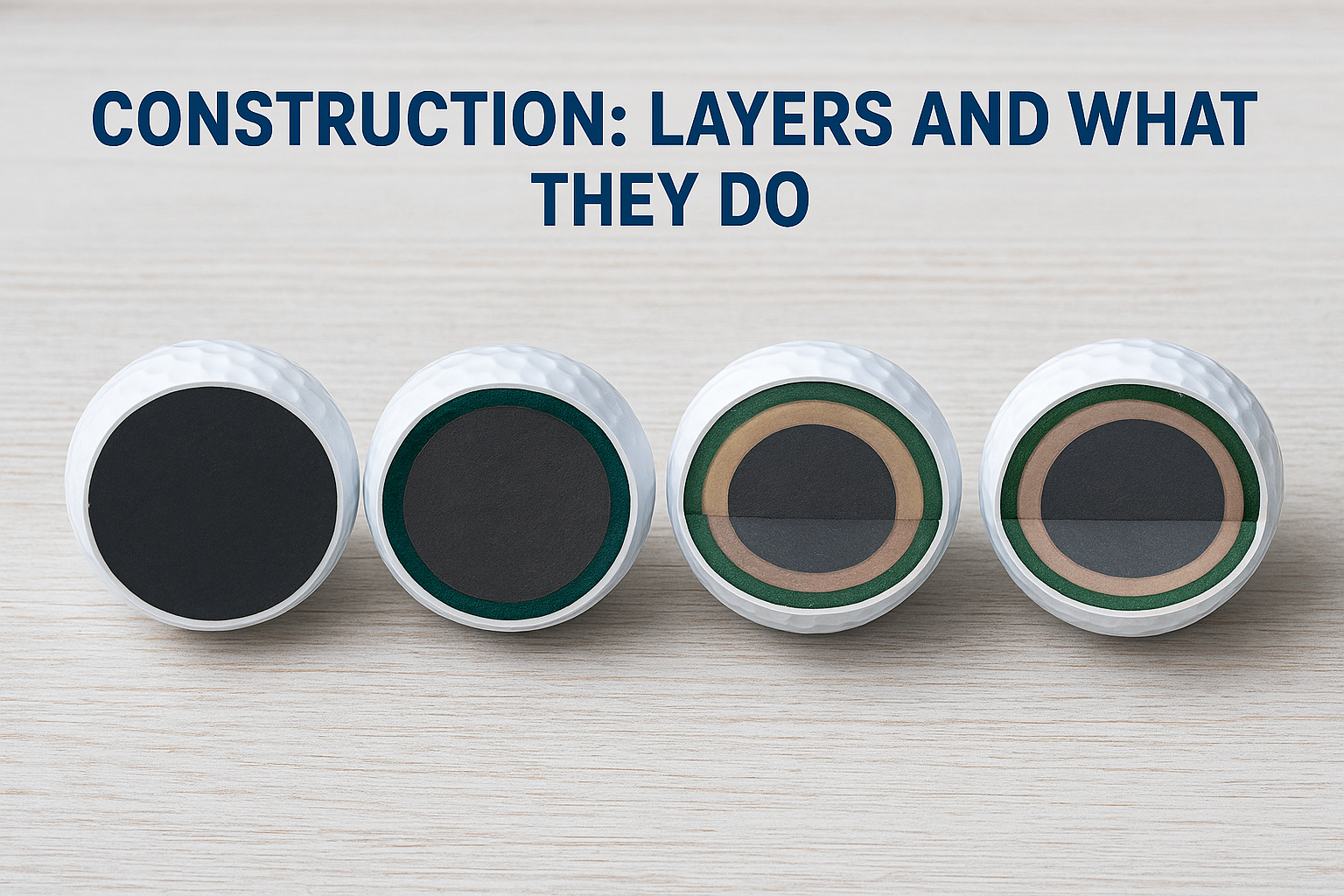
Four-piece and five-piece balls take this further, with each layer engineered to respond to a specific type of shot. Tour-level balls like the Titleist Pro V1x combine low spin off the driver with high spin on wedge shots, all from the same ball. If you're an amateur hitting inconsistent shots, that complexity doesn't necessarily help you. Simpler construction often delivers better results for most club golfers.
Compression ratings and your swing speed
Compression measures how much the ball deforms on impact. A low-compression ball (rated below 70) squishes more when struck, which means slower swings can still compress it efficiently and generate decent distance. A high-compression ball (rated above 90) needs a faster clubhead speed, typically 95 mph or more with a driver, to compress properly. Hit a high-compression ball with a slower swing and you'll lose distance and feel at the same time.
Most amateur male golfers swing between 80 and 95 mph with a driver, which puts them squarely in the mid-compression range of 70 to 90.
Mid-compression balls suit the widest range of club golfers in the UK. Balls like the Callaway Supersoft (compression 38) or Titleist Tour Soft (compression 65) are built specifically for players without tour-level swing speeds who still want a satisfying, responsive feel. Matching compression to your swing speed is one of the biggest performance gains you can make without touching your technique.
Cover material: urethane vs Surlyn
The cover is what the clubface actually contacts at impact, and two materials dominate the market: Surlyn and urethane. Surlyn is a hard ionomer resin. It resists scuffs, lasts longer, and produces less spin across all shot types. That's genuinely useful if you lose balls frequently or if excess sidespin is sending your iron shots offline, but it does limit your ability to hold greens from distance.
Urethane covers are softer and grip the grooves of your clubface more on contact. That friction creates more spin, which translates directly into greater stopping power on approach shots and more feel around the greens. Tour balls almost universally use urethane, but these balls cost significantly more, usually £3 to £5 per ball in the UK. If your handicap sits above 18, a premium urethane ball is unlikely to improve your scores enough to justify that cost per round.
Figure out what your game needs
Before you look at any specific ball, you need an honest picture of your own game. Where you drop shots and how you typically play tells you far more about the right ball than any marketing claim. Most golfers make the mistake of choosing a ball based on what a tour player uses rather than what their own swing and scoring patterns actually demand.
Know your handicap and typical miss
Your handicap is a useful starting point for narrowing the field. High-handicappers (18 and above) generally benefit from a two-piece, low-compression ball that maximises distance and reduces the effect of sidespin on wayward shots. Mid-handicappers (9 to 17) can begin to benefit from three-piece construction, where the extra layer offers better short-game response without sacrificing distance. Low-handicappers (8 and below) have consistent enough ball-striking to take full advantage of a premium, multi-layer urethane ball.
Your typical miss matters just as much as your handicap: if you already spin the ball too much, a high-spin urethane cover will make that worse, not better.
Equally important is your pattern of misses. If you hit a lot of fat irons or thin chips around the green, feel and short-game spin should sit lower on your priority list until your contact improves. Prioritise distance and forgiveness from the tee first, and work back from there once your ball-striking becomes more consistent.
Know your swing speed before you shop
Swing speed is the single most reliable guide to choosing the right compression rating, and it's worth measuring before you buy. If you don't know your driver swing speed, most golf retailers with a launch monitor can give you a number in a few minutes. Use this table as a practical reference:

| Driver Swing Speed | Recommended Compression | Ball Type |
|---|---|---|
| Under 80 mph | Low (below 70) | Soft two-piece |
| 80 to 95 mph | Mid (70 to 90) | Two or three-piece |
| 95 mph and above | High (90+) | Multi-layer tour ball |
Understanding how to choose the right golf ball starts with knowing which row you fall into. A slower swing paired with a high-compression tour ball loses both distance and feel, while a fast swing on a soft ball produces unpredictable results on approach shots where control matters most.
Step 1. Start with your short game priorities
The short game is where most club golfers actually lose their shots. Around 60 to 65% of all golf shots happen within 100 yards of the hole, which means your ball's behaviour around the greens has a bigger impact on your score than what it does off the tee. When you think about how to choose the right golf ball, your short game priorities should be your first filter, not your last.
Why the short game comes first
Most golfers instinctively prioritise distance, but the evidence tells a different story. A ball that flies five yards further off the tee saves you nothing if it skips off the green on a wedge shot you needed to hold. The way a ball reacts to a chip, pitch, or bunker shot depends almost entirely on its cover material and construction, which is why understanding these characteristics before anything else gives you a clearer path to the right choice.
If you regularly struggle to stop the ball on approach shots, a soft urethane cover should move up your priority list before you even think about driver distance.
Match your short game needs to ball characteristics
Your short game patterns should directly influence which cover material and construction you target. Use this guide to match your typical short-game situation to the right ball characteristics:
| Short Game Situation | What You Need | Ball Characteristic |
|---|---|---|
| Ball rolls past the hole on pitch shots | More stopping spin | Urethane cover, 3+ piece |
| Chipping feels unpredictable | Softer feel and feedback | Low-to-mid compression |
| Bunker shots lack control | High short-game spin | Multi-layer, urethane cover |
| Short game is already strong | Distance off tee matters more | Surlyn cover, 2-piece |
Identifying where you lose the most short-game shots is the practical starting point here. If your contact is clean but the ball won't hold greens, that points directly to a Surlyn-covered ball being the wrong choice for your game. On the other hand, if your short-game contact is inconsistent, a softer two-piece ball gives you more margin for error and still delivers adequate feel for most chip and pitch situations.
Step 2. Match the ball to your driver and irons
Your short game priorities give you a strong starting point, but the way a ball behaves off your driver and through your irons shapes the rest of your selection. A ball that spins too much off the tee will balloon in the wind, costing you distance on exactly the shots where you need it most. Understanding how to choose the right golf ball for your full swing adds the second essential filter to your decision.
How ball spin affects your drives
Driver spin is one of the most misunderstood performance factors among club golfers. High-spin balls, typically multi-layer urethane designs, produce more lift and more sidespin off the tee. If your driver swing speed sits above 95 mph, that extra spin helps you shape shots and control trajectory. Below that speed, excess spin causes the ball to climb too steeply and stall, which reduces your carry distance noticeably.

A low-spin two-piece ball can add 10 to 15 yards to your drive if you are currently hitting a high-spin tour ball with a swing speed under 90 mph.
Low-spin Surlyn-covered balls fly flatter and run more after landing, which works well on firm UK links-style courses where roll contributes to your overall distance. If your drives already balloon upward in a headwind, switching to a lower-spin ball is the first adjustment worth making before you look at anything else.
What your iron game tells you about the right ball
Your approach shots reveal exactly whether you need more or less spin from your ball. If your long irons tend to fly too high and fall short of the target, a lower-compression ball will help you keep the ball flight more penetrating and controlled. If your mid-irons regularly overshoot the green, a high-spin urethane cover is likely adding to the problem rather than solving it.
Use this table to match your iron patterns to the right ball adjustment:
| Iron Game Pattern | Likely Issue | Ball Adjustment |
|---|---|---|
| Irons fly too high, fall short | Excess spin | Low-spin, Surlyn cover |
| Irons won't hold the green | Insufficient spin | Urethane cover, 3-piece |
| Irons feel harsh at impact | Compression too firm | Drop to mid-compression |
| Ball flight is already penetrating | Good match | Keep current ball type |
Step 3. Narrow it down with simple testing
Once you have a shortlist based on your swing speed, short game needs, and iron patterns, actual on-course testing is the only way to confirm you've made the right choice. No amount of spec-reading replaces hitting a ball across a full round. Knowing how to choose the right golf ball ultimately comes down to gathering your own data, not trusting a box description.
Run a simple on-course test
Buy a sleeve of three balls from each shortlisted option and play them on separate rounds rather than mixing models in the same round. That separation keeps your feedback clean. Use the same course each time if you can, because conditions on different layouts will skew your results. Take a notepad or use your phone's notes app and record your impressions after each round using a consistent format.
Use this template after each test round:
| Category | Ball A | Ball B |
|---|---|---|
| Driver feel at impact | ||
| Driver distance (estimate in yards) | ||
| Iron trajectory (high/medium/low) | ||
| Wedge stopping distance on greens | ||
| Chipping feel (soft/firm/neutral) | ||
| Overall control and confidence |
Filling in this table honestly after each round gives you a direct comparison without relying on memory.
What to look for during your test
Focus your attention on two or three key moments per round rather than every shot. The shots that matter most for your test are your driver off the first tee, your approach into par fours, and your first chip or pitch from just off a green. These three moments represent the full range of what a ball does across a round, and your instinctive reaction to each shot tells you more than technical analysis.
If you consistently feel more confident standing over a wedge shot with one ball than another, that confidence difference is a real performance factor, not a minor preference.
Pay particular attention to how the ball responds on mishits, not just your best strikes. A ball that feels acceptable on a perfectly struck iron but unpleasant on a thin chip is telling you something important. The right ball for your game should perform tolerably across the full range of your shots, not just the clean ones.
Use fitting tools and data without getting misled
Online ball fitting tools from manufacturers like Titleist and Callaway can help you narrow your shortlist faster than trial and error alone, but you need to understand what they actually measure and what they're designed to do. Most of these tools are built to recommend that brand's own products, which means their output is always going to point you toward their range. Used with that limitation in mind, they still give you useful directional guidance on compression and construction, especially if you're new to the process of how to choose the right golf ball.
Treat any manufacturer fitting tool as a starting filter, not a final answer.
What fitting tools can and can't tell you
The main value of a fitting tool is that it asks structured questions about your swing speed, handicap, and priorities, then maps your answers to ball characteristics rather than specific products. That mapping is genuinely useful. What these tools can't replicate is real on-course feedback, which is why they should feed into your testing process rather than replace it. If a tool recommends a mid-compression, three-piece urethane ball, use that as your shortlist category and then compare two or three specific models from different brands within it.
A launch monitor session with a professional club fitter gives you a more reliable data set. Shops running Trackman or similar systems can show you spin rate, carry distance, and ball flight numbers across multiple ball types in one sitting. This removes guesswork from the compression and spin matching process and gives you objective numbers rather than estimated answers. If you're spending upward of £40 on a dozen balls, investing an hour with a fitter first is a practical decision.
How to avoid being misled by marketing data
Ball manufacturers publish distance and spin figures based on robotic testing at specific swing speeds, usually 100 mph or above. If your swing speed sits at 85 mph, those published numbers don't apply to your game in any meaningful way. When you see a ball advertised as delivering 10 extra yards, check the testing conditions in the small print before treating that claim as relevant.
Use independent data where you can find it. Golf governing bodies like the R&A publish conforming ball lists that confirm which products meet the rules of golf, which gives you a reliable baseline for checking product legitimacy without relying on brand-produced figures alone.
Next steps for choosing your ball
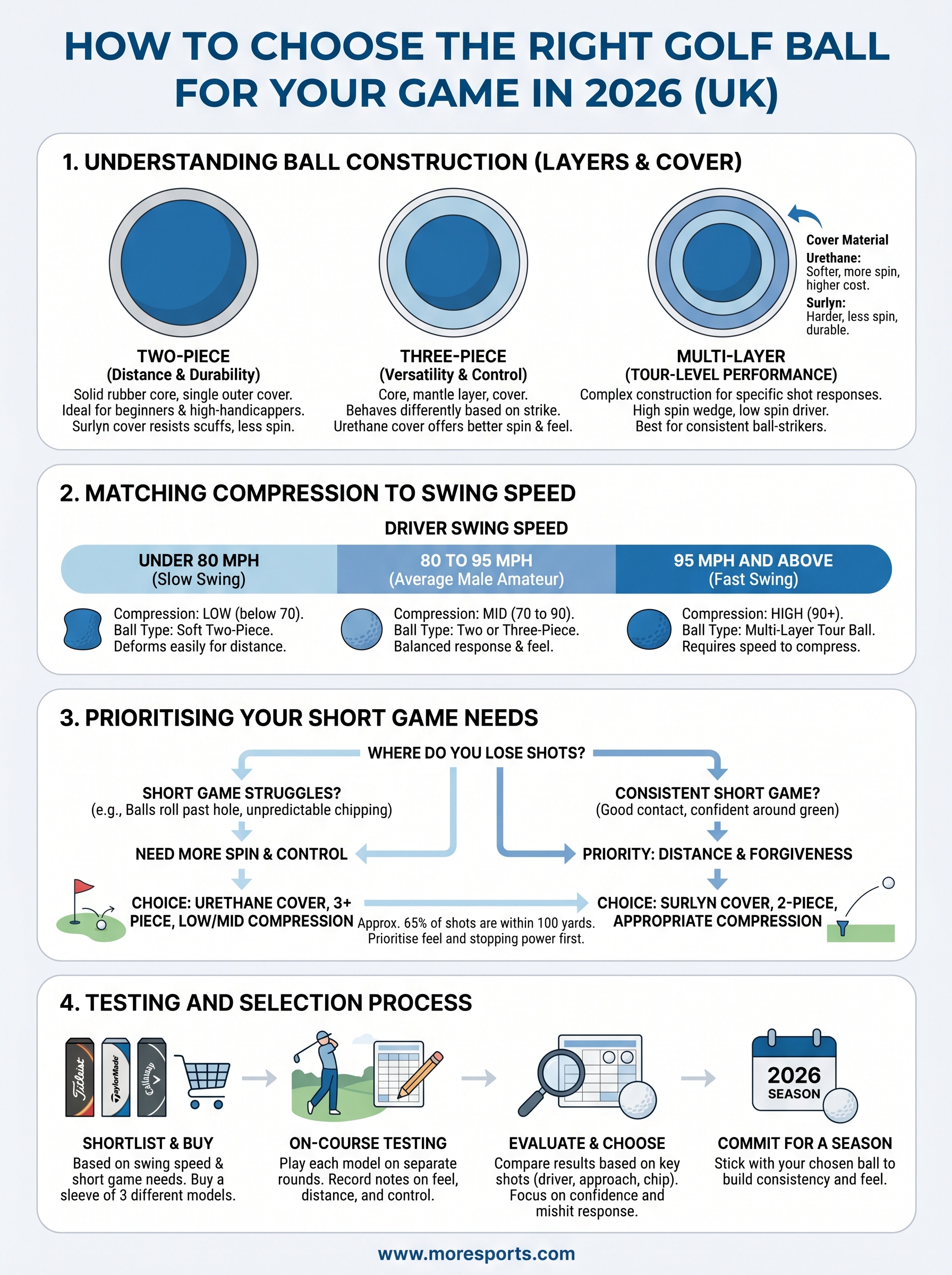
You now have a clear framework for how to choose the right golf ball without getting lost in marketing claims or spec sheets. Start with your swing speed and your short-game patterns, work through the construction and compression filters outlined in this guide, then test two or three shortlisted models across full rounds before committing to a box. That process works at any handicap and gives you real, usable data instead of guesswork.
Resist the urge to jump straight to a tour ball because it's what professionals use. Your swing speed, your miss patterns, and your scoring priorities determine the right ball, not what someone else plays. Once you find a ball that suits your game, stick with it for a full season so you can build genuine feel and consistency with it.
Ready to put this into practice? Browse the full range of golf balls at MoreSports and find the right option for your game today.