 No Duties or Customs Fees For EU & UK Customers
 Express Tracked UK Delivery On 1000s of Items
 90 Day Returns

TaylorMade Wedge Loft Chart: Lofts, Bounces, Grinds
RYChoosing the right wedge setup comes down to knowing the numbers. A TaylorMade wedge loft chart gives you a clear view of every loft, bounce, and grind option across the range, helping you build proper distance gaps rather than guessing at yardages around the green.
At MoreSports, we carry a wide selection of TaylorMade wedges and see first-hand how the right specs sharpen short-game confidence. This guide breaks down every current TaylorMade wedge model with full loft, bounce, and grind details, so you can match the right combination to your swing type, turf conditions, and the distances you need to cover.
Why loft, bounce and grind matter in wedges
When you pick up a wedge, loft, bounce, and grind work together as a system rather than as three separate specs. Getting one right but ignoring the others leads to inconsistent contact and poor distance control, with shots that behave differently depending on the lie. Understanding all three gives you a complete picture of how a wedge performs before you ever hit a ball.
Loft controls your distance gaps
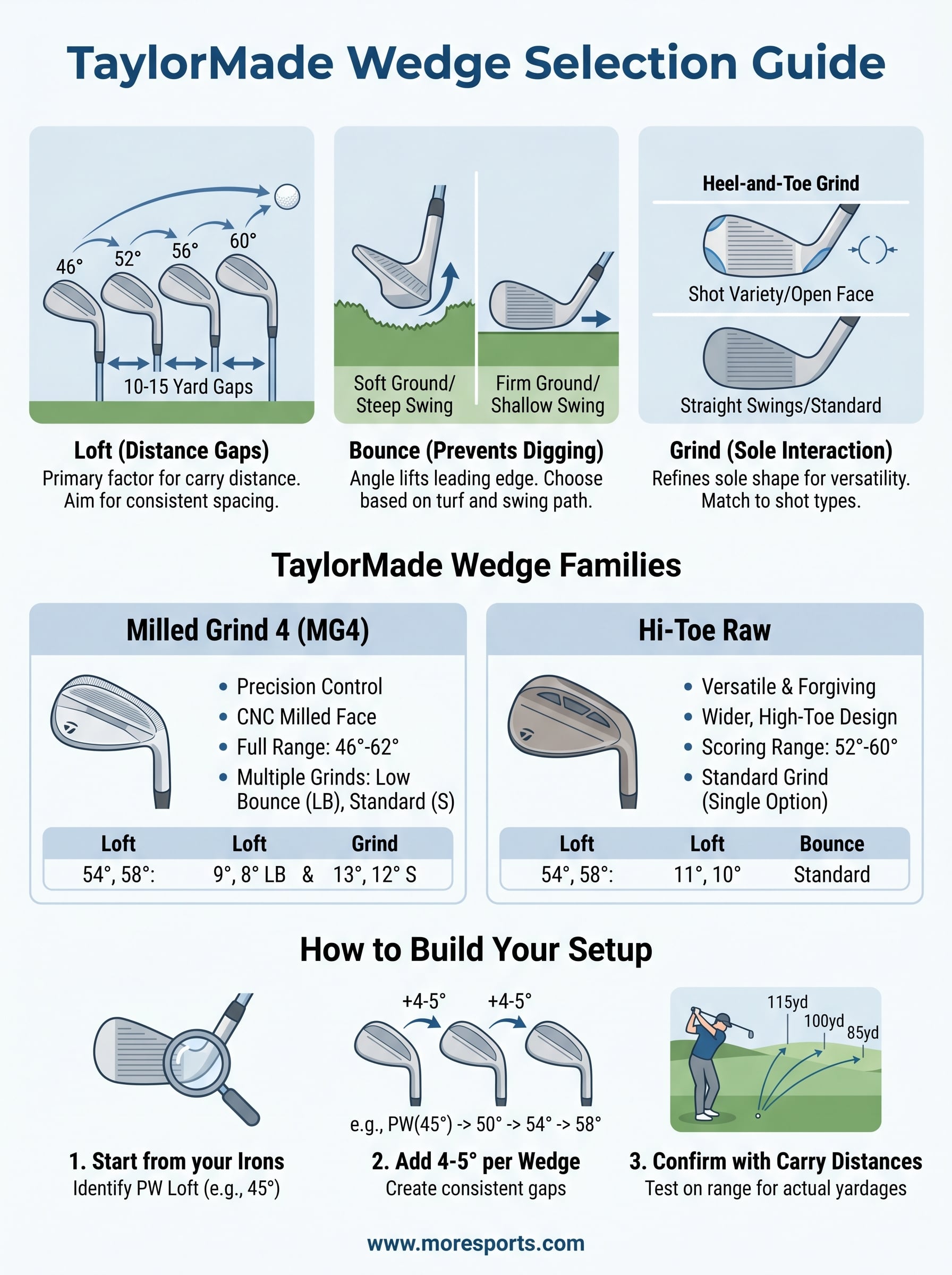
Loft is the angle of the clubface relative to vertical, and it is the primary factor that determines how far your wedge carries. Most golfers carry between three and four wedges, so building consistent gaps of 10 to 15 yards between each club is the goal. Referring to a TaylorMade wedge loft chart helps you map this out precisely so no awkward in-between distances catch you out during a round.
A typical four-wedge setup looks like this:
- Pitching wedge: 45-46°
- Gap wedge: 50-52°
- Sand wedge: 54-56°
- Lob wedge: 58-60°
Uneven loft gaps are one of the most common reasons golfers struggle to control distance from 100 yards and in.
Bounce prevents digging and heavy contact
Bounce is the angle between the leading edge and the trailing edge of the sole, measured in degrees. A higher bounce angle lifts the leading edge off the turf, which suits softer ground and steeper swing paths because it stops the clubhead from burying at impact. Lower bounce works better on firm turf or for players who sweep through the ball rather than take a divot, keeping the leading edge low enough for clean contact.
Choosing the wrong bounce for your conditions will cost you more shots than the wrong loft will.
Grind shapes how the sole moves through turf
Grind refers to the shaping and removal of material from the sole of the wedge. It refines how the club interacts with the ground beyond what the bounce angle alone achieves. A heel-and-toe grind, for example, lets you open or close the face without the sole catching, giving you more shot variety around the green. A full sole grind suits straighter swing paths where that extra flexibility is less relevant.
TaylorMade wedge families and what changes between them
TaylorMade currently produces two main wedge families: the Milled Grind 4 (MG4) and the Hi-Toe Raw. Each family targets a different type of player and playing style, and knowing which one suits you before you consult the TaylorMade wedge loft chart makes the spec selection process significantly cleaner.
Milled Grind 4 (MG4)
The MG4 is TaylorMade's precision-player wedge, built for golfers who want tight spin control and a more traditional, compact head shape. The face and grooves are CNC milled for consistency, which produces reliable spin across different lies and conditions. If you play on firm courses or prefer a cleaner, more workable shape at address, the MG4 is the natural starting point.
The MG4 comes in lofts from 46° through to 62°, giving you full coverage from a pitching wedge down to a high loft lob wedge.
Hi-Toe Raw
The Hi-Toe Raw takes a different approach, with a wider, higher-toe design that keeps the face more square when you open the blade for bunker shots or flop shots. This makes it a strong option if you frequently play from soft lies or need more shot variety around the green. The raw carbon steel finish oxidises over time to reduce glare and maintain friction at impact, which helps spin hold up in wet conditions. Its wider sole also adds some forgiveness on mishits that a compact tour wedge would punish more noticeably.
TaylorMade wedge loft chart by wedge type
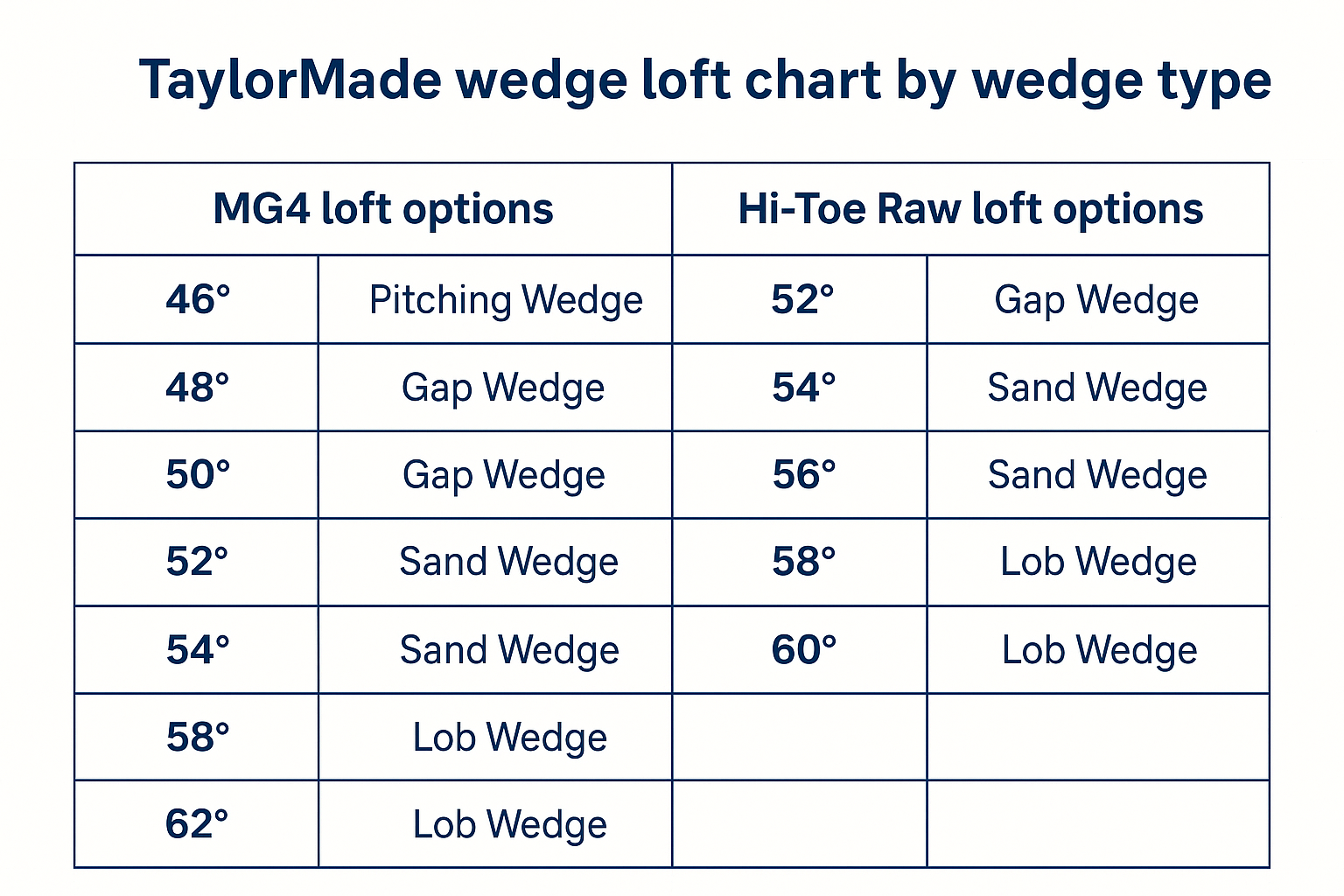
The tables below give you a direct reference for every available loft across both current TaylorMade wedge families. Use this TaylorMade wedge loft chart alongside your existing iron lofts to identify which loft combinations fill your distance gaps most effectively.
MG4 loft options
The MG4 covers the widest loft range in TaylorMade's current lineup, running from 46° all the way to 62°. This makes it the right choice if you want to build a full wedge set from a single family, including a matching pitching wedge.
| Loft | Wedge Type |
|---|---|
| 46° | Pitching Wedge |
| 48° | Gap Wedge |
| 50° | Gap Wedge |
| 52° | Gap Wedge |
| 54° | Sand Wedge |
| 56° | Sand Wedge |
| 58° | Lob Wedge |
| 60° | Lob Wedge |
| 62° | Lob Wedge |
Hi-Toe Raw loft options
The Hi-Toe Raw focuses on the scoring wedge range, starting at 52° and running through to 60°. It does not cover pitching wedge territory, so most golfers pair it with a standard set pitching wedge and use the Hi-Toe Raw for gap, sand, and lob duties.
| Loft | Wedge Type |
|---|---|
| 52° | Gap Wedge |
| 54° | Sand Wedge |
| 56° | Sand Wedge |
| 58° | Lob Wedge |
| 60° | Lob Wedge |
If your current irons run strong (modern sets often pitch at 43-44°), start your wedge gap from 48° rather than 46° to avoid stacking lofts too close together.
TaylorMade bounce and grind chart and what to pick
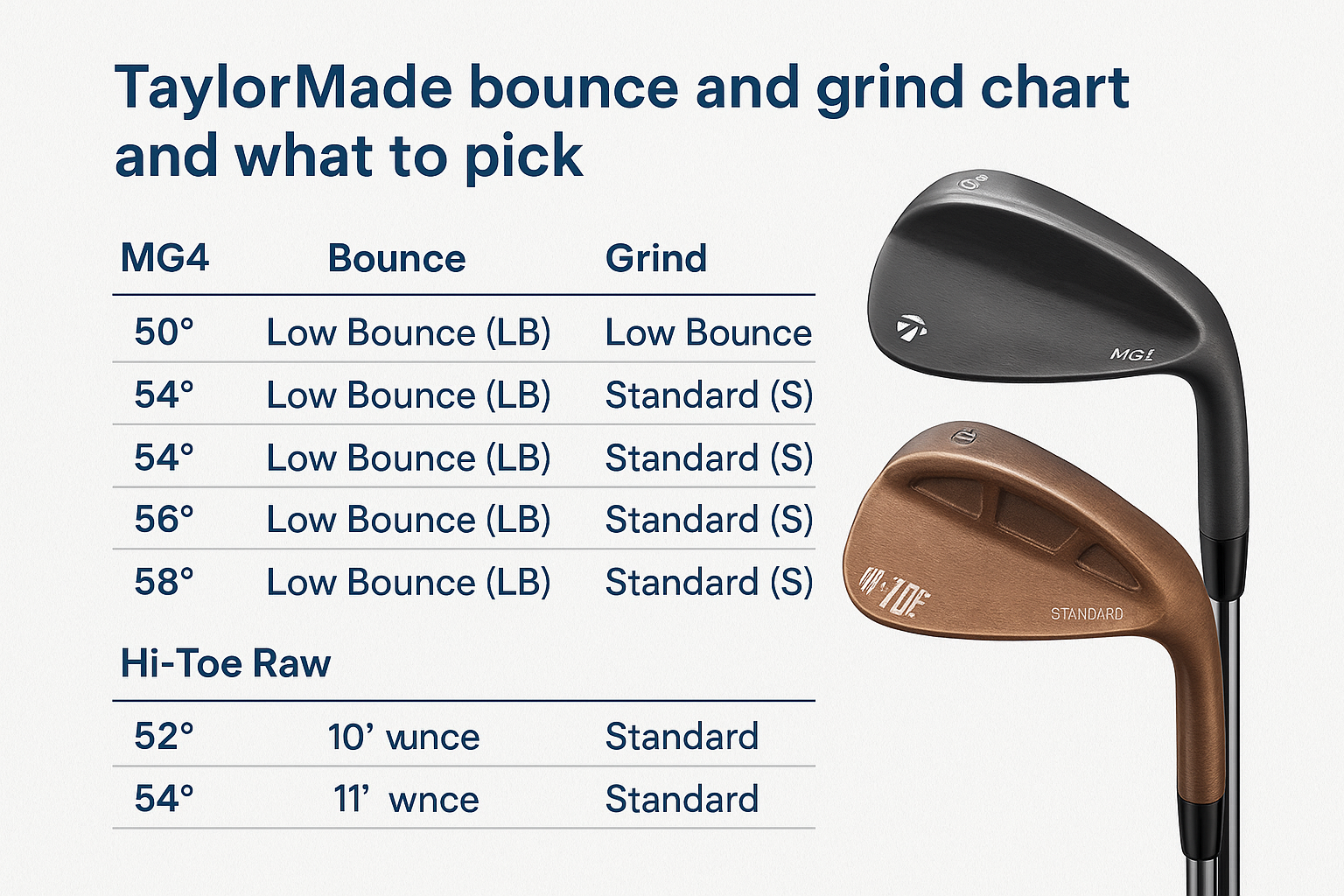
Once you have your loft sequence sorted from the TaylorMade wedge loft chart, bounce and grind become your next decisions. Each loft in the range offers multiple sole configurations, so you can match the club to your swing type and the course conditions you play in most often.
MG4 bounce and grind options
The MG4 gives you two sole options across most lofts. Low bounce suits firm turf and shallow, sweeping swing paths, while the standard grind works better on softer ground where a steeper angle of attack is more natural.
| Loft | Bounce | Grind |
|---|---|---|
| 50° | 9° | Low Bounce (LB) |
| 54° | 9° | Low Bounce (LB) |
| 54° | 13° | Standard (S) |
| 56° | 10° | Low Bounce (LB) |
| 56° | 14° | Standard (S) |
| 58° | 8° | Low Bounce (LB) |
| 58° | 12° | Standard (S) |
| 60° | 8° | Low Bounce (LB) |
| 60° | 12° | Standard (S) |
If you play firm parkland or links-style courses, prioritise low bounce options in your sand and lob wedges to avoid skulled shots from tight lies.
Hi-Toe Raw bounce and grind options
Unlike the MG4, the Hi-Toe Raw keeps things straightforward with one sole configuration per loft. Its wider sole naturally delivers added bounce, making it forgiving through bunkers and soft lies without requiring multiple grind variants to choose from.
| Loft | Bounce | Grind |
|---|---|---|
| 52° | 11° | Standard |
| 54° | 11° | Standard |
| 56° | 14° | Standard |
| 58° | 10° | Standard |
| 60° | 10° | Standard |
Pick the Hi-Toe Raw if you want reliable performance without overthinking sole options, especially if bunker play and open-face chips form a regular part of your short game.
How to build your wedge setup and gap yardages
Building a wedge setup starts with your pitching wedge loft, not with the wedges themselves. Modern iron sets often pitch at 43-45°, which directly affects where your first wedge should begin. Use the TaylorMade wedge loft chart to map from that starting point outward so every club in your short-game bag earns its place.
Start from your irons and work down
Pull out your current pitching wedge and find its loft, either from the manufacturer's spec sheet or stamped on the hosel itself. Add 4-5° for each subsequent wedge to land on loft values that separate your carry distances by roughly 10-15 yards. If your pitching wedge sits at 45°, a sensible three-wedge progression would be 50°, 54°, and 58°, giving you consistent spacing without any awkward yardages left uncovered.
Most golfers underestimate how a 2° loft overlap between consecutive wedges can cost them distance control on approach shots inside 100 yards.
Confirm your gaps with carry distances
Once you have your loft sequence mapped on paper, take your wedges to the range and record actual carry distances for each club using your full swing. Do not rely solely on projected yardages from a spec sheet. Real carry numbers from your own swing give you the accurate picture, and if two wedges produce near-identical distances, you know immediately which loft adjustment to make before committing to a purchase.
Next steps for your wedge setup
You now have everything you need to make a confident decision. Use the TaylorMade wedge loft chart in this guide to match your iron lofts to the right wedge progression, then cross-reference the bounce and grind options against the turf conditions you play most. Commit to the loft sequence first, confirm your carry gaps on the range, and only then settle on your final configuration.
Picking the right wedges does not need to be complicated. The MG4 suits players who want precision and shot control across a full loft range, while the Hi-Toe Raw delivers extra forgiveness and versatility from bunkers and soft lies. Both families give you reliable options at every loft step. When you are ready to buy, browse the full range of TaylorMade wedges at MoreSports and find the exact spec that fits your game.