 No Duties or Customs Fees For EU & UK Customers
 Free UK Delivery On Orders Over £60
 90 Day Returns

What Is a Golf Rangefinder? How It Works and Helps Your Game
RYA golf rangefinder is a handheld device that measures the exact distance between you and a target on the course, whether that's the flagstick, a bunker, or the front edge of the green. Instead of guessing yardages or relying on course markers, you get a precise reading in seconds, which takes a huge chunk of uncertainty out of your club selection.
If you've ever stood in the fairway debating between a 7-iron and an 8-iron, you already know why that matters. Accurate distance information leads to better decisions, tighter approach shots, and ultimately fewer strokes on your scorecard. It's one of the simplest upgrades you can make to your game, and it's why rangefinders have become standard kit for golfers at every level.
In this guide, we'll break down how golf rangefinders actually work, compare laser and GPS options, explain what to look for when buying one, and highlight some of the best models available. At MoreSports, we stock rangefinders and golf equipment from top brands at competitive UK prices, with free delivery over £25 and 90-day returns, so once you know what you need, we've got you covered.
Golf rangefinder basics and what it measures
A golf rangefinder is a compact optical device that gives you real-time distance data directly on the course. When people ask what is a golf rangefinder, the short answer is: it's a tool that removes guesswork from your yardage calculations and replaces it with accurate, reliable numbers you can act on immediately, rather than pacing out distances or squinting at yardage markers.
What a rangefinder actually measures
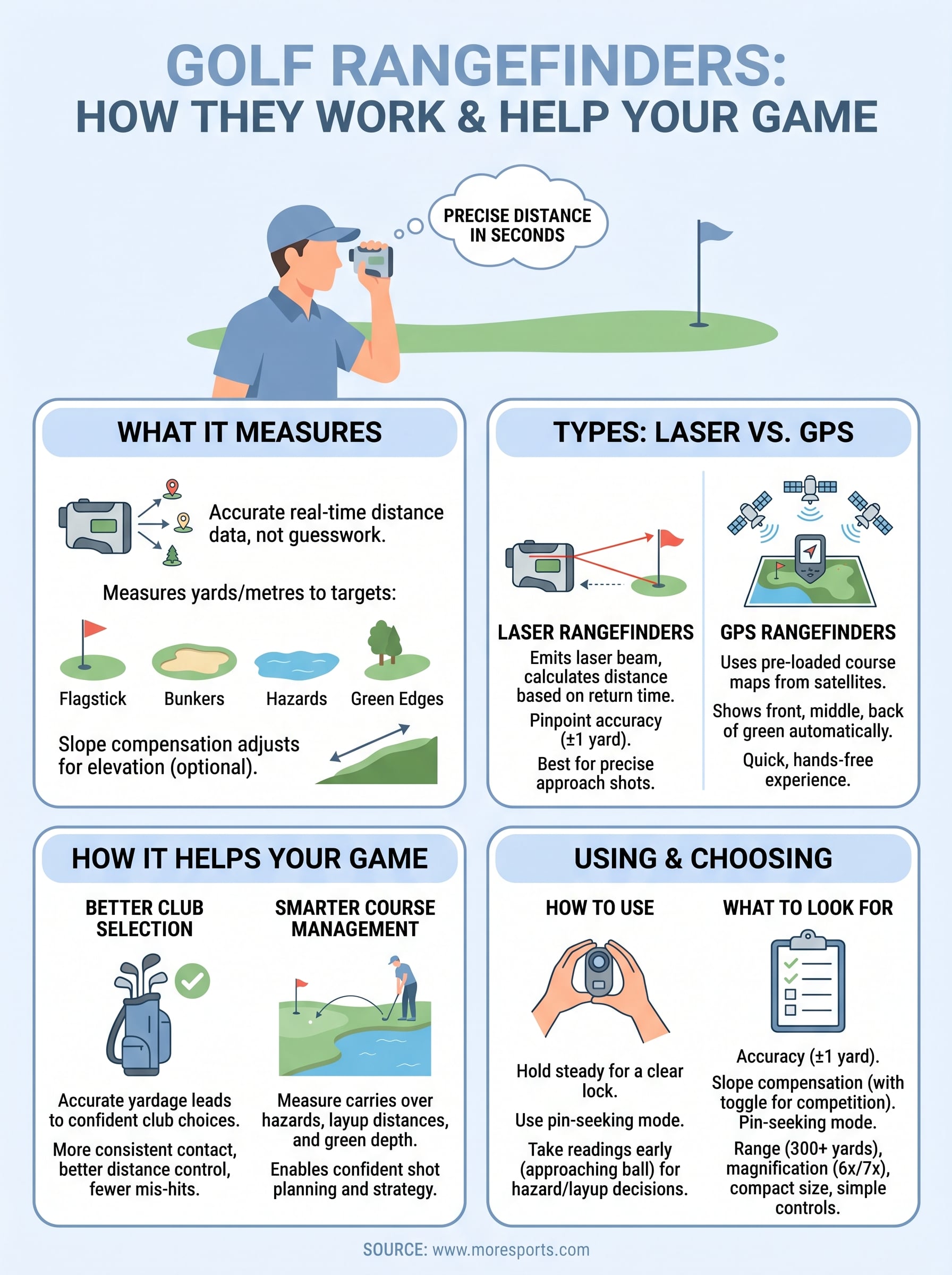
Most rangefinders display distance in yards or metres, and you can usually switch between the two depending on your preference. The reading you get is the straight-line distance from your position to the target you've locked on to, not an adjusted figure based on elevation unless your device includes slope compensation technology. That distinction matters because a 150-yard shot uphill plays very differently to a flat 150-yard shot, and choosing the wrong club because of it will cost you strokes.
Slope-compensating rangefinders calculate an adjusted playing distance based on elevation change, which gives you a far more accurate club recommendation than a raw flat yardage alone.
The targets a rangefinder can lock on to
You're not limited to measuring just the flag. A good rangefinder lets you identify multiple targets in your field of view, which is useful when you need to know the carry distance over a hazard or the exact yardage to the front, middle, and back of the green.
Common targets golfers measure include:
- The flagstick for approach shots
- Bunkers and water hazards for carry calculations
- Trees and rough edges for layup reference points
- Green edges to judge pin position depth
Being able to measure all of these in one device gives you a complete picture of each hole, not just one number. That level of detail is what helps you commit to a shot with real confidence rather than second-guessing yourself at address.
How laser and GPS rangefinders work
When you're trying to understand what is a golf rangefinder fully, knowing the difference between the two main types helps you pick the right one. Both laser and GPS models give you yardage readings, but they work in completely different ways and each has clear strengths depending on how you play.
Laser rangefinders
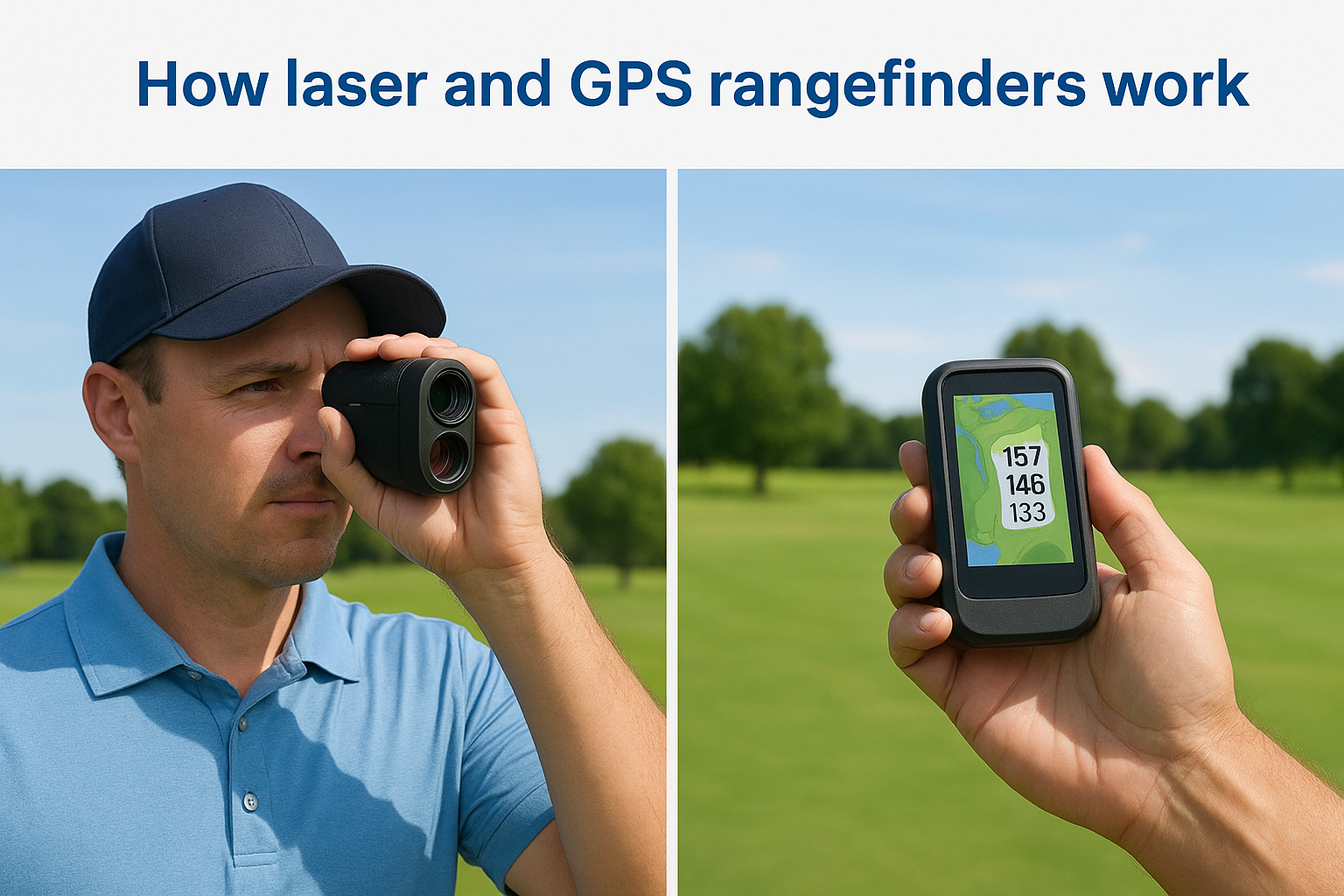
A laser rangefinder works by emitting a beam of infrared light that travels to your target and bounces straight back to the device. It then calculates distance based on how long that signal takes to return, giving you an instant, pinpoint reading. Laser models are highly accurate, typically within one yard, which makes them the preferred choice for precise approach shots.
Laser rangefinders generally deliver accuracy to within one yard, making them the most reliable option for club selection on approach shots.
GPS rangefinders
GPS rangefinders pull pre-loaded course maps from satellites to display distances to key points on each hole. Rather than pointing at a target, you read distances from a digital display or screen that shows the front, middle, and back of the green automatically. GPS models suit golfers who prefer a quicker, hands-free experience on the course. Key points to know:
- No pointing required: distances appear on screen automatically
- Battery life: typically lasts longer per round than a laser device
- Course dependency: requires up-to-date course data to function accurately
How a rangefinder helps your game
Once you understand what is a golf rangefinder and what it measures, the practical benefits become clear. Knowing your exact yardage before you swing removes one of the biggest variables in your decision-making process. Replacing a rough estimate with a precise measurement means you can plan each shot around real information rather than assumptions.
Better club selection
Choosing the right club is the single most important shot decision you make. When you have accurate yardage data, you stop second-guessing yourself between clubs and commit to your choice with confidence. That commitment carries through your swing and produces more consistent contact, better distance control, and fewer costly mis-hits as a result.
Golfers who consistently use a rangefinder tend to hit more greens in regulation because their club selection is based on data rather than guesswork.
More confident course management
A rangefinder also changes how you approach course strategy. You can measure the exact carry needed over a hazard, check your layup distance to a safe landing zone, or confirm how much green you have to work with on a short-sided pin. These are the decisions that separate consistent golfers from erratic ones, and having precise numbers makes each one easier to act on without hesitation.
Key situations where precise yardage makes a real difference:
- Carry distance over fairway bunkers and water hazards
- Layup yardages to a preferred landing area
- Green depth from front to back for pin position decisions
How to use a rangefinder on the course
Knowing what is a golf rangefinder is one thing, but using it well during a round takes a small amount of practice. The good news is that most rangefinders are straightforward once you get the hang of the basic technique and understand when to take each reading.
Getting a clear lock on your target
Point the device at the flagstick and hold it as steady as possible while pressing the button to activate the laser or display. Most modern laser models include a pin-seeking mode that filters out background objects like trees behind the flag and locks on to the nearest target, so your reading reflects the actual flag distance rather than anything beyond it.
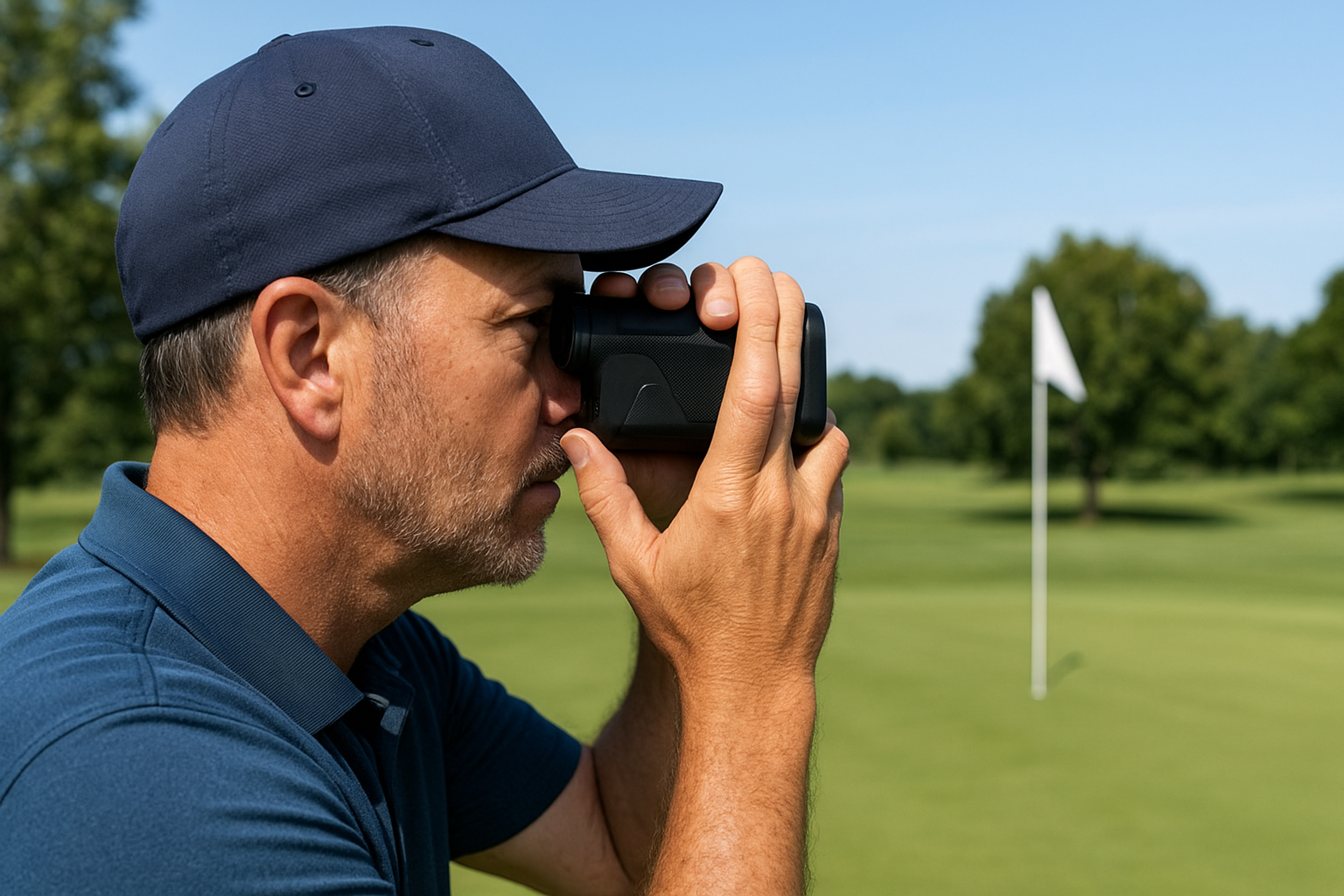
Use both hands to stabilise the device and brace your elbows slightly for a cleaner lock on smaller targets like the flagstick.
When to take your readings
Take your first reading as you approach your ball, not when you're standing over it. Getting the number early gives you time to think through your club selection calmly before you reach your shot. For hazard carries and layup decisions, measure from the fairway as soon as the target is clearly in your line of sight so you can commit to your strategy well in advance.
How to choose the right golf rangefinder
Once you understand what is a golf rangefinder and how it benefits your round, picking the right model comes down to a handful of practical factors. Your budget, how often you play, and the type of courses you regularly tackle all influence which features you actually need rather than which specifications sound impressive on paper.
Accuracy and slope compensation
Accuracy is the first thing to check. Most decent laser rangefinders read within one yard, but cheaper models can struggle at longer distances. If you play on courses with significant elevation changes, slope compensation converts raw yardage into an adjusted playing distance, giving you a more reliable club recommendation.
Slope-compensating rangefinders are not permitted in formal competition unless the slope feature can be switched off, so always check the rules before you play.
Key features to prioritise when buying:
- Slope compensation with a toggle to disable it for competition rounds
- Pin-seeking mode to lock on to the flag rather than background objects
- Water resistance for reliable performance in wet weather
Range and ease of use
Your rangefinder should reliably lock on to targets at least 300 yards away to cover every shot on a standard course. Check the magnification level too, since 6x or 7x makes it noticeably easier to acquire a small flagstick from distance.
Beyond the specs, compact and lightweight models are far easier to carry between shots without disrupting your rhythm. A device that fits comfortably in your hand and operates with simple, intuitive controls will serve you far better on the course than one loaded with features you rarely use.
Key takeaways
Understanding what is a golf rangefinder gives you a clear advantage before you even step onto the first tee. A rangefinder removes the guesswork from yardage decisions, sharpens your club selection, and gives you the confidence to commit to every shot with real information behind it. Whether you choose a laser model for pinpoint accuracy or a GPS device for hands-free convenience, the core benefit is the same: you play smarter, make better decisions under pressure, and cut out the costly errors that come from misjudging distance.
When buying, focus on accuracy, slope compensation, and ease of use rather than chasing the highest spec on paper. A rangefinder that fits your hand, locks on quickly, and works reliably in all conditions will serve you far better than a feature-heavy device you struggle to operate mid-round. Browse our full range of golf rangefinders and equipment at MoreSports, with competitive UK prices and free delivery over £25.