 No Duties or Customs Fees For EU & UK Customers
 Express Tracked UK Delivery On 1000s of Items
 90 Day Returns

Golf Rangefinder Vs GPS: Which Is Best For You In 2026?
RYChoosing between a golf rangefinder vs GPS device is one of the most common equipment decisions golfers face, and it's not a straightforward one. Both technologies help you measure distances on the course, but they do it in fundamentally different ways, and each comes with distinct strengths and trade-offs that suit different types of players.
A laser rangefinder pins exact yardages to specific targets, while a GPS device (whether a watch, handheld, or clip-on) gives you a broader picture of the hole with preloaded course maps. Some golfers want pinpoint accuracy to a flagstick; others want a quick glance at front, middle, and back distances without pulling out a separate device. Your skill level, pace of play, budget, and how you actually use distance data all factor into which one makes more sense for your game.
At MoreSports, we stock rangefinders and GPS devices from leading golf brands and help thousands of golfers find the right gear each year. This guide breaks down exactly how each technology works, what it costs, where it excels, and where it falls short. By the end, you'll have a clear picture of which option fits your game, and you might find that the answer isn't strictly one or the other. Let's get into the full comparison.
What a golf rangefinder and GPS actually do
Understanding the core mechanics of each device gives you a solid foundation for the golf rangefinder vs GPS comparison. Both tools solve the same basic problem: helping you pick the right club by knowing your distance to the target. But they use completely different methods to get there, and those differences shape how useful each one is depending on how you play. Before weighing up which is better for your game, it's worth seeing exactly what each device is actually doing.
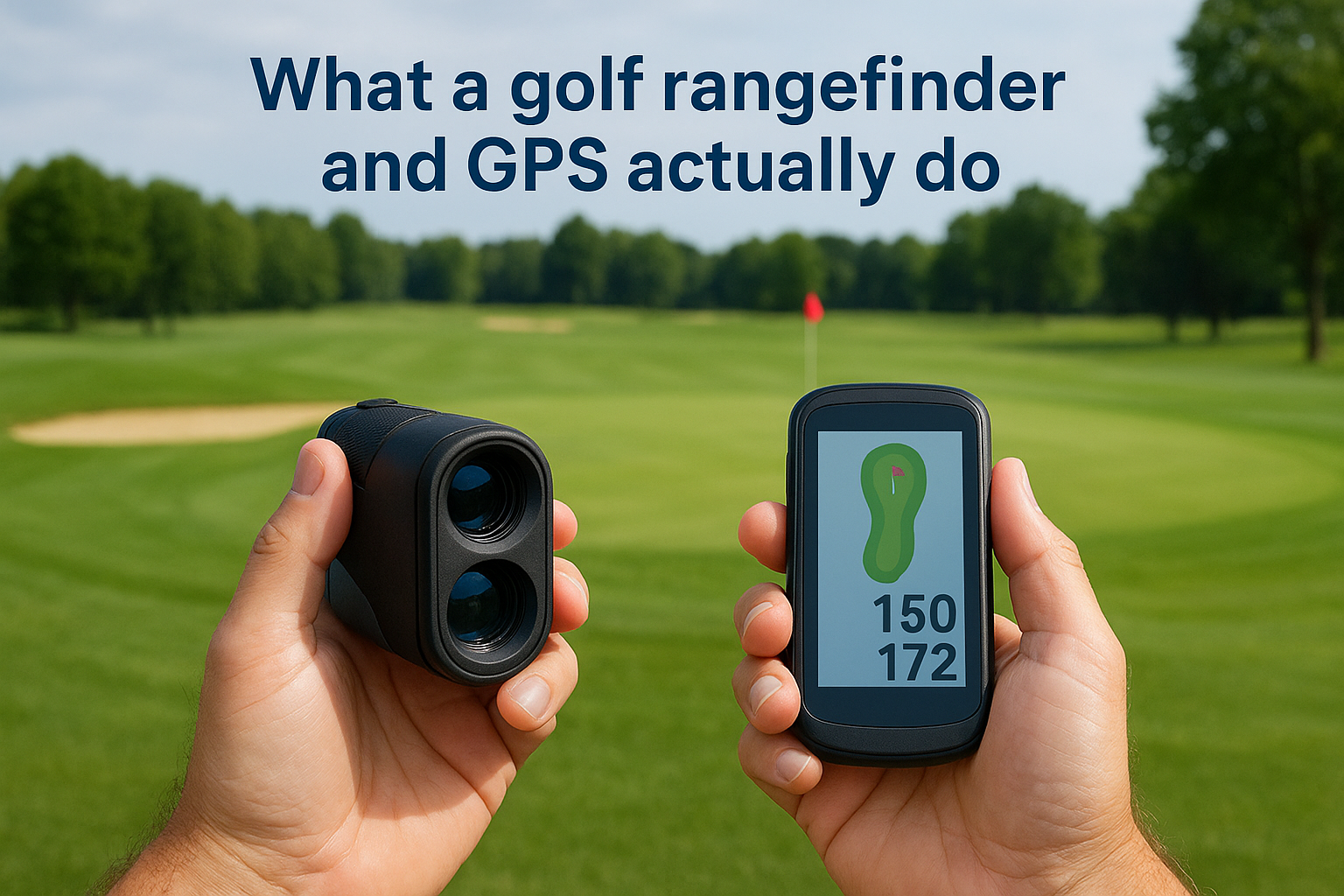
How a laser rangefinder measures distance
A laser rangefinder works by firing an invisible infrared laser beam at a target and measuring how long it takes for that beam to bounce back. The device calculates the time-of-flight of that signal and converts it into a precise yardage, usually accurate to within half a yard. Most modern rangefinders display that reading in under a second, which is fast enough that it does not disrupt your pre-shot routine.
Laser rangefinders are widely regarded as the most accurate distance tool available to amateur golfers and are legal in most competitions when slope mode is disabled.
The target you aim at matters a great deal. Point at the flagstick and you get the distance to the pin. Point at a bunker face, a tree, or the front edge of the green and you get that instead. This precise, target-specific capability is what makes rangefinders especially popular with better players who need exact carry distances rather than rough estimates. Some models include slope-adjusted readings that factor in elevation change and give you a "plays like" distance, though you must switch off this feature during competition rounds.
How a GPS device reads the course
A GPS golf device uses satellite positioning to locate your spot on a preloaded course map. Rather than measuring to a specific target, it calculates your distance to fixed reference points: typically the front, middle, and back of the green. That information appears the moment you glance at your device, with no need to aim at anything. GPS watches, handhelds, and clip-on units all work on this principle, though the screen size and interface vary significantly between them.
The course data is stored on the device or accessed via a connected app, with most GPS units covering tens of thousands of courses worldwide. You download the course map before you play, or the device pulls it automatically based on your location. Premium GPS units also display hazard distances, dogleg markers, and layup points, giving you a bird's-eye view of each hole that a rangefinder alone cannot provide.
Where the two technologies overlap
Both devices give you usable yardage information in seconds, and both are permitted in most recreational rounds. In that sense, they solve the same core problem. The difference lies in how precise that yardage is and how much spatial context around the hole each device delivers alongside it.
Some golfers carry both: a GPS watch on the wrist for a constant at-a-glance overview and a rangefinder in the bag for a precise pin distance when the approach shot demands it. This combination is practical, but it adds cost and, for some players, unnecessary complexity. Knowing what each device does independently helps you decide whether you actually need both, or whether one option covers everything you need out on the course.
Why this choice affects your score and pace of play
The device you carry doesn't just give you a number; it shapes how confidently you commit to each shot and how long you take to do it. When you stand over the ball with a clear, accurate distance in hand, you pick the right club faster and swing with more intent. Get the distance wrong, or spend too long trying to figure it out, and both your scorecard and your playing partners will feel the impact.
How accurate distance data influences club selection
Wrong distances lead to wrong clubs. It's that simple. If you pull out a 7-iron for a 160-yard shot based on an inaccurate reading, you'll either come up short or fly the green, and neither outcome helps your score. A rangefinder's pinpoint accuracy to the flagstick gives you confidence that the number is real, which means your club selection is based on fact rather than guesswork. GPS devices offer a reliable front, middle, and back figure, which is often accurate enough for mid-handicappers who are not yet consistently hitting the exact target line on every approach.
The difference between a 155-yard and a 162-yard reading might seem small, but for a golfer who carries their 7-iron 160 yards, it changes the entire club decision.
How your device affects the speed of your round
Pace of play is a practical concern that often gets overlooked when golfers compare the golf rangefinder vs GPS options. A GPS watch sits on your wrist and delivers distances the moment you reach your ball, with zero setup required. A rangefinder requires you to pull the device from your bag, aim it, lock onto the flag, and read the result. For most golfers, that takes 15 to 20 seconds per shot, which adds up across 18 holes. Slow play frustrates playing partners and, in competition, can result in time penalties.
That said, a rangefinder is still fast compared to pacing out yardages or searching for sprinkler head markers. Both devices represent a significant improvement over playing without any distance tool at all. The key question is whether the extra seconds spent using a rangefinder are justified by the accuracy gain it delivers for your particular level of play.
Golf rangefinder vs GPS: the differences that matter
When you put a laser rangefinder and a GPS device side by side, the headline difference is obvious: one measures to a specific target, the other reads from a preloaded map. But the golf rangefinder vs GPS comparison goes deeper than that single distinction. The differences that actually matter on the course come down to how each device handles accuracy, course awareness, and everyday cost.
Accuracy and targeting
A laser rangefinder locks onto specific targets and measures to them directly, giving you readings that are typically accurate to within half a yard. That level of precision matters when the pin position is at the back of a large green and the centre distance would send you five yards short. GPS devices measure to fixed reference points that do not shift when the flagstick moves, which means their readings can be off by several yards depending on pin placement and the depth of the green.
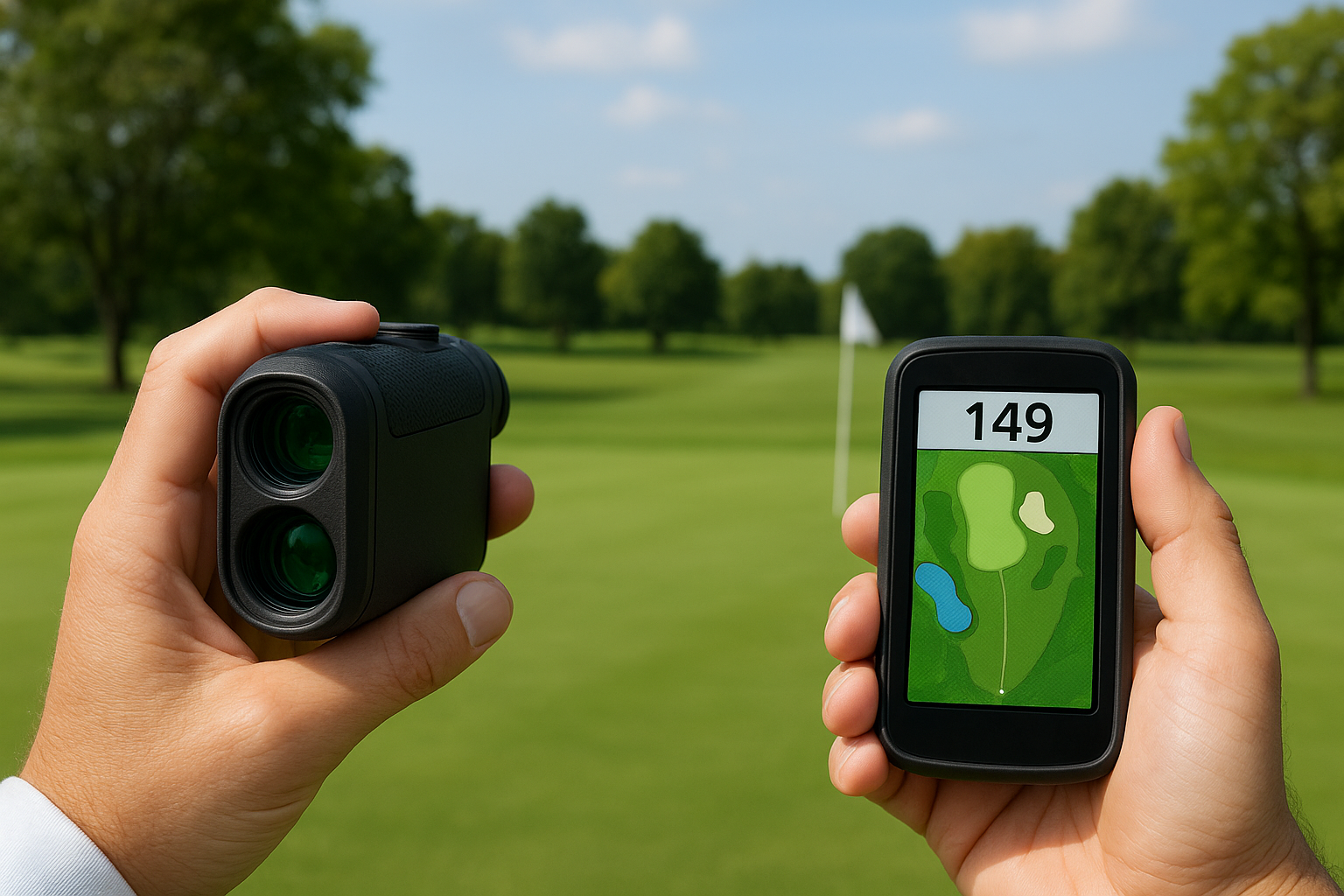
On a 20-metre deep green, the difference between a front and back pin position can represent two full clubs, making pin-specific accuracy far more than a minor detail.
Course awareness and context
A GPS device does something a rangefinder cannot do on its own: it shows you the shape of the hole. You can see where a fairway bunker sits on the left, how far it is to carry water off the tee, or where the fairway narrows before a dogleg. This visual overview helps you plan your route rather than just reacting to each shot as you walk up to your ball.
A rangefinder tells you precise distances to objects you can already see, but it gives you no information about hazards hidden from view or the overall architecture of the hole you are playing. Both types of information are genuinely useful, and neither device delivers both at once.
Cost and ongoing value
Entry-level GPS watches start below £50, while laser rangefinders with slope compensation typically sit between £120 and £300. Running costs differ too: many GPS units charge a small annual subscription for course map updates, while rangefinders carry no ongoing fees beyond the occasional battery replacement. If you play a wide variety of courses throughout the year, the GPS subscription cost is worth factoring into your total budget before you decide.
Pros and cons in real on-course situations
Both devices prove their worth in different on-course scenarios, and understanding those moments helps you see through the abstract golf rangefinder vs GPS debate and into your actual game. The best way to evaluate each tool is to picture real situations where one pulls ahead of the other, rather than comparing spec sheets.
When a rangefinder gives you the edge
A rangefinder earns its place when precise distance to the flagstick is what you actually need. Imagine you are 155 yards out, the pin is cut tight to the back edge of a shallow green, and there is water beyond it. A GPS watch tells you the middle of the green is 148 yards. That seven-yard gap is the difference between attacking the flag with a smooth 7-iron and bailing out to a safer part of the green. The rangefinder tells you exactly where the flag sits and removes the guesswork entirely.
Laser accuracy becomes most valuable when pin positions are extreme and small distance errors carry real scoring consequences.
Better players benefit most from this precision because their ball-striking is consistent enough that a single club difference matters. If you regularly hit greens with a 7-iron but rarely do so with a 6-iron, having exact carry yardages directly affects how often you find the putting surface. Rangefinders also excel on courses you have never played before, where you have no instinctive feel for distances and need reliable, objective data to replace course knowledge.
When GPS serves you better
GPS devices hold a clear advantage whenever hole layout and hazard awareness matter more than pin-specific precision. Picture a tight tee shot where a fairway bunker sits 210 yards out on the right. A rangefinder cannot warn you about it unless you already know where to look. A GPS device shows you the hazard position on a hole map, letting you pick a target line before you even tee the ball up.
GPS is also the more practical choice for players who want fast, frictionless distance information without breaking their routine. If you play at a quick pace, walk with a trolley, or simply prefer keeping your pre-shot process tight, glancing at a wrist unit saves you the time of pulling out a separate handheld device. For high-handicap and casual golfers, the broad distance figures a GPS provides are often precise enough to make confident club selections without needing half-yard accuracy.
Features to look for in 2026
The golf tech market moves quickly, and both rangefinders and GPS devices have added genuinely useful capabilities in recent years. Knowing which features make a real difference on the course helps you avoid paying for gimmicks and focus your budget on the upgrades that actually improve your decision-making. Whether you are buying your first device or upgrading an existing one, these are the specs worth checking before you commit.
Rangefinder features worth prioritising
The single most useful rangefinder feature in 2026 is still fast and reliable flag-lock technology. Look for a model that vibrates when it locks onto the pin rather than a background tree or grandstand, as this confirmation removes any doubt about what you have measured. Beyond flag-lock, slope compensation is worth having even if you disable it for competition play, because knowing the adjusted "plays like" distance during a practice round or casual game sharpens your course management over time.
Slope-adjusted readings are not permitted in stroke play competitions, so confirm your model has a clearly labelled slope-off mode before you use it in a club event.
Optical clarity and magnification level also matter more than many golfers expect. A rangefinder with 6x magnification makes it far easier to lock onto a flag from 200-plus yards, particularly in low light conditions or on courses with complex backdrops behind the green.
GPS features that add real value
In the golf rangefinder vs gps comparison, GPS devices have closed the gap considerably with smarter software and better displays. The features that justify a higher price tag in 2026 are automatic hole advancement, which moves the display to the next hole as soon as you leave the green, and green undulation mapping, which shows you where the green slopes rather than just how far away it sits.
Battery life is a practical factor that often separates the good from the average. A GPS watch that lasts a full 18 holes with regular use is non-negotiable; some premium models now offer multi-round battery life, which removes the need to charge between days during golf trips. You should also check whether the device updates course maps automatically via a companion app or requires a manual download, as course layouts do change and outdated maps can give you inaccurate hazard distances.
How to choose the right device for your game
Narrowing down the golf rangefinder vs GPS debate to your specific situation comes down to three things: your current skill level, how you typically play, and what you genuinely need from a distance tool on the course. Answering those questions honestly steers you toward the right choice faster than any specification comparison.
Match the device to your skill level
Your handicap is a useful starting point. If you are a high-handicap or casual golfer, a GPS watch or handheld unit gives you everything you need. Front, middle, and back distances are accurate enough to make confident club choices when your ball-striking is still developing, and the added benefit of seeing hazard positions before each shot helps you avoid big numbers by making smarter tee-to-green decisions.
If you are consistently hitting greens in regulation and regularly posting scores in the low 80s or better, pin-specific accuracy starts to make a measurable difference to your results.
Better players who already control their distances well will get more from a laser rangefinder's half-yard precision. When you know exactly how far you carry each club, locking onto the flagstick and getting a definitive number removes the last variable from your club selection process.
Consider your budget and course variety
Budget shapes your options more than most golfers admit. A reliable GPS watch fits comfortably under £100 and covers tens of thousands of courses worldwide, making it a practical choice if you play a wide variety of venues throughout the year. A quality laser rangefinder with flag-lock and slope sits between £120 and £300, with no ongoing subscription costs once you have bought it.
If you play the same home course week after week, the course awareness benefits of GPS matter less, because you already know where every bunker and hazard sits. In that scenario, a rangefinder's exact pin distance delivers more value per shot than a course map you have memorised. Conversely, if you travel regularly and play unfamiliar layouts, a GPS device's hole overview and hazard data earns its place in your bag every round.
Some golfers do use both, pairing a GPS watch for constant hole awareness with a rangefinder for critical approach shots. That combination works well if your budget supports it, but for most players, one well-chosen device covers the majority of what you actually need.
Final word
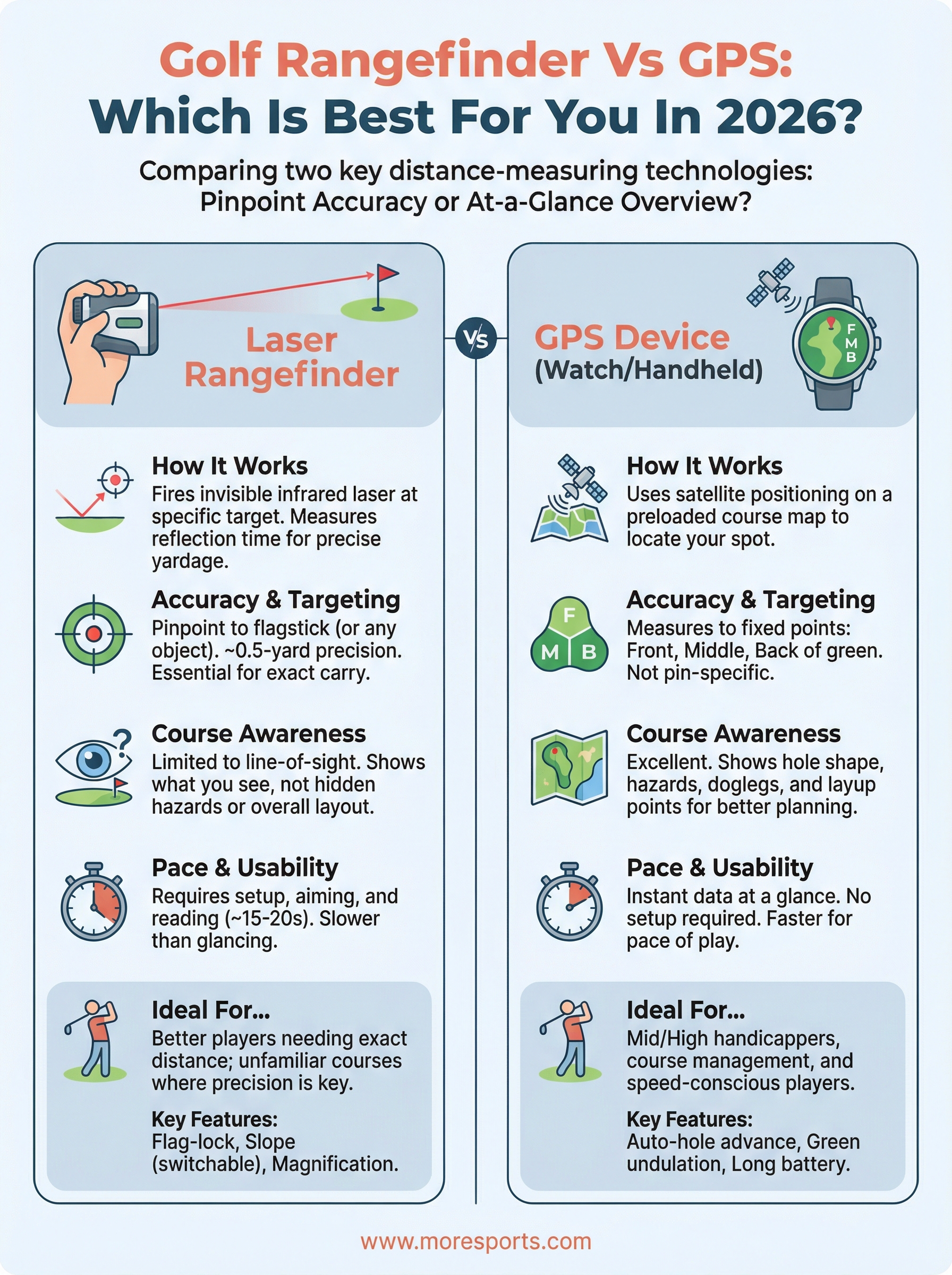
The golf rangefinder vs GPS decision is not about which technology is superior overall. It is about which one matches how you actually play. If you want pinpoint accuracy to the flagstick and your ball-striking is consistent enough to use it, a laser rangefinder is the stronger choice. If you value speed, hole awareness, and hazard information at a glance, a GPS watch or handheld delivers more practical benefit across a full round.
Your budget, handicap, and how often you play unfamiliar courses will point you toward the right answer faster than any spec comparison. Many golfers find that one well-chosen device covers everything they need without the extra cost of carrying both. The key is knowing what you actually use on the course and buying for that, not for features you will rarely touch.
Browse the full range of golf distance devices and accessories at MoreSports and find the right tool for your game.