 No Duties or Customs Fees For EU & UK Customers
 Express Tracked UK Delivery On 1000s of Items
 90 Day Returns

What is Par in Golf – Why It Matters for Beginners
BLGStepping onto a British golf course for the first time can feel overwhelming when unfamiliar words like “par” fly around in conversation. Understanding what par means is key to feeling more confident with every round you play, as it sets the standard for scoring each hole and shapes your improvement journey. By grasping the basics of par in golf, you will find it easier to measure your progress, talk with fellow golfers, and enjoy the game even more.
Table of Contents
- Defining Par In Golf Scoring
- Types Of Par Holes Explained
- How Par Values Are Determined
- Key Par Scoring Terms In Golf
- Common Par Mistakes Beginners Make
Key Takeaways
| Point | Details |
|---|---|
| Understanding Par | Par is the expected number of strokes for a skilled golfer to finish a hole, with categories including Par 3, Par 4, and Par 5. |
| Scoring Terms | Familiarity with scoring terms like Birdie, Bogey, and Eagle helps track performance effectively. |
| Avoiding Common Mistakes | Beginners should focus on correct club selection, technical swing consistency, and strategic shot execution to improve their game. |
| Evaluating Performance | Always compare your score against the hole’s par to assess skill progression and identify areas for improvement. |
Defining Par in Golf Scoring
Golf scoring revolves around a fundamental concept known as par, which represents the expected number of strokes a skilled golfer should require to complete a particular hole. Official golf standards define par as the predetermined number of strokes a scratch (zero handicap) golfer would take under standard playing conditions.
Typically, golf holes are classified into three primary par categories:
- Par 3: Short holes up to 250 yards
- Par 4: Mid-length holes between 251-470 yards
- Par 5: Longer holes ranging from 471-690 yards
The concept of par serves as a critical benchmark for golfers, allowing them to evaluate their performance relative to an ideal standard. Scoring terminology has evolved to describe a player’s performance in relation to par, introducing terms like birdie (one stroke under par) and bogey (one stroke over par).
Interestingly, par was officially standardised by the United States Golf Association (USGA) in 1911, establishing a systematic approach to measuring golfing performance. The standard considers factors beyond mere distance, including hole complexity, terrain features, and expected putting performance.
Pro tip: Always compare your score against the hole’s par to track your golfing improvement and understand your skill progression.
Types of Par Holes Explained
Golf courses are designed with strategic diversity, featuring three primary par hole types that challenge golfers in unique ways. Golf course design incorporates par 3, par 4, and par 5 holes to test different aspects of a player’s skill set and create an engaging playing experience.
Here’s a detailed breakdown of each par hole type:
-
Par 3 Holes: Short holes under 250 yards, demanding precision and accuracy
- Typically reached in one shot
- Requires two putts to complete
- Emphasises technical skill over raw power
-
Par 4 Holes: Mid-length holes between 251-470 yards
- Require a balanced approach of strategy and consistency
- Usually need two shots to reach the green
- Test both distance control and strategic shot placement
-
Par 5 Holes: Longer holes ranging from 471-690 yards
- Designed to challenge endurance and strategic planning
- Typically require three shots to reach the green
- Offer potential scoring opportunities for skilled players
Course layout strategies reveal that golf courses deliberately mix these hole types to create a balanced and challenging 18-hole experience. The variation ensures that golfers must demonstrate a comprehensive range of skills, from precise short-game techniques to powerful long-distance shots.
Each par hole type requires a different mental approach and set of skills. Par 3 holes demand pinpoint accuracy, par 4 holes test overall consistency, and par 5 holes challenge a golfer’s strategic thinking and endurance.
To better understand how par hole types challenge golfers, see this strategic comparison:
| Par Type | Key Challenge | Typical Number of Shots to Green | Skill Emphasised |
|---|---|---|---|
| Par 3 | Accuracy & control | 1 | Technical precision |
| Par 4 | Strategy & approach | 2 | Distance control |
| Par 5 | Endurance & planning | 3 | Long-game strategy |
Pro tip: Practice your skills on different par hole types to develop a well-rounded golfing technique and improve your overall performance.
How Par Values Are Determined
Par values are meticulously calculated using a combination of scientific measurement and strategic course design principles. Official golf guidelines establish a comprehensive framework for determining the par of each hole, considering multiple critical factors beyond simple distance.
The primary considerations for establishing par values include:
- Hole Length: Measuring the total distance from tee to green
- Effective Playing Length: Accounting for elevation changes and terrain
-
Difficulty Factors:
- Presence of hazards
- Wind conditions
- Terrain complexity
- Potential obstacles
Distance guidelines) typically categorise hole pars based on specific yardage ranges:
- Par 3 Holes: Under 260 yards for men
- Par 4 Holes: 240-490 yards
- Par 5 Holes: 450-710 yards
Interestingly, these ranges can vary slightly for women golfers, reflecting differences in typical playing distances. Course designers carefully balance these technical measurements with the strategic intent of creating a challenging and engaging golfing experience.
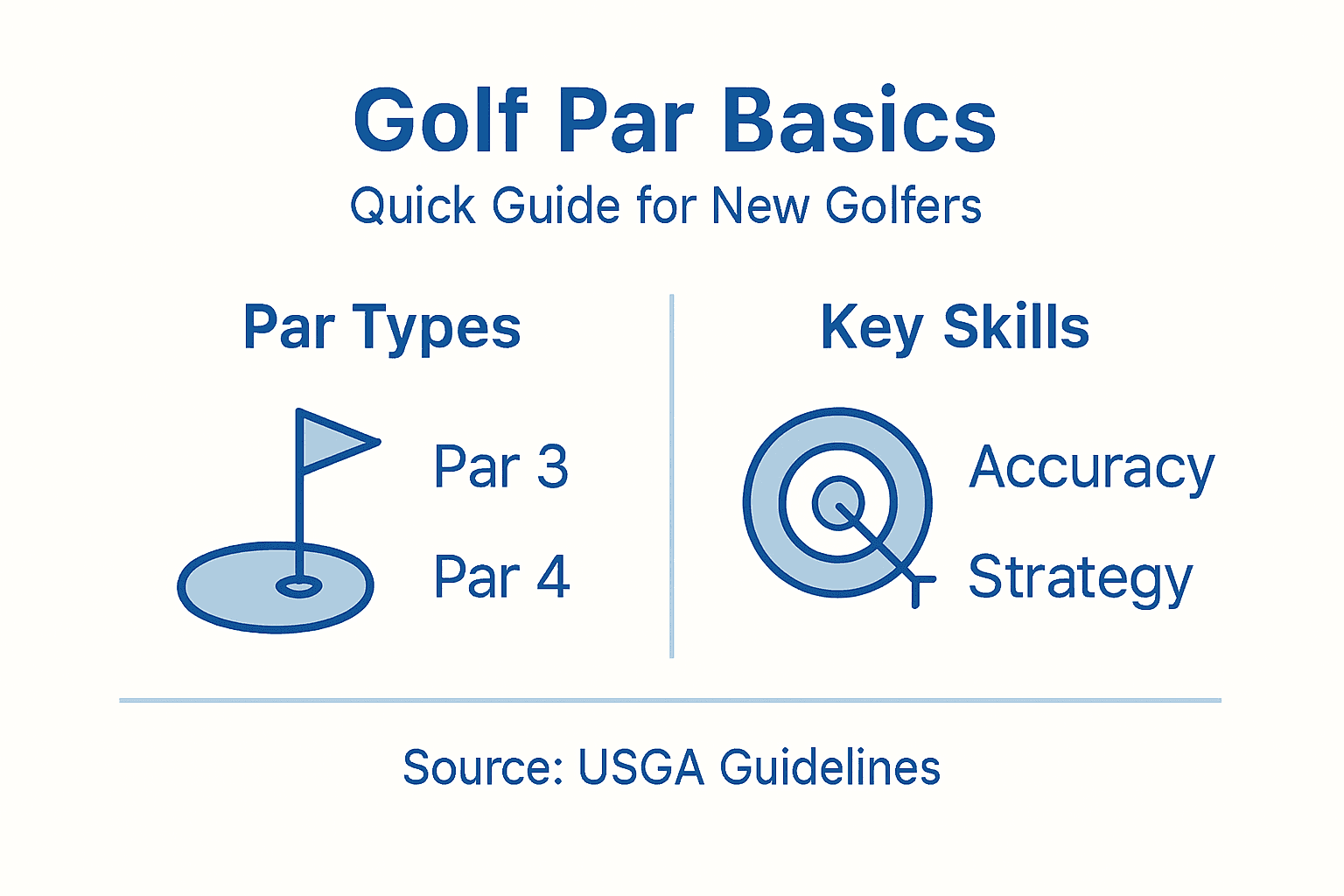
The United States Golf Association (USGA) provides detailed recommendations that allow for some flexibility in par assignment. This means that holes situated near the boundary of different par categories might be classified based on additional design considerations beyond pure measurement.
Pro tip: Always consider the entire hole’s characteristics, not just its length, when understanding why a particular hole is assigned its specific par value.
Key Par Scoring Terms in Golf
Understanding golf scoring terminology is crucial for beginners navigating the complexities of the game. Golf scoring terms provide a standardised language that helps players communicate their performance and track progress across different holes and courses.
Here are the essential scoring terms related to par:
- Birdie: One stroke below par
- Par: Exact number of expected strokes
- Bogey: One stroke above par
- Eagle: Two strokes below par
- Albatross: Three strokes below par
- Double Bogey: Two strokes above par
- Triple Bogey: Three strokes above par
These scoring terms create a universal language for golfers, allowing quick and easy communication about performance. When a golfer says they made a “birdie” on a par 4 hole, it means they completed the hole in three strokes – one less than the expected four.
Here is a clear reference to common scoring terms and their meaning in golf:
| Term | Strokes vs Par | What It Means in Play |
|---|---|---|
| Birdie | 1 under par | Achieved score is better than par |
| Par | Equal to par | Matches expected standard |
| Bogey | 1 over par | Slightly worse than target |
| Eagle | 2 under par | Exceptional performance |
| Albatross | 3 under par | Extremely rare and impressive |
| Double Bogey | 2 over par | Major error on the hole |
| Triple Bogey | 3 over par | Significant mistake made |
Interestingly, these terms provide more than just a numerical description. Understanding golf handicaps becomes easier when players can precisely articulate their performance using these standardised scoring terms.
Mastering these terms not only helps in tracking individual hole performance but also enables golfers to understand more complex scoring systems and competitive play strategies.
Pro tip: Practice using these scoring terms during your games to quickly communicate your performance and sound like a seasoned golfer.
Common Par Mistakes Beginners Make
Navigating the challenges of golf scoring requires understanding and avoiding common beginner mistakes that can significantly impact your par performance. Golfer technique fundamentals reveal several critical errors that can derail a player’s scoring potential.
The most prevalent par-affecting mistakes include:
-
Incorrect Club Selection:
- Not knowing precise club distances
- Using inappropriate clubs for specific shots
- Overestimating personal capabilities
-
Technical Swing Errors:
- Swaying during backswing
- Over-swinging to generate power
- Poor grip pressure
- Inconsistent posture
-
Strategic Misconceptions:
- Rushing shots
- Misaligning body and club
- Incorrect ball positioning
- Over-thinking technical details
Improving golf techniques suggests that many par-related mistakes stem from fundamental misunderstandings about technique and approach. Beginners often try to hit the ball harder instead of focusing on consistent, controlled movements.
Understanding these common errors is the first step towards developing a more strategic and effective golf game. Each mistake represents an opportunity for improvement and can significantly reduce strokes over par when addressed systematically.
Pro tip: Record your golf swings and compare them against professional techniques to identify and correct your specific technical mistakes.
Master Your Golf Par with the Right Gear from MoreSports
Understanding par is essential for any beginner aiming to improve their golf game. This article highlights common challenges like achieving consistent scoring, mastering different par hole types, and avoiding beginner mistakes. You need reliable golf equipment that supports precision, control, and strategic play to confidently tackle par 3s, 4s, and 5s.

Elevate your performance today with premium golf gear from MoreSports. Explore our wide range of trusted brands focused on quality and durability to help you develop your skills and lower your scores. Don’t wait to invest in equipment that matches your ambitions—visit MoreSports golf collection now and take the first step towards playing smarter and scoring better.
Frequently Asked Questions
What does par mean in golf?
Par is the standard number of strokes a skilled golfer is expected to take to complete a hole, which is determined by the hole’s length and difficulty.
How is par determined for each hole on a golf course?
Par values are calculated based on factors such as hole length, effective playing length, and difficulty factors like hazards and terrain features.
What are the different types of par holes in golf?
There are three main types of par holes: Par 3 (short holes typically up to 250 yards), Par 4 (mid-length holes between 251-470 yards), and Par 5 (long holes ranging from 471-690 yards).
Why is understanding par important for beginners in golf?
Understanding par helps beginners evaluate their performance, set realistic goals, and develop a strategy for improvement as they track their progress against the ideal standard.
Recommended
- 12 Best Golf Balls For Beginners And High Handicappers 2026 – More Sports
- Best Golf Drivers For Beginners 2025: UK Top Picks & Guide – More Sports
- 12 Best Golf Balls For High Handicappers: UK 2026 Guide – More Sports
- What Is a Putter In Golf? A Beginners Guide – More Sports
- Glenelg Golf Club - Adelaide Wedding Venues