 No Duties or Customs Fees For EU & UK Customers
 Express Tracked UK Delivery On 1000s of Items
 90 Day Returns

Driver Shaft Flex Guide: Choose The Right Flex By Speed
RYChoosing the wrong shaft flex can quietly rob you of distance and accuracy off the tee. If your drives feel inconsistent, ballooning too high, hooking left, or falling short, the issue might not be your swing. It might be the shaft. A proper driver shaft flex guide helps you match your swing speed to the right flex category, so the club works with you rather than against you. At MoreSports, we carry drivers and golf equipment from brands like TaylorMade, Callaway, and MacGregor, and we know that getting the shaft flex right is one of the simplest upgrades a golfer can make.
Shaft flex affects how the clubhead delivers energy to the ball at impact. Too stiff and you lose launch angle; too soft and you lose control. The difference between a well-fitted shaft and a poor one can mean 20+ yards and significantly tighter dispersion. Yet most golfers grab a driver off the shelf without giving flex a second thought, relying on guesswork instead of data like swing speed and carry distance.
This guide breaks down each flex category, Senior, Regular, Stiff, and X-Stiff, and shows you exactly how to match yours to your swing. You'll find clear speed and distance charts to reference, along with explanations of what happens when you play the wrong flex. By the end, you'll have the confidence to pick the right driver shaft without needing a fitting studio.
What driver shaft flex is and why it matters
Shaft flex describes how much a golf shaft bends during your downswing and through impact. Every swing places a load on the shaft, and the amount it deflects before snapping back to position determines where the clubhead is pointing when it meets the ball. A softer flex bends more, which can help slower swingers generate extra launch and carry distance. A stiffer flex bends less, giving faster swingers more control and tighter shot patterns. Getting this balance right is the core purpose of any driver shaft flex guide.
How the shaft bends during the swing
When you start your downswing, the shaft lags behind the clubhead. This creates a bend known as shaft kick or shaft load, and the timing of that kick directly affects both launch angle and spin rate. If your swing speed matches the flex, the shaft unloads cleanly at the bottom of the arc, squaring the face at impact and transferring maximum energy to the ball.

If the flex is wrong for your speed, the shaft unloads too early or too late. A shaft that is too stiff for your swing speed will under-load, meaning the face stays slightly open at impact and shots leak right. A shaft that is too soft will over-bend, causing the face to close and producing low, hooking drives with unpredictable spin. Neither outcome is fixable through swing changes alone.
Shaft flex doesn't just affect distance - it affects where the ball starts, which means it directly controls your accuracy off the tee.
The four flex categories explained
Any practical driver shaft flex guide organises shafts into four main categories. Each one targets a specific range of swing speeds, and understanding what separates them helps you make a confident decision before you commit to a purchase.
| Flex | Code | General Player Profile |
|---|---|---|
| Senior | A | Slower swing speeds, seniors, beginners |
| Regular | R | Average recreational golfers |
| Stiff | S | Better players with higher swing speeds |
| X-Stiff | X | Fast swingers, low-handicap and competitive players |
These labels are standardised across most manufacturers, though the exact stiffness within each category can vary by brand and shaft model. A Stiff shaft from TaylorMade may feel marginally different to a Stiff shaft from another manufacturer at the same swing speed, because brands also vary in torque, which is the rotational stiffness of the shaft. Torque matters alongside flex, but flex remains the primary variable to get right first. Once you lock in the correct flex category, you can fine-tune from there.
Step 1. Find your real driver swing speed
Before any driver shaft flex guide can help you, you need an accurate swing speed number. Most golfers either overestimate their speed or rely on a figure they heard years ago. Your swing speed changes with age, fitness, and technique, so using an outdated or guessed number will send you towards the wrong flex before you even start.
How to measure your swing speed accurately
The most reliable way to get your swing speed is to use a launch monitor. Devices like TrackMan or FlightScope are available at most professional fitting centres and many golf retailers. You hit several drives with your usual swing, and the monitor records clubhead speed in miles per hour. Take an average across at least five full swings rather than relying on a single reading, since swing speed naturally varies from shot to shot.
Always swing at your normal tempo during the test, not harder than usual, because an artificially fast reading will push you into a stiffer flex than you actually need.
What to do if you don't have a launch monitor
If you don't have access to a launch monitor, your carry distance with a driver gives you a strong indirect estimate. Pace out or use a GPS app to track where your ball lands on a calm day with no helping wind, then use the table below to convert that figure into an approximate swing speed.
| Carry Distance (yards) | Estimated Swing Speed (mph) | Likely Flex |
|---|---|---|
| Under 180 | Under 72 | Senior |
| 180-210 | 72-83 | Regular |
| 210-240 | 84-96 | Stiff |
| 240+ | 97+ | X-Stiff |
These figures assume a reasonably centred strike and average launch conditions. They work well as a starting point, but a launch monitor reading is always more precise when you can access one.
Step 2. Use a swing speed to flex chart
Once you have your swing speed, the next step in any driver shaft flex guide is to map that number directly to a flex category. The chart below gives you a clear reference point based on measured clubhead speed in miles per hour. Use the average speed from your launch monitor session, or your estimated figure from Step 1, and find the row that fits your number.
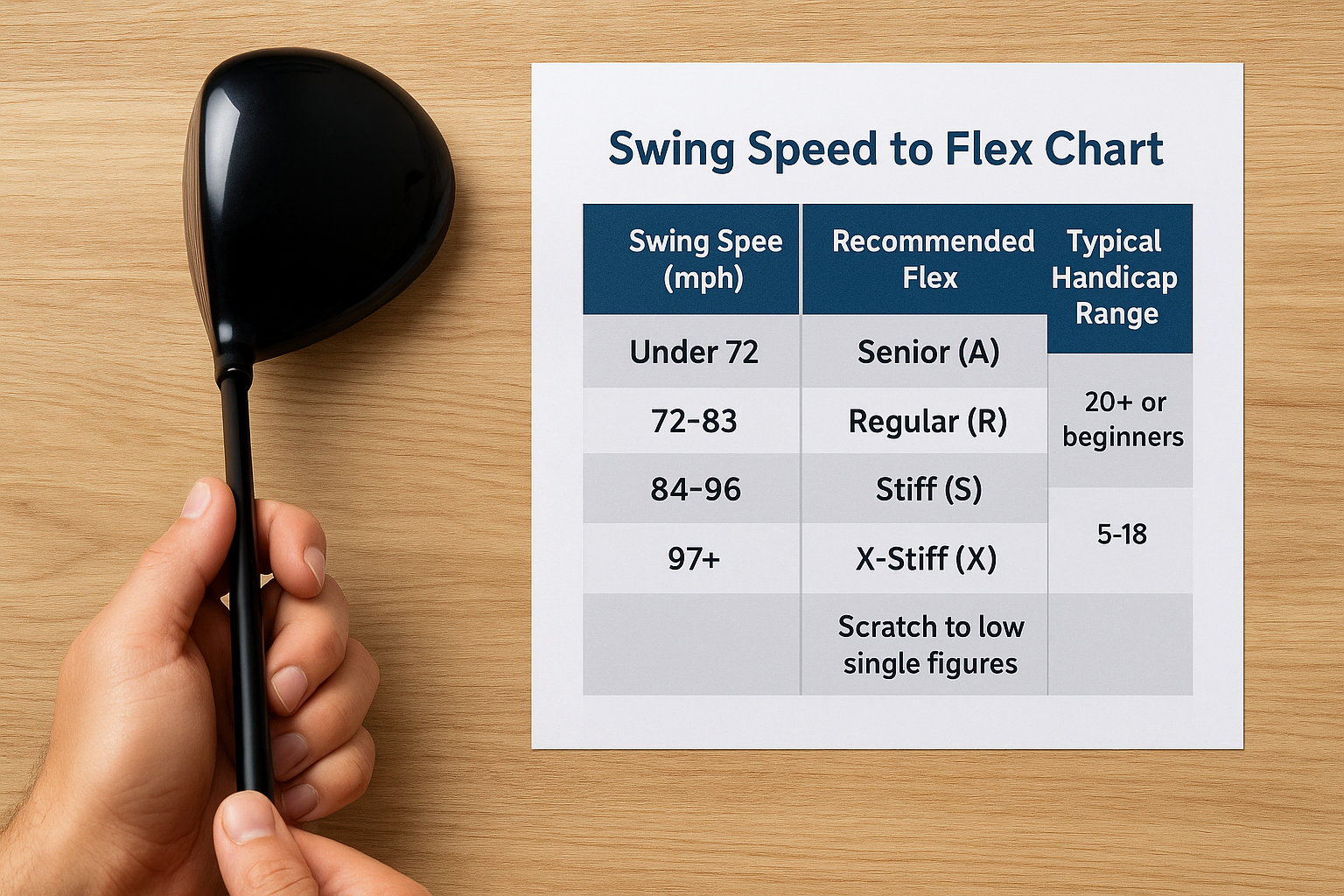
| Swing Speed (mph) | Recommended Flex | Typical Handicap Range |
|---|---|---|
| Under 72 | Senior (A) | 20+ or beginners |
| 72-83 | Regular (R) | 15-25 |
| 84-96 | Stiff (S) | 5-18 |
| 97+ | X-Stiff (X) | Scratch to low single figures |
If your speed sits right on the boundary between two categories, lean towards the softer flex unless you have a particularly aggressive, fast-loading swing.
How to use the chart without over-complicating it
Find your swing speed in the left column and match it to the flex on the right. That gives you your starting flex category, not a final answer. Think of this chart as narrowing the field from four options to one, which you will then refine in the next step based on additional factors like tempo and strike location.
What happens when your speed falls between ranges
If your average swing speed measures at, say, 83-84 mph, you sit at the Regular-to-Stiff boundary. In this situation, consider your typical miss. If you tend to block drives right, a Regular flex may help the shaft unload more fully and square the face. If you hook or struggle with high spin, a Stiff shaft gives you more control through the hitting zone. Use the chart as your anchor, then apply your miss pattern to make the final call.
Step 3. Adjust for tempo, launch and strike
Swing speed gives you a strong starting point, but it doesn't capture everything that matters. Tempo and strike location can shift your ideal flex by one full category in either direction, which is why a complete driver shaft flex guide always accounts for these variables beyond raw speed numbers.
Adjusting for your swing tempo
Tempo describes how quickly you transition from your backswing to your downswing. Golfers with a fast, aggressive transition load the shaft more forcefully, which means the shaft bends more even at the same swing speed. If your tempo is quick and you feel like you're generating a lot of speed in a short time, move up one flex category from what the chart suggests. A slower, smooth tempo does the opposite: it loads the shaft more gradually, so you may benefit from dropping one category softer to help the shaft unload fully at impact.
A useful self-check: if your drives frequently miss right with a shaft that feels correct by the numbers, a softer flex is likely the better fit for your tempo.
Reading your launch height and strike location
Launch height and ball flight shape tell you whether your current or intended flex is working. Shots that balloon high with excessive spin point to a shaft that is too soft for your swing, as the face is closing past square at impact. Shots that fly low and leak to the right indicate a shaft that is too stiff, preventing full face rotation through the hitting zone.
Strike location adds one more layer. Consistent toe strikes produce lower spin, which partially mimics the effect of a softer shaft. Heel strikes do the opposite. If your miss pattern is consistent, factor it in: toe-heavy strikers can often move one flex stiffer without losing performance, while heel-heavy strikers benefit from staying in the softer category.
Step 4. Confirm your choice before you buy
The previous steps narrow your options down to one strong candidate. Before you commit to a purchase, this driver shaft flex guide gives you three practical ways to verify that your chosen flex genuinely suits your swing. Spending a few extra minutes here is far cheaper than returning a driver shaft that doesn't perform the way you expected.
Hit a demo shaft if you can
Most golf retailers and fitting centres stock demo shafts across multiple flex options. If you can arrange even a brief session on a launch monitor with two adjacent flex categories, take it. Hit five to ten shots with each and compare the average spin rate and carry distance across the batch. The flex that produces a consistent, penetrating ball flight at your natural swing speed is the right one. You want the most repeatable pattern, not the single longest drive.
Check the manufacturer's spec sheet
Before you buy, look up the specific shaft model and flex code on the manufacturer's website. Labels like "S" for Stiff vary slightly between brands, so checking the published CPM rating adds an extra layer of certainty. CPM (cycles per minute) measures shaft stiffness directly: a Stiff shaft typically falls between 260 and 280 CPM, while a Regular shaft sits closer to 240 to 260 CPM. If the brand publishes this figure, use it alongside your swing speed to confirm the match before purchase.
If a shaft lists no CPM or stiffness specification, dig deeper before buying, particularly with premium shafts where the cost of a wrong choice is significant.
Run through this pre-purchase checklist
Work through the points below before you finalise your driver shaft selection:
- Swing speed confirmed via launch monitor or carry distance estimate from Step 1
- Flex category matched using the swing speed chart from Step 2
- Tempo and miss pattern reviewed and adjustments applied from Step 3
- Demo shaft tested or manufacturer spec sheet reviewed for CPM rating
- Shaft weight appropriate for your swing speed (lighter shafts for slower speeds, heavier for faster)
Checking all five boxes gives you a confident, data-backed decision rather than a guess off the shelf.
Final checks before you play
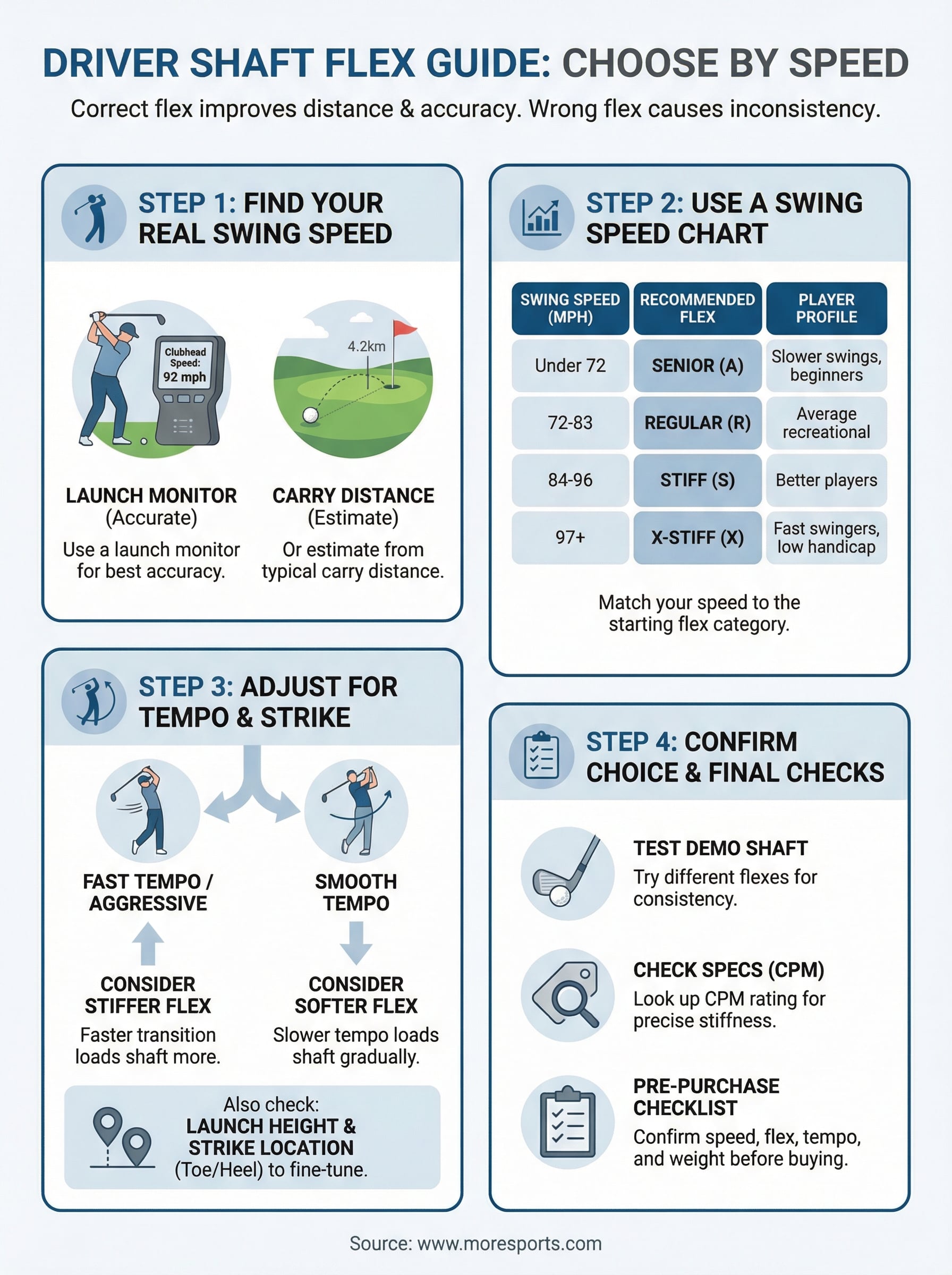
You've worked through every step in this driver shaft flex guide, from measuring your swing speed to confirming your flex with a demo session or manufacturer spec sheet. Before you take your new driver to the first tee, run through these final checks to make sure everything is in order.
First, grip the club at your natural pressure and take a few slow practice swings to feel how the shaft loads. If the flex matches your swing, the shaft will feel smooth and responsive without any unwanted wobble at the top. Second, hit a short warm-up session before your first round to bed in your timing with the new shaft.
Ready to put your decision into practice? Browse the full range of golf drivers and equipment at MoreSports, where you'll find competitive UK prices, free delivery on orders over £25, and a 90-day returns policy if the fit isn't right.