 No Duties or Customs Fees For EU & UK Customers
 Free UK Delivery On Orders Over £30
 90 Day Returns

Golf Ball Fitting Guide: Find Your Best Ball In 10 Minutes
RYMost golfers spend hours researching drivers and irons but grab whatever golf ball is on sale. That's a mistake. The ball is the only piece of equipment you use on every single shot, and playing the wrong one can quietly cost you distance, spin control, and strokes. This golf ball fitting guide walks you through a straightforward process to match a ball to your game in about 10 minutes, no launch monitor appointment required.
You don't need to be a scratch player for ball selection to matter. Whether you swing at 75 mph or 105 mph, factors like compression, cover material, and dimple pattern all influence how the ball behaves off your clubface and around the green. Understanding these basics gives you a real edge, especially when paired with equipment you already trust.
At MoreSports, we stock golf balls from brands like Titleist, TaylorMade, and Callaway at some of the lowest UK prices you'll find online. Below, we'll break down exactly how to assess your swing speed, playing style, and on-course priorities, then point you towards the right ball without the guesswork.
What matters in a golf ball fitting
A proper golf ball fitting comes down to four variables: compression, cover material, layer construction, and your personal shot priorities. Each one affects a different part of your game, and understanding how they interact is the foundation of any golf ball fitting guide worth following. You don't need to memorise technical specs, but knowing what each factor does helps you cut through marketing claims and make a smarter, more targeted choice.
Compression and swing speed
Compression measures how much the ball deforms when you strike it. Low-compression balls (50-70) are softer and designed for swing speeds under 85 mph, where they compress easily and deliver better energy transfer on slower strikes. High-compression balls (90+) require faster swing speeds to activate properly and reward players who generate significant clubhead speed with a firmer feel and tighter ball flight.
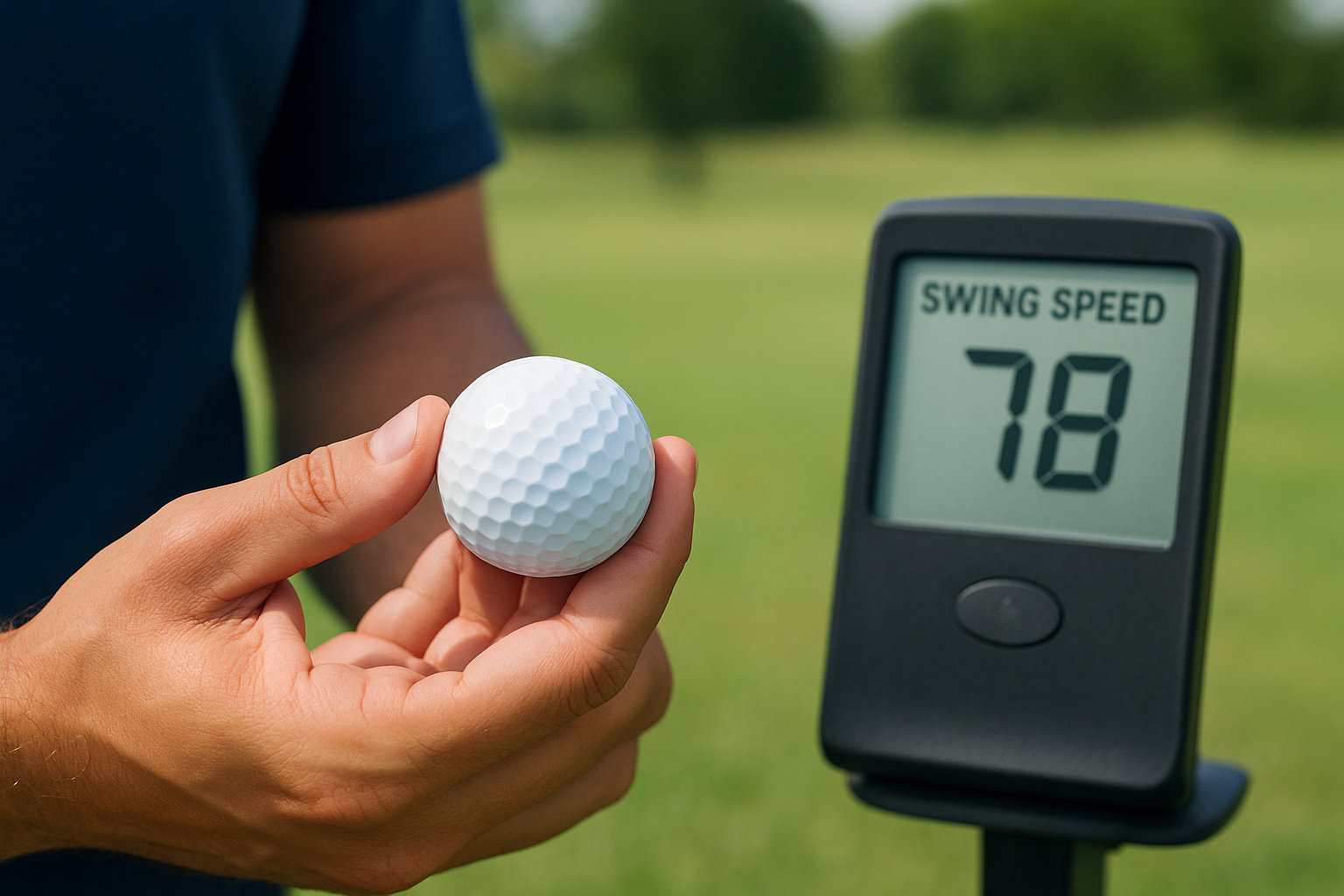
If your swing speed is below 85 mph and you're playing a tour-level high-compression ball, you're leaving distance on the table with every drive.
Measuring your swing speed is straightforward using a launch monitor, a speed radar at a fitting bay, or even a free club speed app on your phone. You don't need precise numbers, just a rough bracket: slow (under 85 mph), moderate (85-100 mph), or fast (100+ mph). That bracket alone will narrow your options considerably before you look at anything else.
Cover material and short game feel
The outer cover of a golf ball has a direct impact on spin around the greens and feel at impact. Urethane covers, found on premium balls like the Titleist Pro V1 or TaylorMade TP5, generate high spin on wedge shots and give a softer, more responsive feel. Surlyn covers, common on two-piece distance balls, are more durable and produce less spin, which can reduce fliers but also limits your ability to stop the ball quickly on firm greens.
Short game style matters here. If you rely on spinning wedge shots to hold greens, a urethane cover is worth the extra cost. If you're a beginner or mid-handicapper focused mainly on keeping the ball in play, a durable Surlyn cover offers better consistency and stronger value for money round after round.
Layer count and what it changes
Golf balls range from two-piece constructions all the way up to five-piece designs. Two-piece balls prioritise distance and durability, making them a solid match for higher handicappers and recreational players. Three-piece balls begin to separate driver performance from short-game feel, offering a genuine middle ground. Four and five-piece balls, such as the Callaway Chrome Soft X or TaylorMade TP5x, are engineered so that each layer serves a specific purpose: maximum energy on long shots, reduced spin on mid-irons, and high spin on wedge approaches.
Adding more layers does not automatically improve your score. A player who still struggles with consistent ball striking will not benefit from a five-piece ball the way a single-figure handicapper will. Matching the layer count to your current skill level and typical shot shape keeps things practical and means you avoid paying for technology you won't fully activate during a round.
Prioritising what matters to your game
Before you start comparing specific models, rank these three things in order of importance to you: distance off the tee, short game feel, or overall durability and cost. Your ranking will make the final decision far easier because most balls are optimised for one or two of these priorities rather than all three equally.
| Priority | Ball type to target | Example |
|---|---|---|
| Maximum distance | Two or three-piece, high-energy core | Titleist Velocity, Srixon AD333 |
| Short game spin and feel | Three to five-piece, urethane cover | Titleist Pro V1, TaylorMade TP5 |
| Durability and value | Two-piece, Surlyn cover | Callaway Warbird, Wilson Staff Fifty |
Use this table as a quick reference point. Your answers in the steps ahead will fill in the gaps and point you towards a specific shortlist.
Step 1. Gather your numbers in 2 minutes
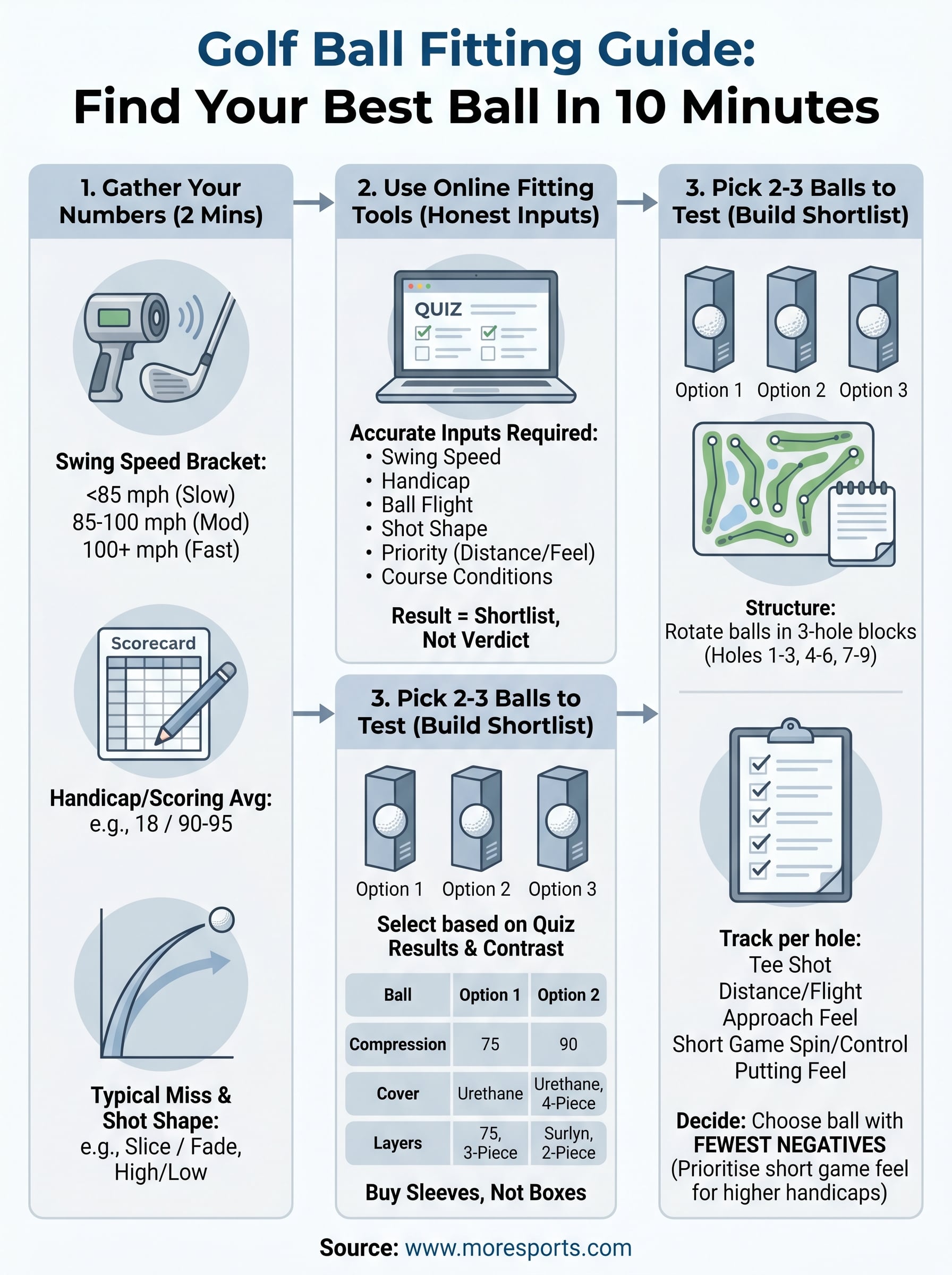
Before you open any fitting tool or browse any product page, you need three pieces of information: your swing speed, your handicap or scoring average, and your typical miss. These numbers take less than two minutes to jot down and they form the foundation of every recommendation in this golf ball fitting guide. Without them, you're guessing rather than deciding, and that guesswork is exactly what a structured fitting process is designed to remove.
Your swing speed
Swing speed is the single most important data point in ball fitting. If you've visited a driving range with a launch monitor bay, you'll likely already have a number. If not, many golf retailers offer free speed checks, or you can use a radar device at the range to get a reliable reading. Use this bracket to place yourself before moving on:
- Under 85 mph - low-compression balls (compression rating 50-70)
- 85-100 mph - mid-compression balls (compression rating 70-90)
- Over 100 mph - high-compression tour balls (compression rating 90+)
If you don't have access to a launch monitor, estimate your swing speed using your 7-iron carry distance: under 130 yards suggests slow speed, 130-160 yards is moderate, and over 160 yards puts you in the fast bracket.
Your handicap and scoring average
Your handicap or typical scoring range tells the fitting process how consistently you strike the ball. A player shooting 95+ regularly will compress and control a five-piece urethane ball very differently from a single-figure handicapper who strikes it cleanly almost every time. Write down your current handicap index if you have one, or simply note your average score over your last five rounds. Both figures help you match layer count and cover material to how you actually perform on the course, not how you performed at your best.
Your typical miss and shot shape
The final number to note is your dominant miss and ball flight shape. Do you consistently fade, draw, or hit it reasonably straight? A player who already generates high spin and hits steep wedge shots will want a ball that manages rather than adds to that spin, whereas a low-spin player benefits from a softer, higher-launching option. Write down one honest answer from your last few rounds: fade, draw, or straight, and whether your ball flight tends to be high or low.
Having these three numbers ready gives any online fitting tool or retail assistant enough information to make a targeted, meaningful recommendation rather than a generic one. Move on to the next step with your swing speed bracket, scoring average, and shot shape noted down.
Step 2. Use online fitting tools the right way
Online fitting tools are useful, but only when you feed them accurate inputs. Most major ball manufacturers offer a free quiz on their websites, and these tools work by matching your swing speed, handicap, and shot preferences to their product range. The problem is that many golfers answer questions loosely or optimistically, which pushes the tool towards premium tour balls that may not suit their actual game. Enter the numbers you gathered in Step 1 honestly, and the results become genuinely useful.
What fitting quizzes actually measure
These quizzes typically ask for the same three inputs you already have: swing speed, handicap, and ball flight preference. Some tools also ask about your priority between distance and feel, or whether you play on firm or soft courses. Each question narrows the algorithm's output. Rather than skipping questions or selecting what sounds best, answer based on your honest average performance rather than your best round this year. That distinction produces a recommendation that holds up round after round, not just on a good day.
Treat the quiz result as a shortlist, not a final verdict. It gives you a starting point, not a guarantee.
How to use a fitting quiz: input template
Use this input template every time you work through a fitting quiz as part of this golf ball fitting guide. Filling in each field before you open the tool means you enter accurate data rather than guessing mid-quiz.
| Field | What to enter |
|---|---|
| Swing speed | Your bracket from Step 1 (slow, moderate, fast) |
| Handicap | Your current index or scoring average |
| Ball flight | Your honest dominant flight (high, mid, or low) |
| Shot shape | Fade, draw, or straight |
| Priority | Distance, feel, or durability |
| Course conditions | Firm, soft, or mixed |
Work through each question methodically before clicking to the next screen. If a tool only asks for swing speed and handicap, use those two inputs and ignore prompts to upgrade to a premium tier unless the data supports it. Once you have two or three ball recommendations from the quiz, write them down alongside the numbers from Step 1. These become the shortlist you test on the course in the next step, grounded in real data rather than marketing copy.
Step 3. Pick 2 or 3 balls to test
Your fitting quiz has given you a shortlist, and now you need to reduce it to a practical, testable set of two or three balls. Testing one ball tells you nothing by comparison. Testing six balls simultaneously spreads your attention too thin and makes it nearly impossible to identify what's actually making a difference. Two or three balls gives you enough contrast to form a clear opinion while keeping the test focused and repeatable.
Why two or three, not one or five
Picking a single ball to test is a common mistake because it removes the reference point you need. Without something to compare against, you'll struggle to judge whether a ball genuinely suits your game or whether your round was simply better than usual. Testing two or three balls in rotation across the same nine holes gives you a direct, controlled comparison under identical conditions.
More than three balls in a single test session introduces too many variables and muddies your conclusions.
Testing five or six at once also gets expensive quickly. Narrowing to three options means you spend a realistic amount on the test while still covering the key differences your quiz identified, whether that's compression level, cover material, or layer count.
How to build your shortlist from the quiz output
Take the two or three model names your fitting quiz recommended and check whether they sit in different categories. Ideally, your shortlist should include at least one ball that matches your swing speed bracket precisely, and one that represents a step up or down in compression. This spread lets you feel the difference directly during the test rather than guessing from a spec sheet.
Use this template to record your shortlist before you buy:
| Ball name | Compression rating | Cover material | Layer count | Why selected |
|---|---|---|---|---|
| Option 1 | e.g. 75 | Urethane | 3-piece | Quiz recommendation |
| Option 2 | e.g. 90 | Urethane | 4-piece | Step up in compression |
| Option 3 | e.g. 65 | Surlyn | 2-piece | Budget comparison |
Matching the shortlist to your budget
This golf ball fitting guide recommends buying a sleeve of three balls for each model on your shortlist rather than a full box. Sleeves cost far less upfront and give you enough balls to run a proper nine-hole test without committing to a bulk purchase before you've confirmed the fit. Once you identify a clear winner, buying a full box becomes a straightforward, confident decision rather than a gamble.
Step 4. Run a 9-hole test and decide
Nine holes gives you enough data to make a confident decision without the time commitment of a full round. Take your shortlisted balls to the course and rotate them across the nine holes in a structured way, not randomly. The goal of this final step in the golf ball fitting guide is to collect honest, repeatable observations that point clearly towards one ball and away from the others.
How to structure the ball rotation
Play each ball for three consecutive holes rather than switching every hole. Three-hole blocks give you a better feel for how a ball performs across different shot types, from the tee shot through to the putting surface, rather than forming impressions based on a single swing. If you have three balls on your shortlist, the rotation works perfectly across nine holes: three holes per ball, each block covering a par 3, a par 4, and a par 5 where possible.
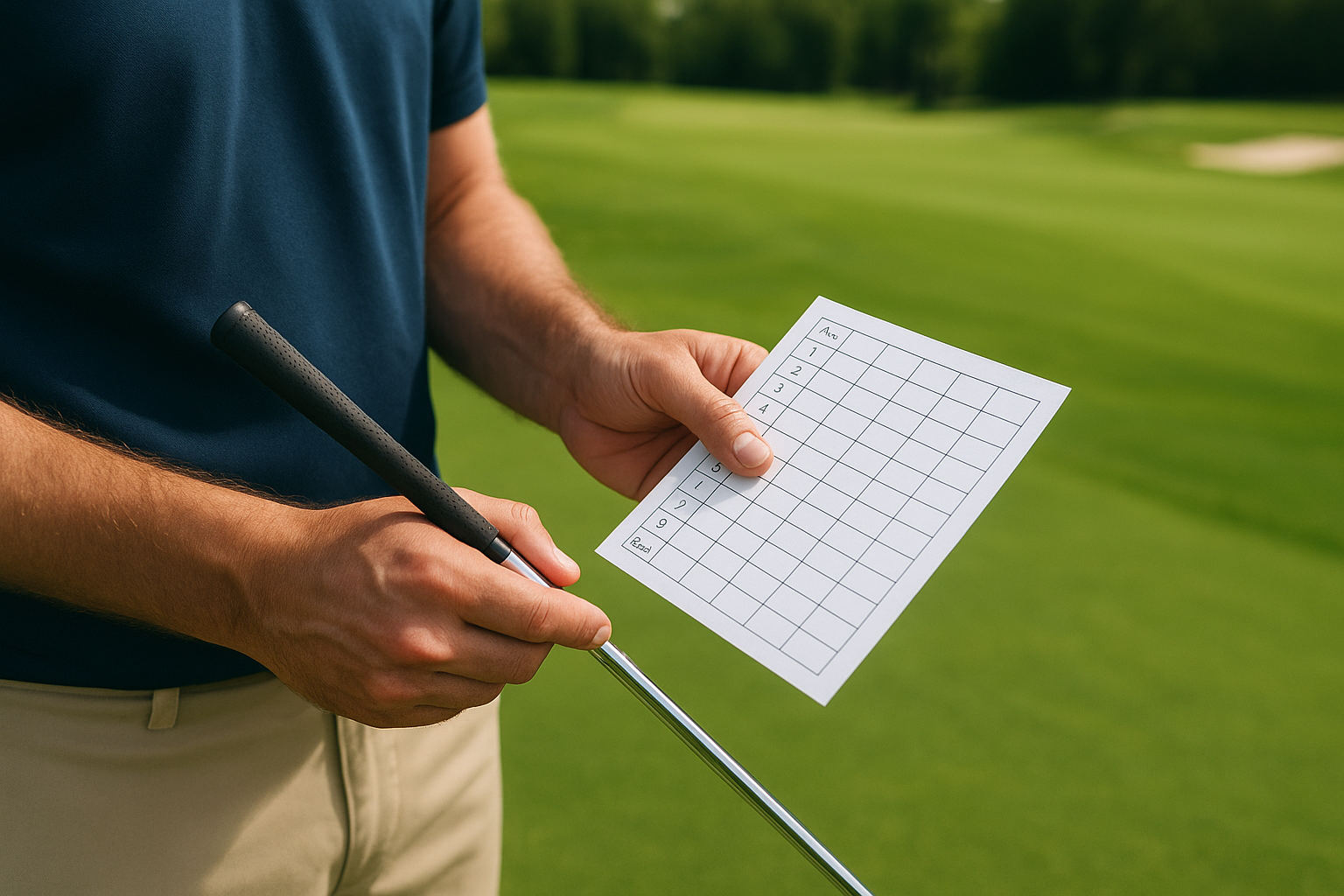
Switching balls every single hole prevents you from building a feel for any one option, which defeats the purpose of a structured test.
What to track on each hole
Carry a small notepad or use your phone's notes app to log four observations per hole: tee shot distance and flight, iron or approach feel at impact, short game spin and control, and putting feel on the green. You don't need precise yardages or technical measurements. Brief, honest notes are enough to reveal patterns across the nine holes when you review them at the end.
Use this tracking template on the course:
| Hole | Ball used | Tee shot notes | Approach feel | Short game control | Green feel |
|---|---|---|---|---|---|
| 1-3 | Option 1 | ||||
| 4-6 | Option 2 | ||||
| 7-9 | Option 3 |
How to read your results and decide
After the round, review your notes and look for the ball that produced the fewest negative comments across all four categories. A ball that felt great off the tee but consistently came up short on wedge spin is not the right fit, regardless of how impressive the drive felt. Weight the short game and feel categories more heavily than distance if your handicap sits above 12, since scoring rounds depend more on approach and putting performance than on raw yards gained off the tee. The ball with the most consistent, positive notes across all nine holes is your match.
Your next round
This golf ball fitting guide gives you a repeatable process you can run before any season starts or whenever your game changes significantly. You now know how to gather your swing speed, handicap, and shot shape, feed accurate inputs into online fitting tools, narrow your shortlist to three testable options, and make a final call after a structured nine-hole comparison. That process removes the guesswork from a decision most golfers ignore entirely.
Your results from the nine-hole test are worth keeping. Note the winning ball model, your swing speed bracket, and the date so you have a reference point if your game develops or you want to retest in six months. Ball technology does not change dramatically year to year, so a well-matched ball today will likely suit you well into next season.
When you are ready to buy, browse golf balls from top brands at the lowest UK prices and pick up your test sleeves with free UK delivery over £25.