 No Duties or Customs Fees For EU & UK Customers
 Free UK Delivery On Orders Over £30
 90 Day Returns

Golf Shaft Flex Explained: Find Right Flex For Your Swing
RYPicking the wrong shaft flex can cost you distance, accuracy, and consistency, even if the rest of your equipment is spot on. That's why having golf shaft flex explained properly matters more than most golfers realise. Shaft flex affects how the clubhead delivers energy to the ball at impact, and playing with the wrong one means you're fighting your own equipment on every single swing.
Shaft flex ratings, L, A, R, S, and X, exist to match different swing speeds and tempos. But the labels alone don't tell the full story. Your swing speed, transition style, and even the type of shot you tend to hit all play a role in finding the right flex. Get it right, and you'll notice tighter dispersion, better ball flight, and more confidence standing over the ball.
At MoreSports, we stock golf equipment and accessories from brands like TaylorMade, Titleist, and MacGregor, many available with different shaft options to suit your game. This guide breaks down exactly what each flex rating means, how to match it to your swing speed, and what signs to look for if your current shaft flex isn't working. By the end, you'll have a clear picture of which flex suits you and why it makes such a difference to your performance.
Why shaft flex matters for distance and accuracy
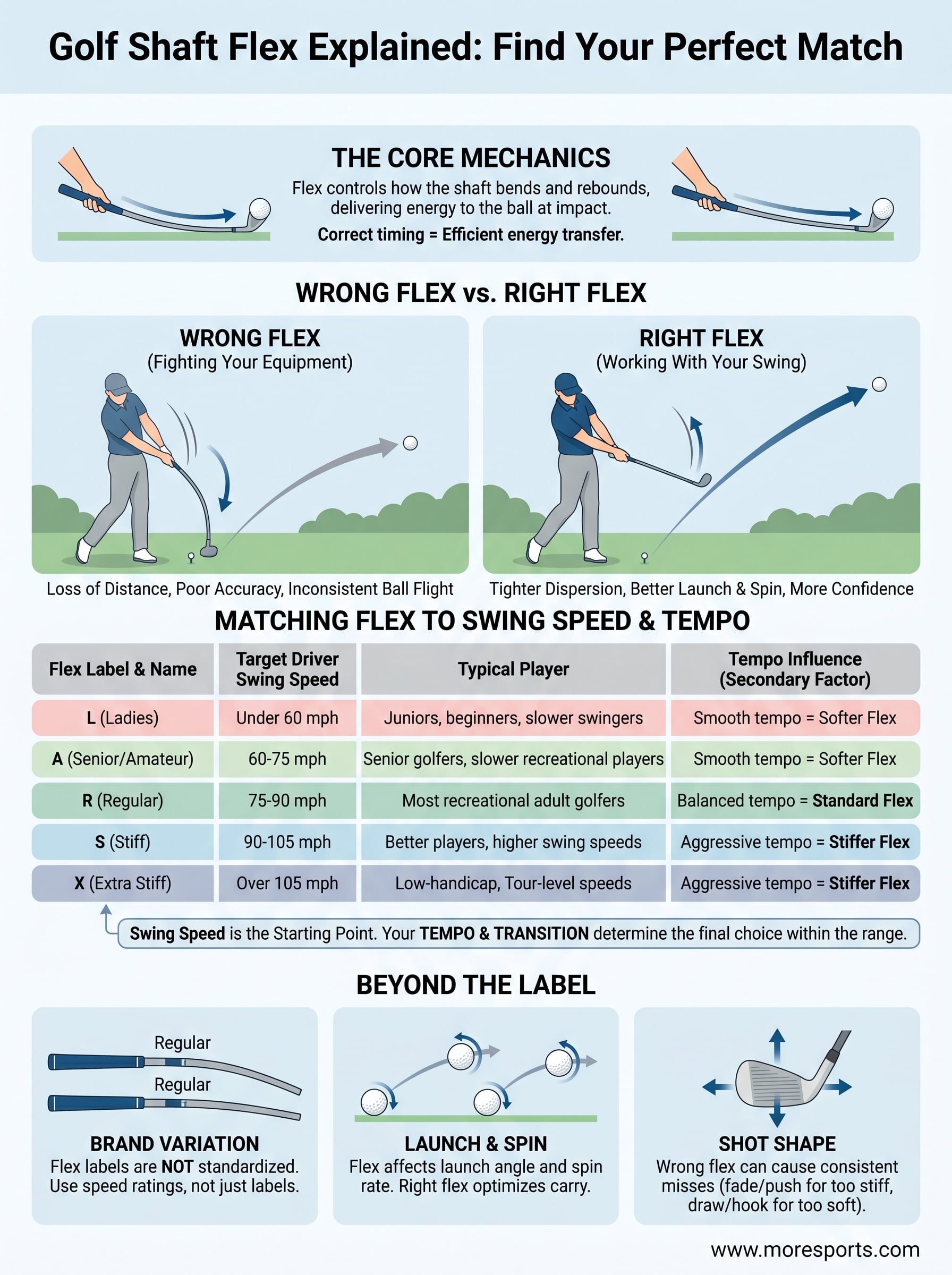
The shaft is the engine of the club, and flex determines how much it bends and rebounds during your swing. When you swing, the shaft loads, stores energy, and then releases it into the clubhead at impact. Matching that release point to your swing speed is what creates efficient energy transfer, and that directly affects how far and how accurately the ball flies.
How the shaft bends during your swing
Every time you swing, the shaft goes through a loading and unloading cycle. During the downswing, centrifugal force causes the shaft to bend forward, meaning the clubhead lags behind the hands. As you approach impact, the shaft kicks back and the clubhead accelerates through the ball. The timing of that kick is what flex controls, and it varies depending on how fast and aggressively you swing.
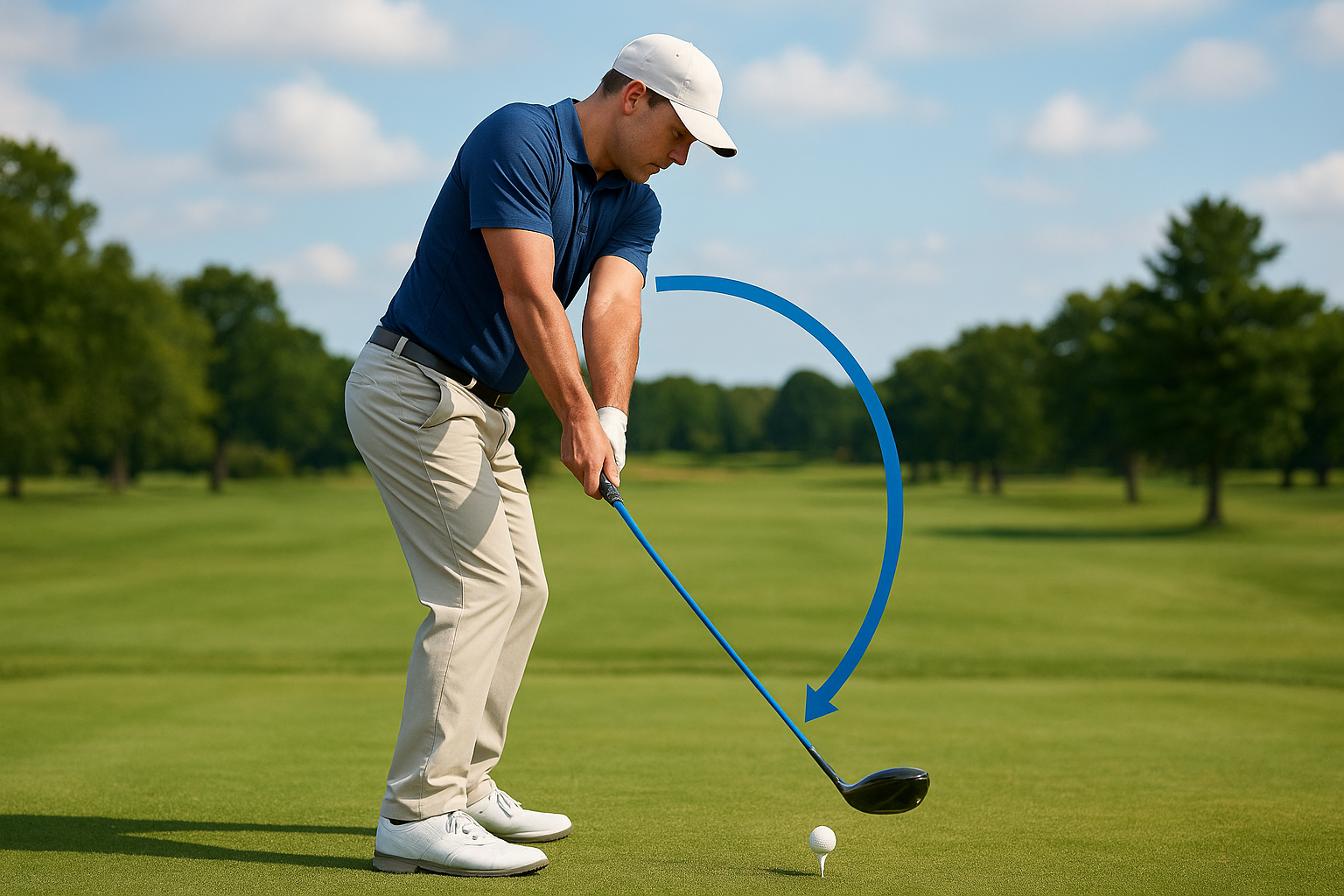
A stiffer shaft bends less and kicks earlier in the downswing, which suits faster swing speeds. A softer shaft bends more and kicks later, giving slower swingers enough time to square the clubface at impact. Getting that timing even slightly wrong causes the face to arrive open or closed, which leads to consistent misses in the same direction every round.
The flex of your shaft affects the clubface position at impact more than most golfers realise, making it one of the most important fitting variables you can get right.
What happens when the flex doesn't match your swing speed
Playing a shaft that is too stiff for your swing speed means the shaft never fully loads. The clubhead doesn't get the extra kick it needs, and the result is a lower, weaker ball flight with less distance. You'll also tend to see shots drifting to the right for a right-handed golfer, because the clubface doesn't have time to square up properly before impact.
On the other side, a shaft that is too soft causes over-loading. The shaft bends too much and kicks forward too aggressively, sending the clubface into a closed position at impact. That typically produces hooks, higher spin rates, and shots that balloon up and lose carry distance. Neither outcome helps your score, and both make your swing feel harder than it should be.
This is exactly why golf shaft flex explained properly goes beyond just picking a flex based on your handicap or gut feel. Your swing speed, your transition tempo, and how you load the club all feed into which flex gives you the cleanest impact and tightest shot dispersion. Two golfers with the same swing speed can still benefit from different flexes if their transitions and tempos differ significantly.
Understanding the mechanics behind flex puts you in a much better position to make smart equipment choices, whether you're buying off the shelf or getting custom fitted. Once you know how the shaft behaves during your swing, you can start to see why the different flex categories exist and what they're actually designed to do.
What flex labels mean and why they vary by brand
The five standard flex labels, L, A, R, S, and X, give you a starting point for choosing a shaft, but understanding what each one actually represents is key to using them correctly. Each label corresponds to a general range of swing speeds and player profiles, and knowing where you sit on that scale is the first step toward making a smarter equipment decision.
The five standard flex categories
With golf shaft flex explained in terms of categories, it becomes much easier to narrow down your options quickly. The table below shows the five labels, their target swing speeds, and the type of golfer each one suits best.
| Flex Label | Name | Driver Swing Speed | Typical Player |
|---|---|---|---|
| L | Ladies | Under 60 mph | Juniors, beginners, slower-swinging women |
| A | Senior/Amateur | 60-75 mph | Senior golfers, slower recreational players |
| R | Regular | 75-90 mph | Most recreational adult golfers |
| S | Stiff | 90-105 mph | Better players, higher swing speeds |
| X | Extra Stiff | Over 105 mph | Low-handicap players, Tour-level speeds |
These ranges are a useful guide, but they are not fixed rules, and treating them as absolute will lead you to the wrong shaft just as easily as ignoring them entirely.
Why brand labelling isn't consistent
One shaft labelled "Regular" from one manufacturer may play significantly stiffer than a "Regular" from another brand, and this is one of the most common sources of confusion among golfers shopping for new equipment. There is no industry-wide standard that forces brands to agree on what each flex label means, so two shafts with the same label can behave very differently on the course.
This is why swing speed ranges matter more than the label itself when you're comparing shafts across different brands.
Your best approach is to use the flex label as a starting point, then cross-reference it with the manufacturer's stated swing speed recommendation for that specific shaft model. When in doubt, getting a fitting will always give you a more reliable answer than relying on the label alone.
How shaft flex affects launch, spin and shot shape
Flex influences far more than just distance. The way your shaft loads and releases at impact directly controls launch angle, spin rate, and the direction your shots tend to miss, which together determine your overall ball flight. With golf shaft flex explained properly, you can start to see why two golfers hitting the same club can produce completely different ball flights from the same swing speed.
Launch angle and flex
A softer shaft loads more during the downswing and releases with a forward kick that adds dynamic loft to the clubface at impact. This pushes the launch angle higher, which helps players with slower swing speeds carry the ball further. For faster swingers using a shaft that is too soft, that exaggerated dynamic loft becomes a problem, as the ball launches too steeply and loses forward momentum before it reaches its peak carry distance.
Slower swingers using a shaft that is too stiff face the opposite issue. The shaft never fully loads, so the dynamic loft stays low, producing a flat, weak ball flight that fails to carry bunkers or reach greens in regulation.
Spin rate and flex
Spin rate follows a similar pattern. A shaft that over-loads and kicks too aggressively adds excess backspin to the ball at impact, which causes the flight to balloon and reduces run. This is most noticeable with the driver, where high spin is one of the main distance killers. A correctly matched stiff shaft keeps backspin in a more efficient range, giving you a flatter, more penetrating flight that holds up in the wind.
Getting your spin rate right through the correct shaft flex can add genuine carry distance without changing your swing at all.
Shot shape tendencies
Your shaft flex also influences the direction your misses tend to go. A shaft that is too stiff leaves the clubface slightly open at impact, nudging shots towards a fade or a push for a right-handed golfer. A shaft that is too soft closes the face early, pushing your natural shot shape towards a draw or a hook.
If you have a persistent miss you cannot fix through technique, your shaft flex is worth checking before you blame your swing.
How to choose the right flex for your swing
With golf shaft flex explained across the previous sections, choosing the right flex comes down to combining a few key pieces of information about your swing. Swing speed is the most important starting point, but it works alongside your tempo and transition style to give you the clearest picture of which flex will perform best for you on the course.
Start with your swing speed
Your driver swing speed is the most reliable number you can use to narrow down your flex options. If you have access to a launch monitor at a fitting session or a driving range, getting an accurate measurement takes less than ten minutes and removes a significant amount of guesswork from the process. Even a rough estimate based on your typical carry distance gives you a workable starting point.

Your swing speed is the single most reliable indicator of which flex category will suit your game, so always measure it before making a shaft decision.
Use the table below to match your driver swing speed to the most likely flex for your swing.
| Driver Swing Speed | Suggested Flex |
|---|---|
| Under 60 mph | Ladies (L) |
| 60-75 mph | Senior (A) |
| 75-90 mph | Regular (R) |
| 90-105 mph | Stiff (S) |
| Over 105 mph | Extra Stiff (X) |
Factor in your tempo and transition
Swing speed alone does not tell the complete story. Your tempo, the pace at which you move from backswing to downswing, plays a significant role in how the shaft loads. A golfer with an aggressive, fast transition loads the shaft more abruptly than someone with a smooth, gradual tempo at the same swing speed. That difference can shift your ideal flex by one category in either direction.
If your transition is quick and aggressive, leaning toward a stiffer option within your swing speed range will give you more control and tighter shot dispersion. If your tempo is slower and more relaxed, a softer flex will let the shaft load properly and deliver the clubhead squarely through impact without extra effort from your swing.
Common shaft flex myths and fitting mistakes
Several widespread myths around shaft flex lead golfers to make poor equipment decisions that they carry forward for years without questioning. Having golf shaft flex explained clearly is useful, but knowing what not to believe is just as important as understanding the mechanics themselves. These misconceptions come up constantly, both on the course and in pro shops, and they affect golfers at every level.
Stiff shafts are not automatically better
Many golfers assume that playing a stiffer shaft signals a more skilled or serious player, so they reach for a Stiff or Extra Stiff option regardless of their actual swing speed. That logic is backwards. A shaft that is too stiff for your swing leaves the clubhead under-loaded through impact, producing weak ball flight, reduced distance, and shots that drift right for a right-handed golfer. Choosing a shaft based on ego rather than measured data is one of the fastest ways to add strokes to your round consistently.
Playing the correct flex for your swing speed will always outperform a shaft that is technically too stiff, regardless of how the label sounds.
Your handicap does not determine your flex
Another common mistake is treating your handicap as a direct indicator of which shaft flex you should play. A 10-handicapper with a smooth 80 mph swing belongs in a Regular shaft. A 20-handicapper who generates 95 mph through raw athleticism likely needs a Stiff. Your handicap reflects scoring consistency over time, not your swing speed or tempo, so keep it entirely separate from any shaft fitting conversation.
Buying off the shelf without checking the specs
Most off-the-shelf clubs come fitted with a Regular shaft as the default option because it suits the broadest possible range of buyers. That works for some golfers, but it also means many players spend years swinging a shaft that was never matched to their speed or transition style. Before you commit to a purchase, check the manufacturer's stated swing speed range for the shaft included with the club.
If your numbers fall outside that range, ask about alternative shaft options or book a short fitting session before you pay. Spending thirty minutes with a launch monitor can save you significant frustration over the life of that club.
Quick recap and what to do next
With golf shaft flex explained across this guide, the key takeaway is straightforward: your swing speed is the most reliable starting point, but your tempo and transition style matter just as much when narrowing down the right flex for your game. A shaft that matches your swing delivers the clubface squarely at impact, which translates directly into tighter shot patterns and better carry distance without any change to your technique.
Before your next equipment purchase, measure your driver swing speed using a launch monitor if you can access one. Cross-reference that number with the manufacturer's stated swing speed range for the shaft you're considering, and factor in whether your transition is aggressive or smooth. If your current shaft flex feels off, that is worth addressing sooner rather than later.
Browse the full range of golf equipment and accessories at MoreSports to find clubs and shafts suited to your swing.