 No Duties or Customs Fees For EU & UK Customers
 Express Tracked UK Delivery On 1000s of Items
 90 Day Returns

Soft Tip Vs Steel Tip Darts: Key Differences Explained
RYStanding in front of a wall of dart sets, you've probably wondered whether you need soft tip or steel tip darts, and the honest answer is that it depends entirely on your board and how you play. The soft tip vs steel tip darts debate isn't just about the point at the end of the barrel. It affects the board you buy, the games you can play, and even how your throwing style develops over time. Get this choice wrong and you'll end up with darts that don't fit your setup at all.
If you're after a quick answer: steel tip darts are the traditional choice for bristle boards and competitive pub-style play, while soft tip darts work with electronic boards that automatically score for you and tend to suit home and family setups better.
In this guide, we'll break down the practical differences between the two, from weight and barrel design to board compatibility and scoring, so you can match your darts to your setup rather than guessing. We'll also point you towards the brands and sets worth considering once you've decided which direction suits you.
Why the tip type you choose actually matters
The tip on your dart isn't a cosmetic detail, it's the single factor that decides which board you can play on and how the whole game behaves. Choose wrong and your darts either won't stick, will damage the board, or will trigger scoring errors every time you throw. This is the real reason the soft tip vs steel tip darts question comes up so often among beginners: get the pairing wrong and nothing about your setup works properly.
Board type dictates everything
Steel tip darts need a bristle dartboard, the kind you'll see in most pubs and darts clubs across the UK. The sisal fibres grip the metal point and self-heal after each throw, which is why proper bristle boards last for years of regular play. Soft tip darts, on the other hand, are built for electronic dartboards with plastic segments full of tiny holes. Push a steel tip into one of these and you'll crack the plastic within a few throws. Push a soft tip into sisal and it'll just bounce out, because there's nothing for the plastic point to grip.
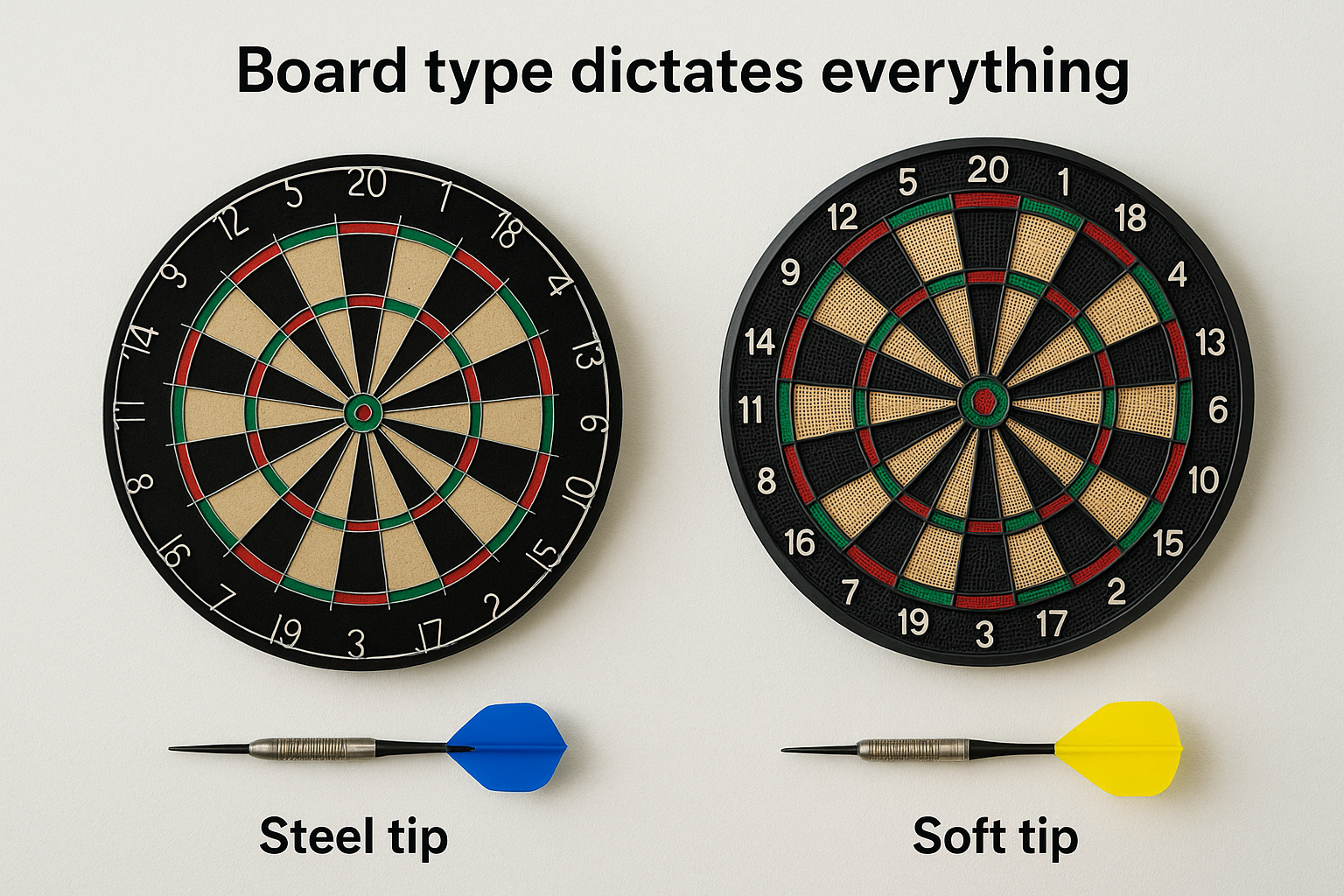
If the tip doesn't match the board, nothing else about your darts setup matters.
Weight and barrel construction differ too
Beyond the point itself, the two dart types are built differently throughout. Steel tip darts typically weigh between 20g and 26g, with dense tungsten or brass barrels that let players load more weight into a smaller barrel for better grip. Soft tip darts sit lighter, usually 16g to 20g, because electronic boards have weight limits built into their scoring sensors and heavier darts simply don't register properly.
| Feature | Steel Tip | Soft Tip |
|---|---|---|
| Typical weight | 20g–26g | 16g–20g |
| Board type | Bristle (sisal) | Electronic (plastic segments) |
| Barrel material | Tungsten, brass | Tungsten, brass, nickel-plated |
| Tip material | Steel point | Plastic, replaceable |
| Common setting | Pubs, clubs, competitions | Home, family rooms, arcades |
Getting the barrel weight right matters just as much as the tip material, because a dart that's too heavy or too light for the board type throws off your grip and release without you realising why your scores have dropped.
Scoring and game options change with tip type
Here's where the difference really shows up in how you actually play. Electronic boards paired with soft tip darts calculate scores automatically, track statistics, and often come loaded with dozens of game variants beyond standard 501 and Cricket. That's brilliant for casual players who don't want to do mental arithmetic after every throw. Steel tip darts on a bristle board mean you're scoring manually, which is exactly how competitive and league darts works, and it's the format most serious players eventually gravitate towards because it's the standard for tournament play. Neither approach is better in isolation, but they lead to genuinely different playing experiences, which is why matching your darts to your goals matters more than chasing whichever set looks flashiest on the shelf.
How to choose between soft tip and steel tip darts
Picking a side in the soft tip vs steel tip darts debate comes down to three questions: what board do you have access to, who's playing, and how competitive you want to get. Answer those honestly and the decision practically makes itself.
Start with the board you already own or plan to buy
Your board decides your darts, not the other way round. If you've already got a bristle board hanging in the garage or you're joining a local league, steel tip darts are the only sensible choice. If you're setting up a games room for the whole family, or you live in a flat where a stray steel tip through drywall isn't an option, an electronic dartboard paired with soft tip darts is far more forgiving. There's no point falling in love with a beautiful tungsten steel tip set if you don't own, and won't own, a bristle board to throw them at.
Think about who's actually throwing
Households with children, beginners, or mixed skill levels tend to get more use out of soft tip setups. The automatic scoring removes the maths, the lighter darts are easier for smaller hands to control, and there's no steel point flying around a room with kids nearby. Adults who already play regularly, or who want to build a throw that transfers to pub and club darts, are better served learning on steel tip darts from the start, since technique built on a lighter soft tip dart doesn't always carry over cleanly.
Factor in your competitive ambitions
If you can see yourself entering local competitions, joining a club, or just want the format used in televised darts, steel tip is the road that leads there. According to the World Darts Federation, steel tip on bristle boards remains the standard for organised tournament play worldwide. Soft tip has its own competitive scene, particularly in the US and parts of Asia, but it's a smaller pool in the UK.
Choose based on your board and your goals, not on which barrel looks nicest in the box.
A few quick prompts to settle it:
- Do you already own a bristle board? Go steel tip.
- Is this mainly for kids or casual family games? Go soft tip.
- Want to join a league eventually? Start with steel tip now.
Soft tip vs steel tip darts: differences at a glance
By now you've seen the headline differences in board type and weight, but a handful of smaller distinctions matter once you're actually shopping for a set. Price, durability, and flight setup all shift depending on which tip you're buying, and these details often decide which specific set you end up ordering rather than just which category.
Points beyond the board and barrel
Steel tip darts generally cost more upfront because the tungsten barrels used in serious sets are denser and pricier to manufacture, letting players pack more weight into a slimmer grip. Soft tip darts skew cheaper on average, partly because the plastic tips wear out and need replacing regularly, and manufacturers price the barrels accordingly. Flight and shaft compatibility also differs slightly: soft tip sets often ship with shorter shafts and smaller flights to suit the lighter overall build, while steel tip players have a much wider aftermarket to choose from, including nylon, aluminium, and titanium shafts built for heavier barrels.
The tip material decides your board, but the small stuff, cost, flight size, and tip wear, decides how much you'll spend keeping your darts playable.
Durability and ongoing costs
Here's where soft tip darts ask more of you long-term. The plastic points snap or wear down after repeated throws, especially against a well-used electronic board, so you'll be buying replacement tip packs every few months if you play often. Steel tips, by contrast, barely wear at all, since the steel point simply pushes into sisal fibres without breaking down. That single difference changes the real cost of ownership over a year or two, even if the initial steel tip set costs more.
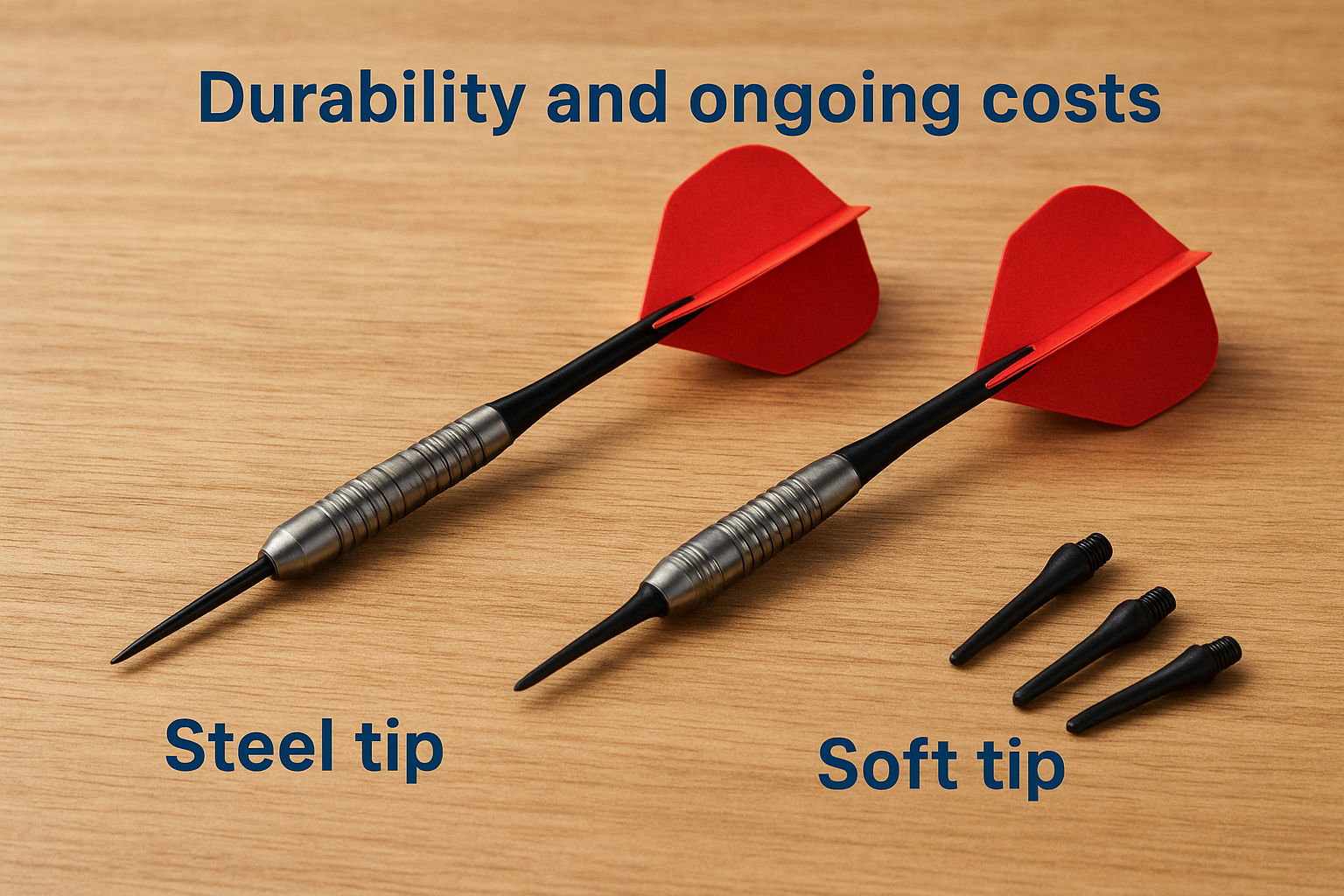
| Factor | Steel Tip | Soft Tip |
|---|---|---|
| Upfront cost | Higher (tungsten barrels) | Lower to mid-range |
| Ongoing cost | Minimal, tips don't wear | Regular tip replacements needed |
| Flight/shaft options | Wide aftermarket range | Smaller, lighter components |
| Typical lifespan | Years with normal care | Tips need swapping every few months |
Weigh these figures against how often you'll actually play. A casual family setup won't notice tip replacement costs, but a serious player throwing daily will feel the difference in their wallet within months, not years.
Switching between soft tip and steel tip darts
Many players eventually try both, and switching between soft tip and steel tip darts is common once you've been throwing for a while. Maybe you started on an electronic board at home and now you've joined a club with bristle boards, or you want a soft tip set for a quieter evening without waking the house. Either way, the switch is straightforward as long as you understand what actually changes when you cross over.
What carries over and what doesn't
Your throwing motion, stance, and release stay largely the same, which is the good news. What changes is the feel in your hand: steel tip darts are heavier and denser, so your grip pressure and follow-through need small adjustments. Players moving from soft tip to steel tip often find their throws land slightly lower at first, simply because the extra weight changes the arc. Give it a few sessions of 501 or Around the Clock and your muscle memory recalibrates quickly.
Your technique travels with you, but your grip and weight sense need a few sessions to catch up.
Practical steps for making the switch
Rather than buying a whole new setup blind, ease into it with a few sensible steps:
- Borrow or try a set first. Most clubs and shops will let you throw a few darts before committing to a full purchase.
- Match the weight gradually. If you're moving from an 18g soft tip set to steel tip, start around 20g rather than jumping straight to 26g.
- Keep both setups if space allows. A lot of serious players keep an electronic board for practice and a bristle board for the real thing, switching darts to match.
- Replace worn components. Soft tip flights and shafts don't always suit steel tip barrels, so check compatibility rather than assuming everything transfers across.
When switching makes sense financially
If you're only an occasional player, it's rarely worth owning two full sets. Buy for the board you use most and borrow or rent for the rest. But if you're coaching kids on soft tip while playing steel tip yourself in a league, running both setups side by side is genuinely the most practical option, and the cost balances out once you factor in how much use each set gets.
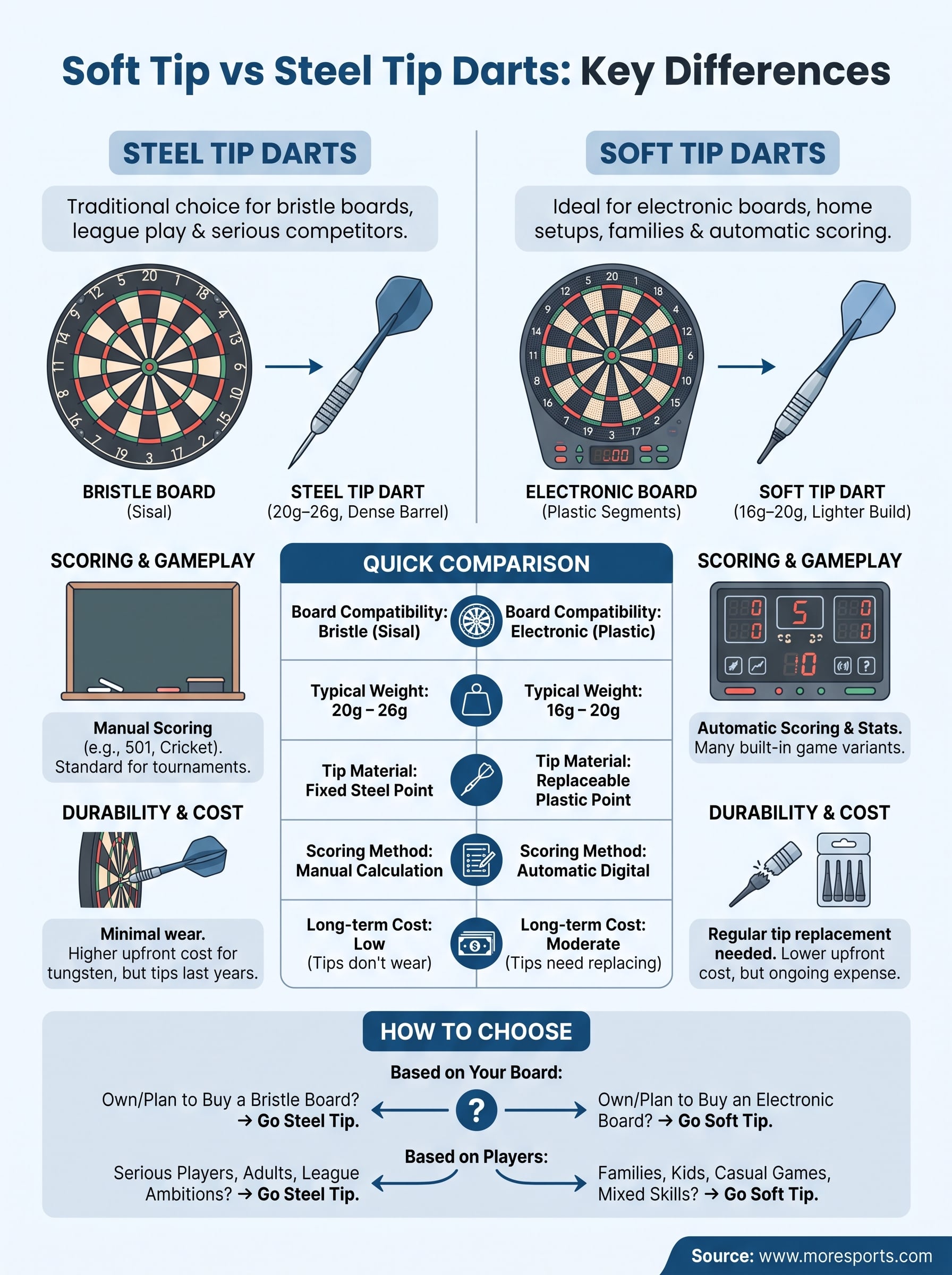
Finding the right darts for your game
The soft tip vs steel tip darts decision really boils down to what board you own and how seriously you want to play. Steel tip suits bristle boards, league ambitions, and players who don't mind manual scoring. Soft tip suits electronic boards, family setups, and anyone who wants automatic scoring without the arithmetic. Neither option is wrong, they're just built for different setups, and now you know which questions to ask before you buy.
Once you've settled on a tip type, the barrel weight, brand, and flight setup are where you'll fine-tune your feel and accuracy. Don't rush that part, since a well-matched set makes a bigger difference to your scoring than most players expect.
Ready to pick a set that actually suits your board? Browse the full dart and dartboard range at MoreSports and get your setup sorted properly.