 No Duties or Customs Fees For EU & UK Customers
 Free UK Delivery On Orders Over £25
 90 Day Returns

TaylorMade Irons Comparison Chart 2026: 8 Models Compared
RYTaylorMade's 2026 iron lineup covers a lot of ground, from forgiving game-improvement clubs to compact players' irons built for shot shaping. That's great for golfers, but it also makes picking the right set genuinely difficult. If you've been searching for a TaylorMade irons comparison chart, you're clearly past the browsing stage and ready to narrow down your options based on real specs and performance differences.
We've put together a side-by-side breakdown of eight current TaylorMade iron models, comparing lofts, construction, forgiveness, and the type of player each one suits best. Whether you're a high handicapper chasing more distance or a single-figure player who wants workability, this guide cuts through the noise and gives you the data you need in one place.
At MoreSports, we stock a wide range of TaylorMade irons and ship across the UK with free delivery on orders over £25. We've sold over 500,000 items with 99.9% positive feedback, so if you spot something you like in this comparison, we can get it to your door quickly, or you can collect from our store in Coleraine, Northern Ireland. Let's get into the numbers.
1. TaylorMade Qi irons
The Qi iron is TaylorMade's flagship game-improvement iron for 2026, built to deliver maximum distance and forgiveness for golfers who want results from every swing. It sits at the top of the accessibility tier in the current lineup and uses multi-material construction to generate ball speed that older cavity backs simply cannot match.
Where it sits in the TaylorMade line-up in 2026
Within the full TaylorMade irons comparison chart, the Qi occupies the game-improvement category, positioned to attract mid-to-high handicappers who need help with both distance and consistency. It sits above the Qi HL in terms of target skill level, but remains firmly in the forgiving end of the range rather than the players' section.
Key specs for the chart
| Feature | Specification |
|---|---|
| Construction | Multi-material hollow body |
| Face material | 450 steel |
| 7-iron loft | 30.5° |
| Offset | High |
| Available shafts | Steel and graphite |
These specs position the Qi as a strong-lofted, high-launching iron. You get a wide sole that handles turf interaction well, making it more forgiving than it looks at address.
Ball flight and distance tendencies
The Qi launches high and fast, with a low and back centre of gravity that pushes the ball up quickly. You'll gain meaningful carry distance over older game-improvement designs, even on slightly off-centre strikes where face flex does a lot of the heavy lifting.
Forgiveness, offset, and shot shape bias
The Qi carries significant offset and a clear draw bias, which helps players who fight a slice bring the ball back towards the target. Mishits stay surprisingly close to the intended line, and the hollow body construction preserves ball speed across the face.
If you already play a strong draw, the Qi's built-in bias may push the ball too far left under pressure.
Who should choose it
You'll get the most from the Qi if you carry a handicap of 15 or above and prioritise forgiveness and distance over workability. Golfers returning to the game after a long break are also a natural fit for this iron.
Alternatives to compare side-by-side
Consider the Qi HL if you need even higher launch, or the Stealth iron if you want a slightly older design at a lower price without sacrificing meaningful forgiveness.
2. TaylorMade Qi HL irons
The Qi HL takes everything that works in the standard Qi and pushes the launch and forgiveness even further for golfers who need the highest possible ball flight to hold greens and stop the ball close to where it pitches.
What "HL" changes versus standard Qi
"HL" stands for High Launch, and that label tells you exactly what TaylorMade changed. The HL version carries a higher loft on each iron and features a lower, more rearward centre of gravity, which gets the ball airborne faster without requiring a fast swing speed.
Key specs for the chart
| Feature | Specification |
|---|---|
| Construction | Multi-material hollow body |
| Face material | 450 steel |
| 7-iron loft | 32° |
| Offset | Very high |
| Available shafts | Graphite standard |
Launch, spin, and stopping power
The Qi HL produces noticeably higher peak height than the standard Qi, with extra spin that helps the ball land more steeply and stop closer to the pitch mark. This makes a real difference on firmer greens where a flatter trajectory would kick the ball forward and cost you distance control.
If your ball flight tends to be low or you struggle to hold approach shots, the Qi HL deserves a serious look in any taylormade irons comparison chart.
Forgiveness and gapping notes
The wider sole and extra loft mean you need to re-check your gapping before committing to the Qi HL. Your longest irons will carry noticeably further than equivalent numbered clubs in most other sets, so test each one before locking in the full set configuration.
Who should choose it
This iron suits high handicappers and senior golfers who generate moderate swing speeds and need extra height to get the most from their approach shots.
Alternatives to compare side-by-side
Compare the standard Qi if you want slightly flatter flight with the same forgiveness, or the SIM2 Max for an older design at a lower price point.
3. TaylorMade P790 irons
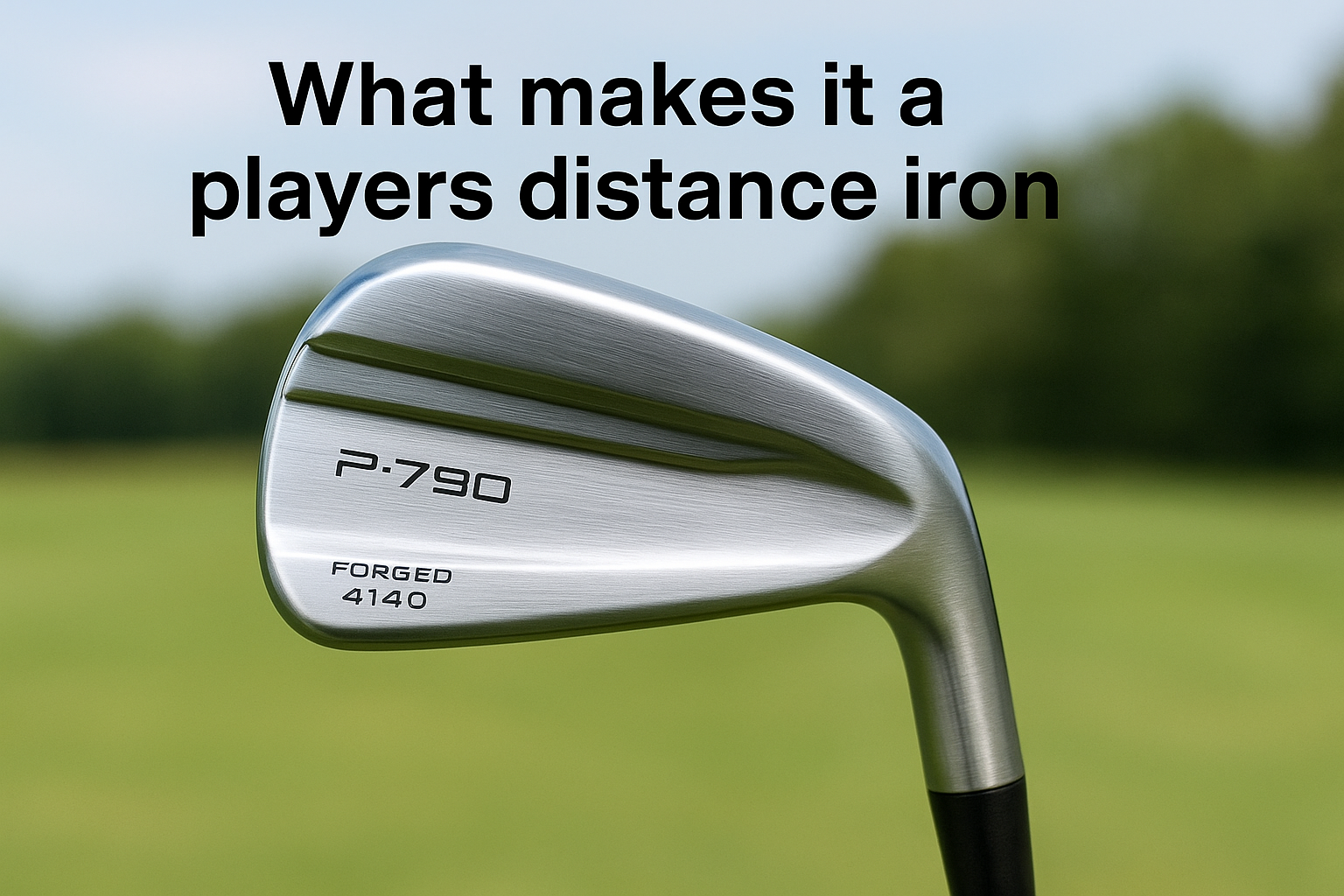
The P790 is TaylorMade's benchmark players distance iron, combining a compact head profile with a hollow body filled with SpeedFoam Air to boost ball speed without sacrificing the clean look that better players demand.
What makes it a players distance iron
The P790 uses a thin forged face over a hollow cavity, which flexes more at impact than a traditional blade or cavity back. That construction gives you extra ball speed from a club that still looks and plays like a proper iron, not a bulked-up game-improvement design.
Key specs for the chart
| Feature | Specification |
|---|---|
| Construction | Hollow body, SpeedFoam Air |
| Face material | Forged 4140 steel |
| 7-iron loft | 30.5° |
| Offset | Low-mid |
| Available shafts | Steel and graphite |
Distance, speed, and spin profile
The P790 launches mid-high with strong carry numbers relative to its loft. Ball speed off the face is notably quick, and the spin profile sits lower than a traditional players iron, which helps distance without turning the iron into a lob wedge replacement.
Feel, workability, and forgiveness trade-offs
You get more feedback than a game-improvement iron but less forgiveness than the Qi range. Mishits lose distance more noticeably, yet the P790 still rewards partial shaping on demand, which is exactly what mid-handicap players moving up expect.
The P790 is the best-balanced option in any taylormade irons comparison chart for golfers bridging the gap between game-improvement and players irons.
Who should choose it
Target the P790 if you carry a handicap between 5 and 15 and want a distance boost without giving up the ability to shape shots or hold firm greens.
Alternatives to compare side-by-side
Compare the P770 if you want a more compact, lower-launching iron with less distance assistance, or the Qi iron if forgiveness matters more than feel.
4. TaylorMade P770 irons
The P770 sits between the P790 and the P7CB in TaylorMade's players iron range, offering a more compact profile than the P790 while still using a hollow body construction to preserve some forgiveness for better players who want a cleaner look at address.
What makes it a compact hollow-body players iron
Inside the P770, a thin forged face sits over a hollow cavity, similar in principle to the P790, but the head is noticeably smaller. That gives better players the narrow topline they prefer without fully abandoning the ball speed benefits that hollow construction brings.
Key specs for the chart
| Feature | Specification |
|---|---|
| Construction | Compact hollow body |
| Face material | Forged steel |
| 7-iron loft | 31° |
| Offset | Low |
| Available shafts | Steel and graphite |
Launch and spin versus P790 and P7CB
Compared to the P790, the P770 launches slightly lower and spins a touch more, giving you better distance control on approach shots. Against the P7CB, it still delivers more ball speed from the hollow construction, so carry holds up even when contact is slightly off centre.
If you want a cleaner look than the P790 without committing to a full blade, the P770 hits that middle ground well in any taylormade irons comparison chart.
Forgiveness and dispersion expectations
Mishits on the P770 lose more distance than on the P790, and your dispersion window is noticeably tighter, meaning consistent ball striking becomes a genuine requirement rather than just a recommendation.
Who should choose it
Golfers with handicaps between 3 and 10 who want a workable iron with some hollow-body assistance behind it will find the P770 a strong fit.
Alternatives to compare side-by-side
Stack it against the P790 if you want more forgiveness and distance help, or the P7CB if you prefer a traditional cavity back that puts full control in your hands.
5. TaylorMade P7CB irons
The P7CB is TaylorMade's tour cavity back, sitting firmly in the players' section of any taylormade irons comparison chart. It delivers traditional construction with a shallow cavity behind the face, giving skilled golfers precise control without the added bulk of a hollow body design.
What makes it a tour cavity back
The P7CB uses a forged carbon steel body with a compact cavity that retains some perimeter weighting while keeping the head profile tight. This sits between the P770's hollow assist and the full muscleback of the P7TW, making it a genuine option for low handicappers who want feedback without total blade demands.
Key specs for the chart
| Feature | Specification |
|---|---|
| Construction | Forged cavity back |
| Face material | Forged 1025 carbon steel |
| 7-iron loft | 34° |
| Offset | Minimal |
| Available shafts | Steel |
Control and consistency profile
The P7CB rewards consistent ball striking with precise distance gaps and predictable flight. You get enough feedback to notice mishits immediately, which helps you self-correct quickly during a round rather than carrying a bad habit through 18 holes.
The P7CB suits golfers who already strike the ball well and want a club that rewards clean contact rather than compensating for it.
Turf interaction and strike quality demands
The narrow sole requires a controlled angle of attack. Steep swings will cost you turf interaction quality, so a shallow, sweeping strike produces the best results with this iron.
Who should choose it
This iron fits golfers with handicaps of 5 or below who prioritise control and shot shaping over distance assistance.
Alternatives to compare side-by-side
Stack the P7CB against the P770 if you want more forgiveness, or the P7TW if you want the full blade experience with no cavity assistance.
6. TaylorMade P7TW irons
The P7TW sits at the most demanding end of any taylormade irons comparison chart, designed with input from Tiger Woods for golfers who want maximum feel and complete shot control on every iron they hit.
What makes it a true muscleback blade
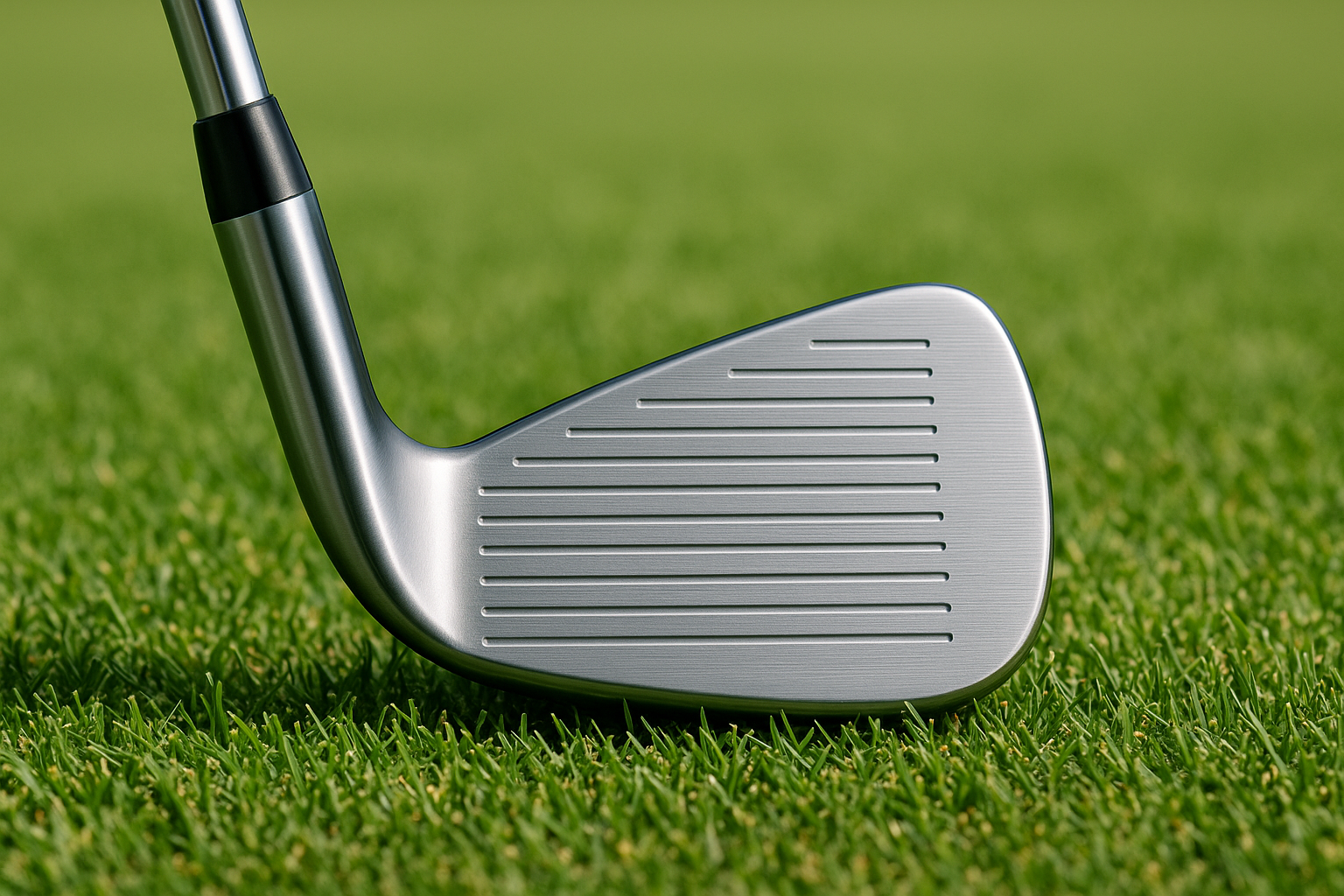
The P7TW is a full muscleback blade, meaning the back of the head is solid with no cavity and no hollow construction. This concentrates mass directly behind the sweet spot, delivering exceptional strike feedback but removing any safety net for off-centre contact.
Key specs for the chart
| Feature | Specification |
|---|---|
| Construction | Forged muscleback blade |
| Face material | Forged 1025 carbon steel |
| 7-iron loft | 33.5° |
| Offset | Minimal |
| Available shafts | Steel |
Distance and spin realities with traditional lofts
The P7TW carries more traditional lofts than the P790 or Qi range, which produces lower carry distances. In return, you get precise spin control that lets you flight the ball to a specific window and hold firm greens with a steep landing angle.
Forgiveness limits and mishit penalties
Mishits on the P7TW cost you immediately with meaningful distance and directional loss. There is no perimeter weighting to redistribute mass across the face, so consistent ball striking is a requirement, not a preference.
If your handicap sits above 5, the P7TW will cost you more shots than it saves over a full round.
Who should choose it
You need a scratch or single-figure handicap alongside consistent contact before the P7TW becomes a practical choice rather than an aspirational one.
Alternatives to compare side-by-side
Stack the P7TW against the P7CB if you want tour-level feedback with a small cavity behind it, or the P770 for a compact look that still brings hollow-body ball speed.
7. TaylorMade Stealth irons
The Stealth iron may sit a generation behind the Qi range, but it remains a solid choice for golfers who want proven game-improvement performance at a more accessible price point.
Why it still makes sense in 2026
TaylorMade's Stealth iron still delivers meaningful forgiveness and distance for mid-to-high handicappers. Stock on the Stealth has become more readily available at reduced prices, making it one of the stronger value options in any taylormade irons comparison chart right now.
Key specs for the chart
| Feature | Specification |
|---|---|
| Construction | Multi-material hollow body |
| Face material | 450 steel |
| 7-iron loft | 31° |
| Offset | High |
| Available shafts | Steel and graphite |
Launch and distance tendencies
The Stealth produces a high, penetrating ball flight with strong carry numbers for its loft. You'll get consistent distance gaps between each iron, which makes club selection straightforward on approach shots.
Forgiveness and draw-bias notes
The Stealth carries notable offset and a slight draw bias that helps players who push or slice the ball.
If you already play a draw, test the Stealth carefully before committing, as the bias may push your natural shape further left.
Mishits stay relatively close to the target line, and the hollow body construction preserves ball speed across most of the face.
Who should choose it
You'll suit the Stealth best if you carry a handicap between 12 and 22 and want a forgiving iron without the premium price tag of the current Qi range.
Alternatives to compare side-by-side
Stack the Stealth against the Qi iron for more up-to-date technology, or the SIM2 Max for a similarly priced older design with comparable forgiveness.
8. TaylorMade SIM2 Max irons
The SIM2 Max is a few generations old now, but it still holds up as a practical choice for golfers on a budget who want proven game-improvement performance without spending current-range prices.
Why it remains a strong value option in 2026
Stock availability and reduced retail pricing make the SIM2 Max one of the most cost-effective entries in any taylormade irons comparison chart. TaylorMade built it with a multi-material construction that delivers genuine distance and forgiveness, and those core characteristics have not aged poorly.
Key specs for the chart
| Feature | Specification |
|---|---|
| Construction | Multi-material hollow body |
| Face material | 450 steel |
| 7-iron loft | 31° |
| Offset | High |
| Available shafts | Steel and graphite |
Launch, height, and carry tendencies
The SIM2 Max produces a high ball flight with strong carry for its loft. You will notice consistent distance gaps between clubs, which keeps approach shot decision-making straightforward across a full round.
Forgiveness and gapping notes
The wide sole and high offset give the SIM2 Max a forgiving character that holds up on slightly off-centre strikes. Check your gapping carefully against your wedges, as the strong lofts can leave distance gaps between your shortest iron and highest lofted wedge.
If budget is your main consideration, the SIM2 Max delivers reliable forgiveness without the premium cost of newer releases.
Who should choose it
This iron suits golfers carrying a handicap between 12 and 24 who want a capable game-improvement iron at a lower price point.
Alternatives to compare side-by-side
Stack the SIM2 Max against the Stealth iron for a more recent design at a similar price, or the Qi iron if your budget stretches to current-generation technology.
What to do next
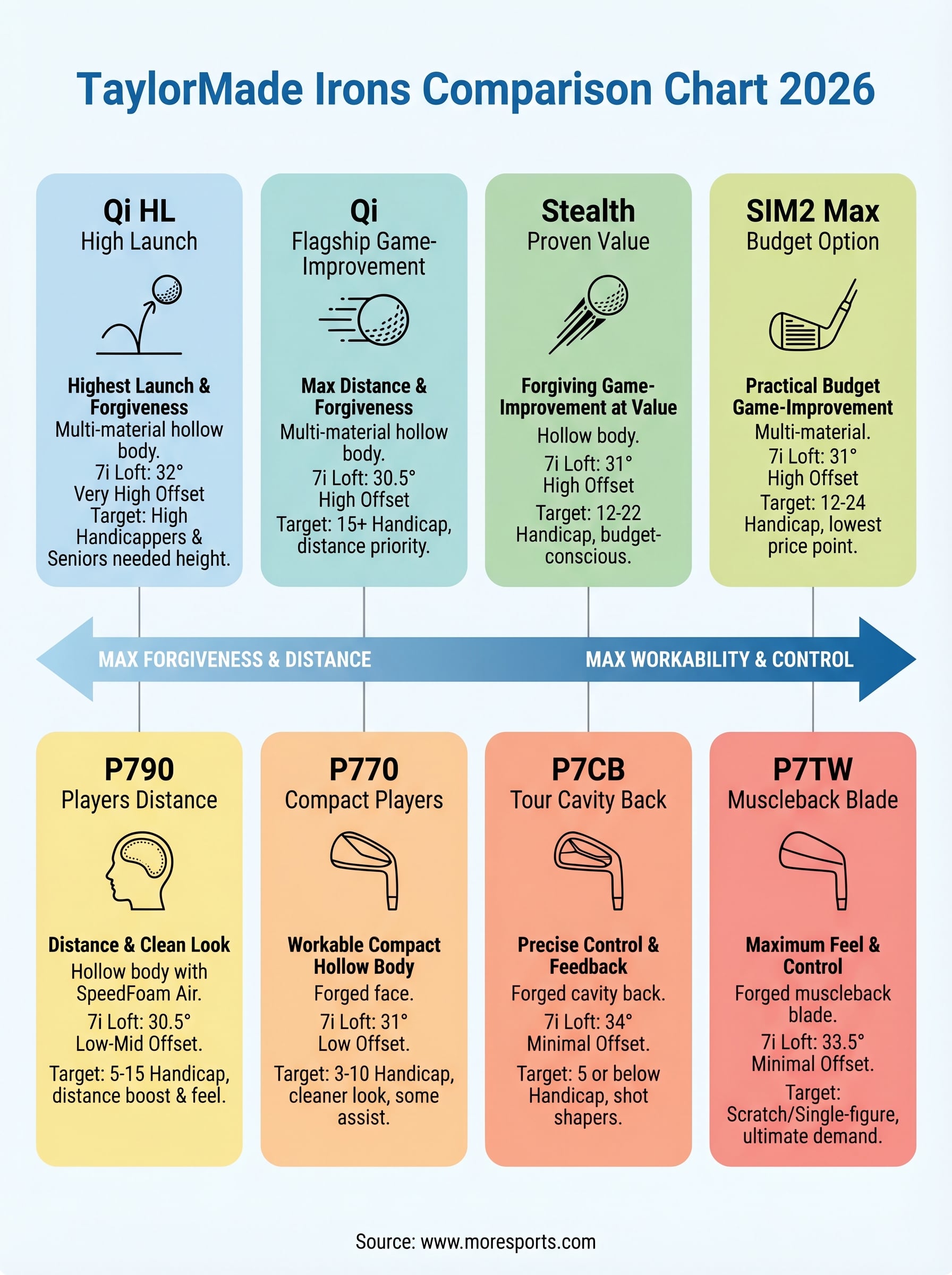
This taylormade irons comparison chart covers eight models across the full range, from the forgiving Qi HL through to the demanding P7TW blade. Use the specs and player profiles above to narrow your shortlist to two or three irons that match your current handicap and what you actually need from your game, not what you'd like to need in a few years' time.
Once you have a shortlist, your next step is to confirm loft gapping and shaft options before you commit. The strong lofts on game-improvement models can leave gaps near your wedges that cost you distance control on approach shots, so check each number carefully.
At MoreSports, you'll find a wide selection of TaylorMade irons across current and recent generations, with free UK delivery on orders over £25. Browse the full range and find the right set for your game at MoreSports.