 No Duties or Customs Fees For EU & UK Customers
 Free UK Delivery On Orders Over £25
 90 Day Returns

How Should Golf Shoes Fit? Toe Room, Width & Stability
RYA golf shoe that's too tight will leave you with blisters by the 9th hole. Too loose, and your feet slide during every swing, robbing you of power and balance. Understanding how should golf shoes fit is one of the simplest ways to improve both your comfort and performance on the course, yet it's something many golfers get wrong.
The right fit goes beyond just picking your usual shoe size. Toe room, heel lock, width, and midfoot support all play a role in how stable you feel over the ball. Get any of these wrong, and you'll notice it, especially during a full round where you're walking several miles across uneven ground. Your feet change shape throughout the day too, which adds another layer to the fitting process.
At MoreSports, we stock golf shoes from brands like FootJoy, Stuburt, and Adidas, and we've helped thousands of golfers find the right pair through our online store and our physical shop in Coleraine, Northern Ireland. This guide breaks down exactly what to look for when fitting golf shoes, covering toe room, width, stability, and how to measure your feet properly so you can buy with confidence.
What a proper golf shoe fit should feel like
When you slip on a golf shoe, the immediate feeling should be snug but not tight. There should be no pressure points, no pinching across the toe box, and no heel slipping when you walk. Understanding how should golf shoes fit means paying attention to several distinct areas of the shoe at once, because a shoe that feels fine standing still can behave very differently once you're mid-swing or walking a long par-5.
Toe box feel
Your toes need room to spread naturally without being crammed against the front of the shoe. When you stand upright, aim for roughly a thumb's width of space between your longest toe and the end of the shoe. This space stops your toes from jamming forward when you walk downhill or transfer weight through impact.
A thumb's width of clearance at the toe is the single most reliable indicator of correct shoe length.
Toes should never feel curled or compressed inside the shoe. If you wiggle them and they press against the sides or the top of the toe box, you need a wider fitting or a half size up rather than forcing a shoe to stretch over time.
Midfoot and arch support
The midfoot should feel held, not squeezed. A well-fitting golf shoe wraps around the arch area firmly enough that your foot doesn't roll inward or outward when you shift your weight. If you feel your arch collapsing or the shoe feels hollow in the middle, the volume of the shoe is too high for your foot shape.
Many golfers overlook this area completely when trying shoes on. Run your fingers along the inside of the shoe before wearing it. The arch support should sit directly under your foot's natural arch, not behind it or in front of it.
Heel and ankle fit
Your heel should sit firmly in the heel cup with minimal vertical movement. Lift your heel slightly while keeping the ball of your foot on the ground. If the heel rises more than a few millimetres, the shoe is either too long or too wide at the back. Heel slip causes blisters and reduces your traction at the point of impact, which directly affects how consistently you can strike the ball through a full swing.
Step 1. Measure your feet the right way
Most golfers reach for their usual shoe size and assume it will carry over from trainers or casual shoes. It often doesn't. Foot size varies between brands, and your feet can change shape over time, especially after injuries or significant weight changes. Measuring your feet before you buy is the most reliable starting point for understanding how should golf shoes fit for your specific foot shape.
When to measure your feet
Measure your feet later in the day, ideally in the afternoon or evening. Feet swell throughout the day due to activity and gravity, and they'll be at their largest by then. If you measure in the morning and buy based on that reading, you risk buying a shoe that feels tight by the back nine. Wear the socks you plan to golf in when you measure, since thicker socks add volume and affect how the shoe fits around the forefoot and instep.
How to measure correctly
You'll need a piece of paper, a pen, and a ruler. Follow these steps:
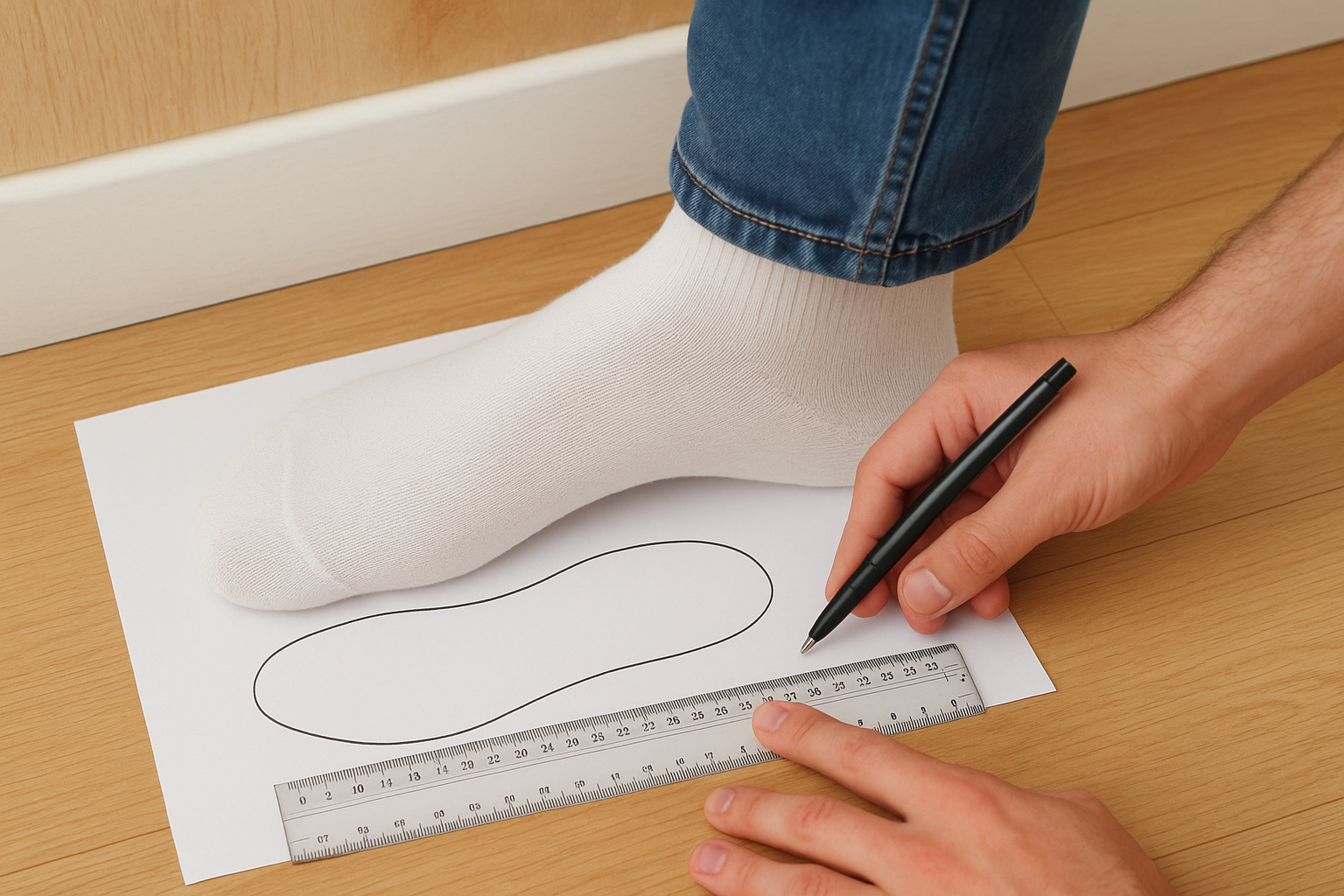
- Place a piece of paper flat on the floor against a wall.
- Stand on it with your heel pressed firmly against the wall.
- Trace around your foot, keeping the pen upright at all times.
- Mark the longest point of your foot and the widest point across the ball.
- Measure the length from heel to toe in millimetres.
- Measure the width at the widest point.
Always measure both feet and use the larger measurement to choose your size.
Compare your measurements against the brand's specific size chart before purchasing, since sizing can differ noticeably even within the same brand across different models.
Step 2. Dial in length and toe room
Once you have your measurements, the next step is translating those numbers into the right shoe length and confirming there's enough space at the front of the shoe. Length is the foundation of how should golf shoes fit, and getting it right stops both toe pain and heel slippage before they become a problem on the course.
How to test length at the shop or at home
Put the shoe on and push your foot forward until your toes touch the end of the shoe lightly. You should be able to slide one finger, about the width of your thumb, into the gap between your heel and the back of the shoe. If you can't fit your thumb in, the shoe is too short. If you can fit two fingers, it's likely too long and your foot will shift during your swing.
A half size up from your normal trainer size is often the right call for golf shoes, particularly if you plan to wear thicker socks.
The table below shows how to read the results of this test:
| What you feel | What it means | What to do |
|---|---|---|
| Toes pressing the front | Shoe too short | Go up half a size |
| One thumb's width at heel | Correct length | Confirm with width check |
| Two fingers at heel | Shoe too long | Go down half a size |
| Toes feel compressed on top | Toe box too low | Try a roomier model |
Signs the length is wrong during movement
Walking a few steps in the shoe tells you far more than standing still. If your toes jam forward each step or your heel lifts away from the cup, the length is off and no amount of lacing adjustment will fix it. Ask to walk on a hard floor rather than carpet if you're in a shop, since carpet masks movement issues that turf will expose.
Step 3. Get width and volume right
Width and volume are two areas where golfers often settle for a shoe that's "close enough" without realising the effect on swing mechanics and foot comfort. Understanding how should golf shoes fit means recognising that length alone doesn't determine the overall fit, and a shoe with the wrong width or volume will cause rubbing, numbness, or foot fatigue long before the final hole.
Identifying the right width
Golf shoes typically come in standard, wide, and extra-wide fittings, and the difference between them is measured across the ball of your foot. Stand in the shoe with your full weight on it and check whether the sides of your foot press against the inner walls of the shoe. If they do, you need a wider fitting rather than a longer shoe.
Going up a size to compensate for a narrow shoe is one of the most common fitting mistakes golfers make.
A useful way to check width is to remove the insole and stand on it. Your foot should sit within the insole's edges without overhanging on either side. If you see your foot spilling over the edge, the shoe is too narrow for your foot shape.
Checking volume across the instep
Volume refers to how much internal space sits between the top of your foot and the upper of the shoe. A high-volume foot needs a shoe with a deeper toe box and a roomier instep, while a low-volume foot needs a closer-fitting upper to avoid the foot shifting internally during your swing.
Press the laces down with your fingers after tying them normally. If the laces sit almost flat with no visible gap, the volume is matched well to your foot shape.
Step 4. Lock in heel hold and swing stability
The heel is the anchor point of your swing. If it lifts, even slightly, it breaks the chain of force from your feet up through your hips and into the club. Understanding how should golf shoes fit means giving just as much attention to heel hold as you give to toe room or width, because a loose heel will cost you consistency on every shot.
How to test heel hold
Stand in the shoe with laces tied at your normal tension. Lift your heel deliberately while keeping the ball of your foot flat on the ground. Your heel should move no more than a few millimetres before the heel cup resists. If the heel rises freely or the back of the shoe collapses inward, the fit is too loose and no lacing adjustment will fully correct it.
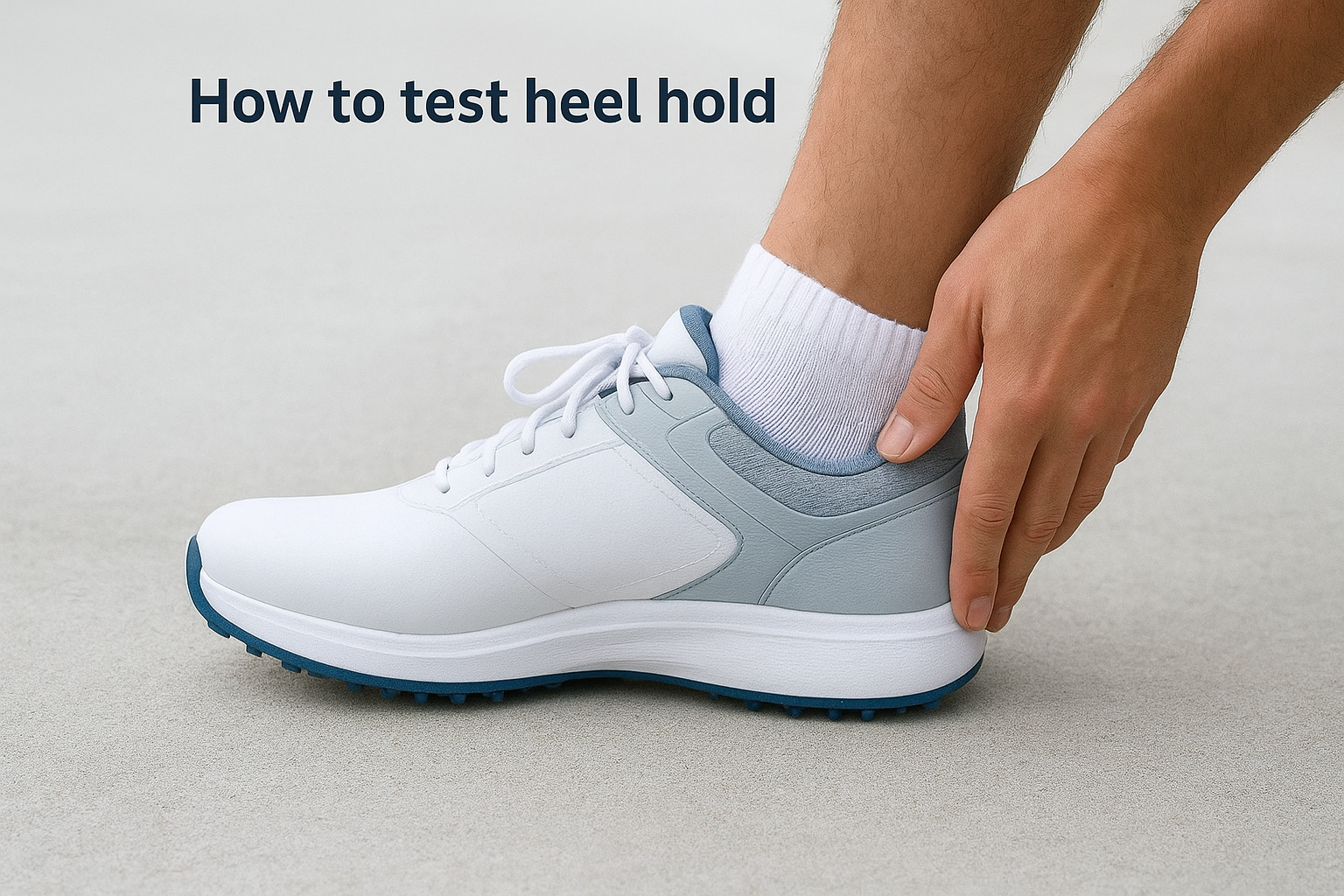
A firm heel cup is more important for swing stability than any other single part of the shoe.
Walk a few steps on your toes. If the heel section wrinkles or folds rather than staying structured, the shoe lacks the support and rigidity needed to handle the rotational forces of a full swing.
Lacing adjustments that strengthen heel lock
Most golfers lace from toe to top without thinking about heel security. Use the heel lock lacing method to add meaningful hold at the back of the shoe without tightening the rest of it:
- Lace normally up to the second-to-last eyelet.
- Thread each lace through the top eyelet on the same side to create a small loop.
- Cross the laces through the opposite loops.
- Pull both ends down and tie as normal.
This method draws the collar firmly around your ankle and reduces internal heel movement during your backswing and follow-through.
Wrap up and choose with confidence
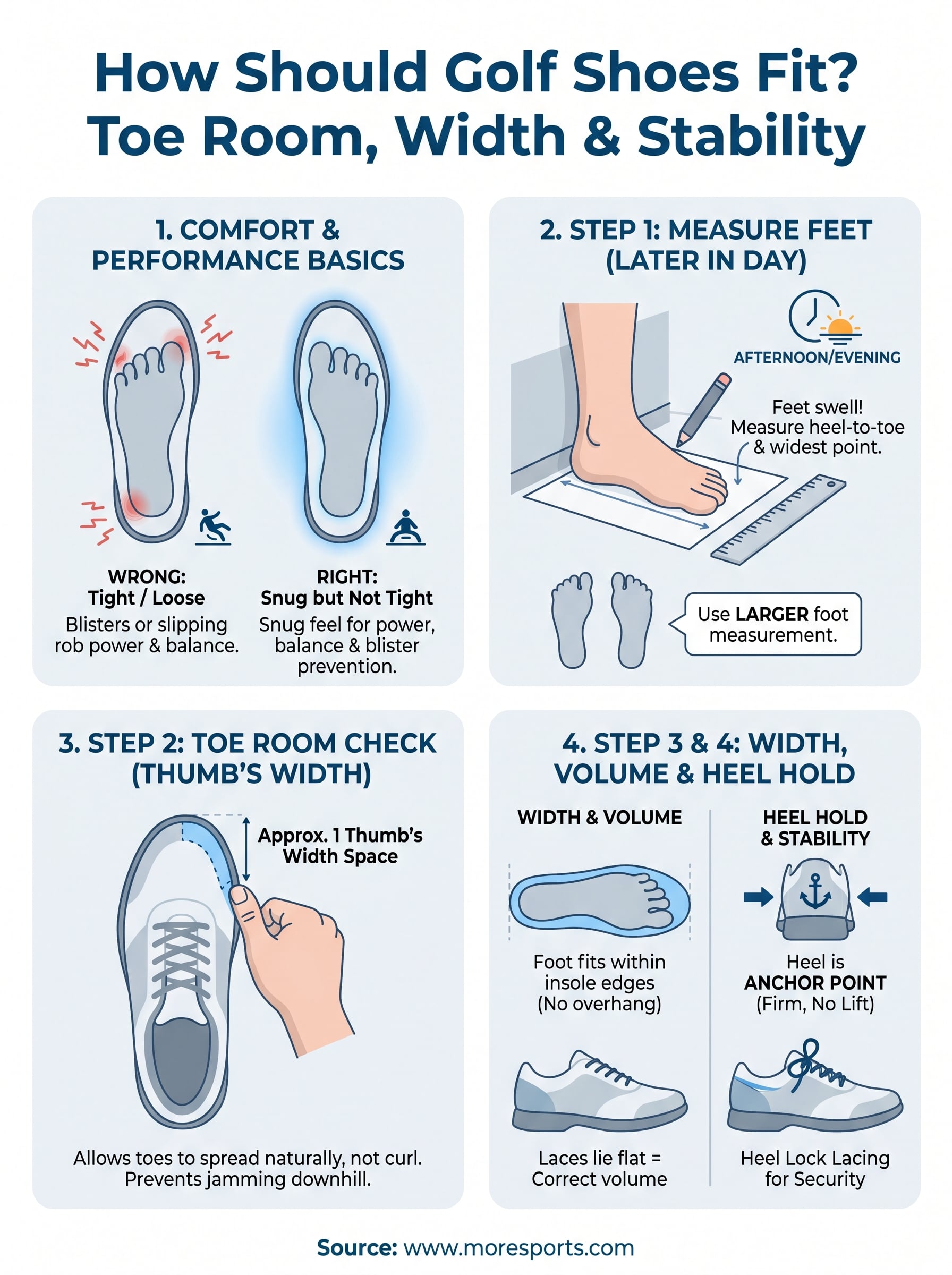
Knowing how should golf shoes fit comes down to four practical checks: correct length with toe room, matched width and volume, and a firm heel hold that stays locked through your swing. Each of these elements works together, and ignoring any one of them will affect your comfort and consistency across a full round.
Start by measuring both feet later in the day, use the measurements against brand-specific size charts, and always test movement rather than just standing still when trying shoes on. A proper fit should feel snug, structured, and free of pressure points from the moment you put the shoes on, not after a break-in period.
Ready to find your next pair? Browse our full range of golf shoes from FootJoy, Stuburt, Adidas, and more at MoreSports, with free UK delivery on orders over £25.